
A waterstop TCO model built on the USPS lifecycle formula (TCO = P + PV of O+T+M+W+E-S) shows that the purchase line on a construction waterstop quote is typically a small share of 30-year cash outflow, while joint-leak remediation, hydrostatic re-test labour, and replacement during structural repair dominate the curve [S1][S2].
Waterstops are passive PVC, HDPE, rubber, or stainless-steel profiles embedded across construction and expansion joints in basements, tanks, tunnels, dams, and lift stations; their job is to bridge the joint against hydrostatic pressure for the design service life of the structure, not just the pour. The four commercial families most often compared in 2026 specifications are PVC ribbed, HDPE, rubber (natural or EPDM), and stainless-steel centre-bulb or plate, and each one tilts the TCO differently waterstop.
Cost driver stack ranked by 30-year cash impact
Purchase price (P) on a waterstop RFQ usually lands between USD 2-8 per running metre for PVC ribbed, USD 4-12 for HDPE, USD 6-18 for EPDM or natural rubber, and USD 25-80 for grade-304/316 stainless-steel centre-bulb, before installation accessories are added [S3]. Installation labour (O) is the single largest line for buried waterstops because half-joint welding, intersection tees, and site splices are field-intensive: typical productivity is 8-15 m/hour for PVC/HDPE and 4-8 m/hour for stainless, with two certified welders and a splice rig per crew.
Maintenance and remediation (M) is the second-largest bucket. PVC waterstops carry a published oxidation and embrittlement risk on long-duration sun exposure before pour-back, with stockpile limits around 12-18 months in many specs. Rubber and EPDM grades tolerate higher in-service movement cycles and are routinely chosen for water-retaining structures with cyclic joint opening above 10 mm. Stainless-steel waterstops eliminate the polymer embrittlement path but introduce weld inspection cost, typically 100% visual plus 10-20% dye-penetrant on splices. Disposal and salvage (S) is small for inert metal but non-zero for chlorinated PVC off-cuts, which often must be segregated at demolition [S1].
Material family comparison against four decision criteria
Specifying a waterstop is a four-axis problem: hydrostatic head, movement cycle, chemical exposure, and weldability on site. PVC ribbed (typically 150-300 mm wide, 3-8 mm web) is the default for cast-in-place basements and sewage plants up to about 20 m head where joint movement is small, and it welds cleanly with a hot-air or electric splicing iron. HDPE raises chemical resistance and low-temperature ductility, useful for hydrocarbon bunding and cold-climate pours, but needs higher splice temperature and tighter tolerance. [S2]
Rubber (EPDM or natural) absorbs 50-100% more cyclic strain than PVC at equivalent section, so it is preferred on dam contraction joints, reservoir roofs, and digester walls. Stainless-steel centre-bulb grades (304 or 316L) are specified where head exceeds roughly 30 m, where chlorides or aggressive chemicals attack polymer, or where a 50-100 year service life is contractually pinned, and the upgrade penalty shows up first in the purchase line and again in weld QC [S3][S5].
Installation, joint prep, and the hidden rework line
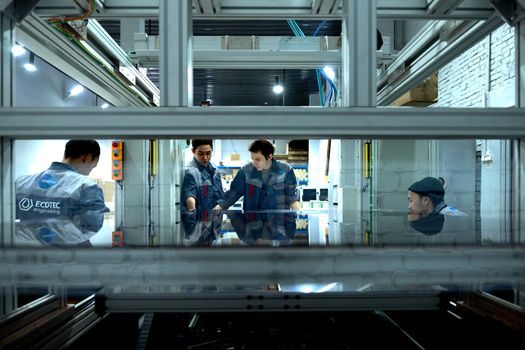
First-sentence technical fact: rework on waterstop splices is the single most volatile TCO line item, because a failed pull-test or hydrostatic re-test on a buried joint can force a structural chip-out and re-pour costing 50-200 times the failed splice in direct cost. The USPS TCO formula treats estimating as iterative across the project life cycle: a preliminary estimate at concept stage, a refined estimate at source evaluation, and a final reconciliation at closeout, and the same discipline applies to waterstop because splice geometry, rebar congestion, and pour sequence are usually not fixed until shop drawings are issued [S1][S2].
Field productivity is governed by three controllable variables: rebar clearance around the waterstop centre line, splice table coverage (number of factory-made intersections delivered as one piece), and weather windows for hot-air welding. A typical basement perimeter on a 30 m × 50 m footprint carries 160-200 m of waterstop with 12-20 corner and T intersections; lifting those intersections off the critical path with factory-fabricated tees and crosses is the cheapest TCO move available, because each site-made intersection adds 30-60 minutes of welder time plus a destructive pull-test coupon [S3].
Service-life drivers and failure modes that re-cost the TCO
Polymer waterstops fail in service along four paths: oxidative embrittlement from UV/heat exposure before pour-back, weld separation under cyclic movement above rated strain, chemical attack from hydrocarbons or chlorinated water, and mechanical puncture from rebar placement or concrete aggregate. Each path is a known failure mode that maps to a spec choice, and each is a line item in the TCO because repair usually means cutting back the structural face on both sides of the joint, exposing the failed profile, and splicing in a new section inside a confined excavation [S5].
Stainless-steel waterstops trade these polymer failure modes for two new ones: weld corrosion if a non-matching filler is used in chloride service, and galvanic coupling if the profile is tied to mild-steel rebar with direct contact. Both are addressable in spec (316L filler, dielectric sleeves at rebar tie-points) but the mitigation cost is real and must be carried into TCO. For comparison context on lifecycle cost stacks in heavy civil assets, the Concrete Pump Truck TCO: 10-Year Cost Stack, Driver Map, and Sourcing Specs reference applies the same 30-year discipline to capital plant, and the Carbon Fiber TCO: 5-Year Cost Stack, Driver Map, and Sourcing Specs piece covers the same framework on composite materials where certification and splice QC dominate.
Standards, sourcing, and acceptance-test cost lines
Waterstop performance is governed by a small set of standards that a sourcing engineer can map to spec clauses: tensile and elongation at break (commonly ASTM D638 / ISO 527 for polymers), hardness (ASTM D2240 Shore A), hydrostatic head resistance (commonly reported as 20-60 m of water column for civil grades), and joint movement rating (commonly ±10-25 mm or 25-50% shear deflection depending on profile). Acceptance testing on a typical 200 m basement pour includes on-site splice pull-tests, visual inspection of every welded junction, and a flood or hydrostatic test of the pour section, and the labour for those tests is the part of the TCO most often left off the quote [S1].
Sourcing levers that move the TCO in 2026: order factory-fabricated intersections instead of site-fabricated ones, hold stockpile UV exposure under 6 months, and pre-qualify the splice welder with a destructive coupon test before the first pour. On the cost side, the Capping & Sealing Machine TCO: 10-Year Cost Driver Stack and Spec Map reference applies an analogous lifecycle lens to packaging-line capex, useful for comparing how a one-time spec upgrade can defer replacement. For adjacent waterproofing systems, the Modified Bitumen Membrane Installation: 2026 Spec-Driven Field Guide covers the membrane side of the same basement or roof assembly where a waterstop is typically the joint component and the membrane is the plane component.
Selection rule of thumb and what to track next
Use PVC ribbed for basements and tanks under 20 m head with low movement; specify HDPE for hydrocarbon bunds and cold pours; switch to EPDM or natural rubber on dam contraction joints and digester walls with cyclic movement; and reserve stainless-steel centre-bulb for aggressive chemistry, high head, or contractually pinned 50-100 year service life. The Busch engineering guidance on vacuum equipment TCO, that the initial purchase price is only a fraction of lifetime expense, applies directly to waterstop because the buried profile cannot be economically replaced without disturbing the structure on both sides of the joint [S3].
Trackable signals for the next sourcing cycle: the revision status of the polymer aging and chemical-resistance clauses in the project spec, the proportion of intersections delivered as factory-fabricated tees versus site-fabricated, and the average splice pull-test pass rate from the first three pour sections. A first-pass splice pass rate below 90% is the clearest leading indicator that the TCO model is under-counting rework.
The underlying component specifications are covered under total station, and pressure transmitter.