Specifying a gas-fired aluminum melting furnace for an automotive parts line in 2026-08 means balancing bath capacity (typically 1-10 t per station), NG/LPG burner modulation, refractory grade, and stack-NOx compliance against takt-time constraints on cylinder heads, transmission housings, and EV battery trays [S1][S3].
For the automotive segment, three furnace architectures dominate quotations: stack-melt reverb units for 1-3 t/h throughput, regenerative-burner designs above 5 t/h, and combined melting+holding crucible units sized for die-cast cells feeding 200-800 t/yr structural parts [S1][S4].
Capacity Classes and Burner Configuration for 5-10 t Lines
Gas-fired aluminum melting furnaces in the 5-10 metric tonne class are commonly quoted with a 10 t bath, single-station configuration, and 4 sets/month production capacity out of Guangdong, China, per the 10 t melting-and-holding product listing active in 2026 [S1]. The listing's 1-piece MOQ with negotiable pricing is typical for direct-OEM sourcing rather than stocking distribution.
Burner selection splits on fuel: NG (methane ~35.8 MJ/Nm³) versus LPG (propane ~46 MJ/Nm³), with high-velocity recuperative or regenerative burners being the default above 2 MW thermal input to recover flue-gas enthalpy and drop specific energy consumption toward 1.0-1.1 GJ/t aluminum [S1][S3]. For a 10 t station, rated thermal input commonly lands in the 3-6 MW range to deliver a 4-6 h cold-melt cycle plus continuous holding trim.
Refractory Lining and Bath Temperature Envelope
Refractory specification drives campaign life on a gas aluminum melting furnace; the standard practice is a 200-250 mm working lining of high-alumina or SiC-based castable, a 50-80 mm insulating layer, and a steel shell rated for 760-800°C continuous bath exposure with Al-Mg alloy chemistries (A356, A380) [S1][S6]. SiC refractory R&D at Chinese geological-university research groups has historically targeted oxidation-resistant bonding to extend campaign life past 18-24 months in holding-furnace service [S6].
For automotive-grade cleanliness, the bath is typically held at 720 ± 10°C for A356 and 700 ± 5°C for A380, with dross generation reported in the 1-3% range when fluxing and rotary-sparging are correctly applied. Stack temperatures on a well-tuned regenerative system run 150-200°C above bath, which sets the ducting and baghouse sizing for downstream filtration.
Selection Criteria: Reverb vs. Crucible vs. Holding-Only
Three architectures compete for the automotive die-casting cell: [S2]
1. Reverb furnace (stack-melt): 1-10 t capacity, 2-6 t/h melt rate, lower capex (~US$80-150k for a 3 t unit), suits low-mix high-volume cast houses, accepts contaminated charge.
2. Crucible furnace (lift-out or tilting): 0.3-1.5 t typical, 0.3-0.8 t/h, higher specific energy (1.2-1.5 GJ/t), suits job-shop flexibility and alloy-changeover under 30 min, lower refractory wear per campaign.
3. Combined melt+holding station: 5-10 t bath with separate holding well, the dominant 2026-OEM pattern for automotive structural parts at 200-800 t/yr, holding-loop trim maintains ±5°C without recycles.
The decision axes are alloy-changeover frequency, charge cleanliness, NOx/CO emissions permit, and whether the line runs 1-shift (crucible) versus 2-3-shift (reverb or melt+hold) [S1]. For melting furnace purchasing at 5 t and up, regenerative-burner reverb systems are the default 2026 OEM reference in the Chinese export catalogue [S1][S4].
Fuel-Side Controls: NG vs. LPG Train and Burner Management
Gas-train design follows the same logic as the automotive CNG/LPG engine control domain, with a dedicated supplier base (Shenzhen Kaipengyuan et al.) offering gas supply system, pressure regulator, and gas control system modules tested for engine duty and adaptable to industrial burner BMS (burner management systems) with 4-20 mA or Profinet modulation inputs [S3]. For a 5 MW burner, a zero-governor NG train sized to 600-800 Nm³/h, dual-block valves, and a UV/IR flame scanner are the standard 2026 specification.
LPG-fired installations add a vaporiser train, typically 100-200 kg/h for a 3-5 t furnace, and require a purge cycle compliant with NFPA 54 / EN 746-2 industrial heating-equipment safety rules; EN 746-2 governs gas-fired furnace safety across the EU, while NFPA 54 covers US installations.
Where Gas-Fired Makes Sense (and Where It Doesn't)
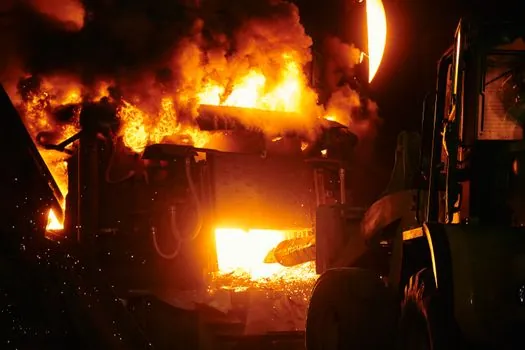
Gas-fired aluminum melting furnace is the right call for: high-throughput automotive structural castings, sites with cheap piped NG, operations running >16 h/day, and any plant that can recover flue-gas heat for building HVAC or die pre-heat. It is the wrong call for: sites with <US$0.04/kWh electricity and a decarbonisation mandate, very small batch sizes (<500 t/yr), and operations that require vacuum or controlled-atmosphere melting for premium aerospace alloys. [S1]
For electric-only plants, induction furnaces (medium-frequency coreless or channel) at 0.5-2 t/h are the alternative, with a 10 t holding furnace still gas-fired in many 2026 layouts because the holding-loop energy cost is dominated by wall losses, not by melt cost. Mixed-cell configurations are common: induction melt + gas-fired holding.
Specification Workbook for a 5-10 t Automotive Cell
The minimum data package a buyer should pin before issuing a 2026-08 RFQ: bath capacity 5 or 10 t; charge mix (% ingot / % return / % chips); melt-rate target ≥3 t/h for 2-shift operation; bath-temperature control ±5°C; specific energy ≤1.15 GJ/t (regenerative) or ≤1.35 GJ/t (recuperative); NOx ≤100 mg/Nm³; refractory campaign ≥24 months; burner turndown 10:1; BMS SIL2; CE/PED conformity for EU delivery [S1][S4].
Procurement channels in 2026-08 split between direct-OEM (Foshan, Henan, Guangdong suppliers) and European system integrators; lead time for a 10 t regenerative reverb is typically 5-8 months ex-works, with installation commissioning adding 6-10 weeks. For sourcing adjacent capital equipment, see Line frequency induction furnace selection for hardware manufacturing: 2026 spec gates on induction-melt alternatives, and Line Frequency Induction Furnace Sizing for Lighting-Fixture Foundries for smaller-scale sizing examples.
Lining, Heat-Treatment Tie-In, and Materials Reference
After melt, most automotive castings drop directly into a T6 heat-treat cycle at 530-545°C solution treat then water-quench and age at 155-180°C; furnace selection should account for a steady-state holding-oven tie-in so the same NG train can serve a fired brick-lined ageing oven if a single-header plant is configured. For aluminum alloy chemistry control, ICP-OES or XRF at the furnace deck confirms Si, Mg, Fe, Cu within A356/A380 spec windows before pour, with Fe held <0.20% to avoid sludge formation that punctures die life. [S3]
Two trackable signals for the next 6 months: (1) EU CBAM carbon-pricing impact on NG versus induction OPEX for aluminum billet, and (2) the rollout of low-NOx burner upgrades under China's GB 31573 ultra-low emission timetable, which will reshape the 2026-2027 rebuild/refurb market for existing reverb furnaces serving auto-parts foundries [S1][S3].
Component reference pages worth checking: gas aluminum melting furnace, melting furnace, and fired brick.
See also our earlier report, Line frequency induction furnace selection for hardware manufacturing: 2026 spec gates.