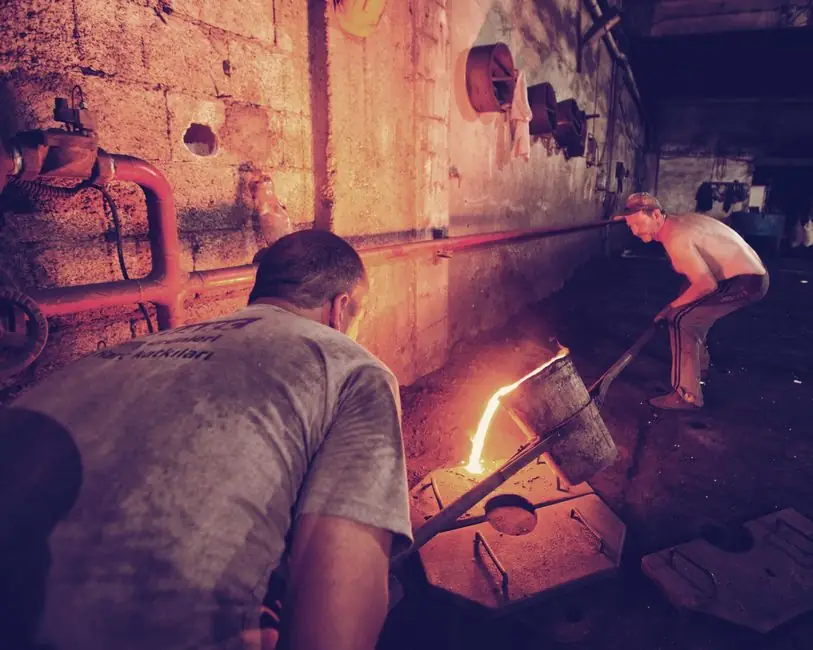
For pump and valve foundries pouring aluminum-alloy bodies, bonnets and impellers, a gas-fired melting furnace is typically specified in the 500-3000 kg capacity band with melt rates from 200 to 1500 kg/h of liquid metal delivered to the holding bay [S1]. Holding chambers adjacent to the melt well are commonly held between 660°C and 760°C, the practical working window above the 660.3°C pure-aluminum liquidus and below the point where excessive oxide skin forms on A356 and A380 type alloys used for valve trim [S1].
Burner selection is the second decision gate. Open-flame radiant, immersed-tube, and regenerative burner topologies each map to a different mix of thermal efficiency, melt-loss and NOx, and the choice cascades into the fired-brick lining class and the stack-side waste-heat recovery package [S1]. For foundries pouring both A356 (Al-Si-Mg, ~7% Si) for pump housings and A380 (Al-Si-Cu, ~9% Si) for valve bodies, the furnace must be sized for the higher liquidus of the silicon-rich alloy and for the higher iron pick-up tolerance of the Cu-bearing grade.
Burner Topology Comparison for 500-3000 kg Crucible Furnaces
Three burner families dominate the gas-fired aluminum melting furnace market served by Chinese furnace builders: open-flame recuperative, regenerative, and immersed-tube [S2].
Immersed-tube burners fire inside a SiC or alumina tube submerged in the bath, eliminating flue-gas heat loss through the roof and giving the highest melt rate per unit footprint, but the immersed tube limits alloy flexibility because iron pickup from the tube accelerates sludge formation in low-iron alloys such as A356 used for pressure-containing pump housings [S1]. For a pump and valve foundry running both A356 and A380, the practical default is a stack or multi-chamber design with open-flame recuperative burners on the melt well and a separate holding bay kept at 700-720°C for launder transfer to the pouring line. A side-by-side gate table follows.
Decision Gates: Capacity, Melt Rate, Burner Type, Refractory Class
Decision gate 1, hourly melt rate: small job-shop pump foundries typically run 200-500 kg/h, mid-volume valve foundries 500-1200 kg/h, and high-mix production with multiple pouring stations 1000-2000 kg/h [S1]. The melt rate must be matched to the casting cell demand with a 20-30% buffer to avoid holding the bath above 760°C, which accelerates dross formation and magnesium burn-off in A356T6 heat treatments. Decision gate 2, charge material ratio: a foundry feeding primarily ingot and T-bar needs a different flame pattern than one running 60-80% return scrap with paint, oil and iron inserts from valve trim machining.
Decision gate 3, aluminum-alloy family: pump housings in A356 demand tight iron control (Fe <0.20% typical) and low dross, while valve bodies in A380 tolerate higher Fe and Cu but require melt temperatures held below 720°C to keep silicon-rich eutectic phases in solution. A 200-250 mm wall thickness of 70% alumina brick plus 50-75 mm of ceramic-fiber back-up insulation is typical for 1000-2000 kg crucible furnaces in this service. Decision gate 5, emissions and excess-air: gas-fired combustion with a 10-15% excess-air ratio (lambda 1.10-1.15) keeps NOx below typical EU industrial furnace benchmarks while holding CO under 100 ppm at the stack [S3].
Cross-Reference: Gas-Fired Selection Logic vs Other Melting Routes
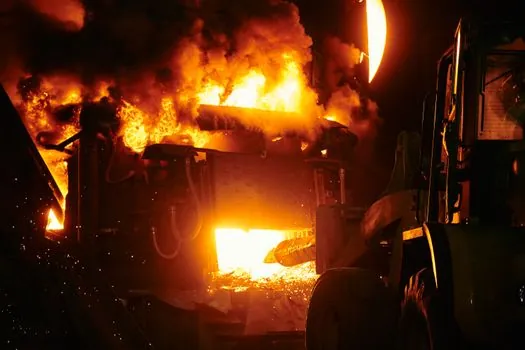
The trade is justified when natural gas is cheap, when the foundry is already plumbed for gas, or when scrap preheating is straightforward. Induction wins on melt cleanliness and tight temperature control for thin-wall pump impellers where oxide inclusions are reject drivers.
Compared with a line-frequency furnace used in rail-component foundries, gas-fired crucible units are more tolerant of variable charge makeup, accept painted and oily return scrap with less smoke control cost, and do not require the heavy three-phase power supply and water-cooled coil infrastructure that channel furnaces demand. For a foundry pouring both pump housings and valve bodies with significant return-scrap content, the gas-fired crucible typically wins on flexibility; for a dedicated high-pressure valve body line running 90% certified A356 ingot, a channel or coreless induction unit will deliver tighter alloy chemistry at the same throughput.
Standards, Combustion Air and Stack-Side Compliance
Combustion-side design follows a layered standards stack. General-purpose industrial gas-fired boiler and furnace installations in most jurisdictions reference BS 6798-type selection and commissioning practice for sub-70 kW packages, while larger units (input >1.5 MW thermal) fall under national boiler and pressure-vessel codes plus local gas-safety approval [S6]. For larger Chinese-built gas-fired furnace systems, the equipment is typically factory-tested to the manufacturer's rated input and supplied with a CE / EAC marking for export to European and CIS customers, with a controlled oxygen or lambda trim loop holding flue-gas O2 at 2-4% to stabilise efficiency across the firing range [S5].
For a 1000 kg/h class furnace in pump and valve service, a practical spec envelope reads: natural gas input 1.2-1.8 MW thermal, melt rate 800-1000 kg/h from cold charge, holding bay 700-720°C, melt well 720-780°C, recuperator preheat 400-500°C, refractory 70% alumina brick, wall thickness 200-250 mm, and a dry-flue gas O2 target of 2-4% [S1][S5]. Excess-air control at lambda 1.10-1.15 keeps stack temperature in the 200-280°C range and thermal efficiency in the 45-55% band on a single recuperator. These values are typical, not absolute: actual factory test reports should be demanded before purchase order, particularly the cold-to-tap melt time and the natural gas consumption per tonne at the rated melt rate.
Spec Sheet Anchors and What to Verify in the FAT
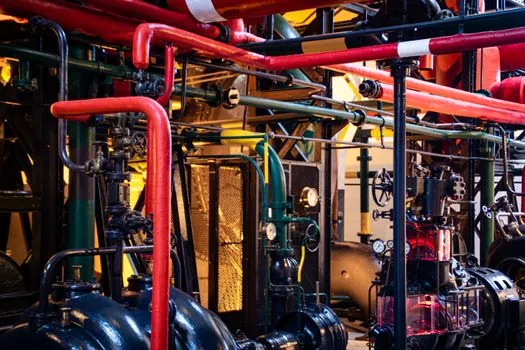
Four numeric anchors should be on every quote review and factory acceptance test. First, the rated cold-charge melt rate in kg/h, measured from a 30°C charge to a 720°C tap, not extrapolated from a hot-charge run. Second, the specific natural gas consumption in Nm³/t at the rated melt rate; vendors quoting below 50 Nm³/t on a cold charge should be asked for the supporting test certificate, because the theoretical minimum for melting aluminum is around 360 kWh/t and any gas figure below that benchmark in equivalent terms should be cross-checked. Third, the holding-bay temperature uniformity at +/-5°C across the bath, critical for consistent pouring of thin-wall valve bodies. Fourth, the dross generation rate in kg per tonne of metal processed; a well-tuned gas-fired crucible with a clean door-charge routine should sit at 15-25 kg/t on A356, rising to 30-50 kg/t on painted return scrap [S1].
Design-stage cross-checks: confirm the burner manufacturer is on the supplier's reference list with at least three similar-size installations in aluminum service; confirm the recuperator is sized for 10-15% excess-air at the maximum firing rate, not for the nominal point; and confirm the refractory anchor system and expansion-joint layout are detailed in the drawing pack, because the most common field failure on gas-fired aluminum furnaces is refractory pull-out at the door sill and the burner block, not burner failure [S1].
Who Gas-Fired Aluminum Melting Is For, and Where It Loses
Gas-fired aluminum melting fits pump and valve foundries that run 8-16 hour shifts with significant return-scrap content, have reliable natural gas supply at sub-1.0 USD/Nm³ equivalent pricing, and need to melt A356 and A380 interchangeably without changing the metallurgical vessel. It loses in three situations. First, dedicated thin-wall impeller lines where oxide inclusion and Fe pick-up are reject drivers; here induction is cleaner. Second, foundries without natural gas grid access where propane supply is the only fuel option; propane is workable but raises specific energy cost and complicates flame-stability control. Third, very small job shops under 200 kg/h demand; here a 250-500 kg gas-fired tilting crucible is the floor, and below that an electric resistance or small induction unit is typically more economical. [S1]
Two signals to track before purchase order. The first is the supplier's published thermal efficiency at the rated input, not at the maximum continuous rating; a 10% efficiency spread at the actual operating point is worth more than the burner upgrade on paper. The second is the refractory supplier and anchor pattern on the reference list; a 70% alumina brick from a reputable mill, anchored properly, will run 2-3 years on a 1000 kg class furnace in two-shift aluminum service, and a mismatch on either side of that bond is the most common cause of unplanned shutdowns.