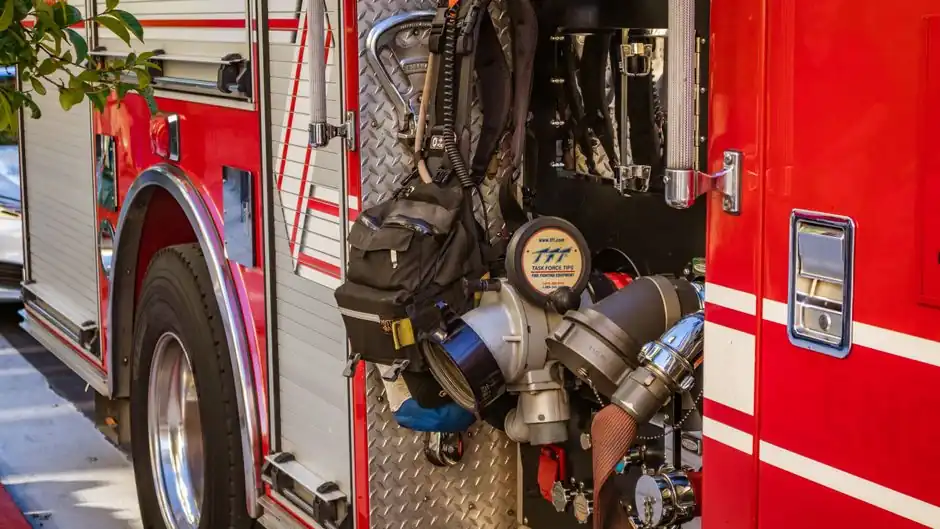
For an occupied server room, a control room, or any enclosure where people are present during a discharge, the safe default in 2026 is an inert blend such as IG-541 (INERGEN) or a low-GWP halocarbon such as FK-5-1-12 (Novec 1230), while CO2 at its 34-50% extinguishing concentration is restricted to unoccupied hazards only [S4]. The decision is governed by four hard constraints: occupancy of the protected room, environmental regulation on global warming potential, room integrity at a defined hold time, and 30-year total cost of ownership rather than purchase price alone [S1][S3].
Across the clean-agent family, three storage-pressure bands are in commercial use: CO2 at roughly 58 bar at 21 °C, halocarbon agents at 25-42 bar, and inert blends at either 200 bar (2,900 psi) or 300 bar (4,350 psi), with the 300 bar option cutting cylinder count on protected volumes above roughly 200-400 m³ [S3][S4]. The retention time, normally at least 10 minutes and often 10-20 minutes at design concentration, is verified by a door-fan room integrity test and is a non-negotiable procurement line item because an undetected leak can drop the concentration below the extinguishing threshold within seconds of discharge [S3][S5].
Agent Families and the Decision Criteria That Separate Them
CO2 is the most widely installed gaseous agent globally, works by oxygen displacement at 34-75% design concentration depending on fuel, is the lowest-cost agent per kilogram, and is reserved for unoccupied enclosures such as generator sets, transformer bays, and paint spray booths [S2][S4]. Halocarbon clean agents (HFC-227ea / FM-200, HFC-23, and FK-5-1-12) work by heat extraction and chemical-chain interruption, discharge in roughly 10 seconds rather than minutes, and leave oxygen concentration unaffected, which suits tight enclosures with minimal venting [S2][S4].
On environmental regulation, HFC-227ea carries a GWP of approximately 3,220 and is being delisted under regional F-gas rules, while FK-5-1-12 at a GWP of 1 and a 5-day atmospheric lifetime is the regulated replacement now specified on new European and US data-centre builds [S2][S4]. Sapphire, an alternative fluoroketone, sits in the same GWP <1, ODP 0 envelope as Novec 1230 and is named in vendor literature as the current halocarbon-replacement agent of choice for new Australian special-hazard installations [S2]. NAF S-III and HFC Blend A, with a GWP of 1,546 and an ODP of 0.048, were the first halocarbon replacements and remain in service on legacy systems but are no longer the default for new procurement [S2].
Selection Criteria: Occupancy, Footprint, and Storage Pressure
Occupancy is the single hardest gate. CO2 at extinguishing concentration is an asphyxiant and is code-prohibited in normally occupied rooms; IG-541 maintains oxygen at a designed safe level for the discharge window, and FK-5-1-12 occupies no oxygen space at all, both of which satisfy the no-immediate-threat-to-life test required for occupied critical-asset rooms [S1][S4][S8]. For laboratories, where reagent inventories and small-bench hoods are common, the same occupancy rule applies and a detailed gas suppression spec map for laboratories lays out the agent, enclosure, and detection tradeoffs by bench-scale hazard class.
Storage pressure sets both the footprint and the recurring test cost. A 300 bar (4,350 psi) inert system achieves the same protected volume from fewer cylinders and shorter pipe runs than a 200 bar (2,900 psi) bank, and below the 200-400 m³ crossover, 200 bar hardware is cheaper, while above that crossover 300 bar wins on total installed cost because the pipework saving offsets the higher-pressure cylinder premium [S3]. Each 50-80 L DOT or EN cylinder adds a recurring hydrostatic test cost at the 10-year interval, refill labour after every discharge, and a scrap-metal recovery or disposal line at end of life, so halving the cylinder count by going from 200 bar to 300 bar, or by switching from a low-pressure halocarbon to a high-pressure inert blend, directly halves those recurring test and refill line items over the asset life [S3].
30-Year TCO: Why the Cheap Quote Is Rarely the Cheap System
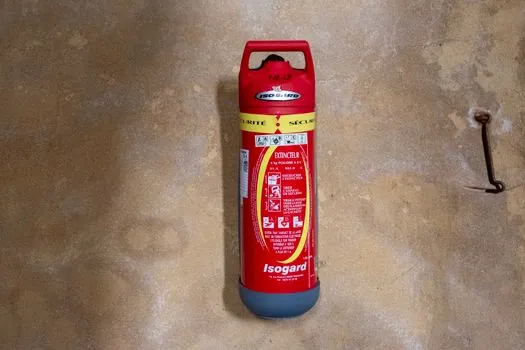
For a representative 500 m³ occupied server room, the 30-year TCO stack of CO2, 200 bar inert, 300 bar inert, and halocarbon lands at roughly 0.85x, 1.30x, 1.20x, and 1.95x of the CO2 baseline respectively, with the 200 bar and 300 bar inert options within 5-10% of each other across the full life cycle and the halocarbon option carrying a roughly 50-60% TCO premium driven almost entirely by agent replacement cost at every test interval [S3]. Room integrity testing is the cost line item most often missed at procurement because NFPA 2001 and ISO 14520 both require a door-fan or quantitative leakage test before commissioning, with the test repeated at defined intervals thereafter [S3][S5].
Detection and control scope is the second-largest TCO lever after agent. Addressable smoke detection plus a FM-approved, UL-listed, or EN 12094-2-compliant releasing panel with abort, pre-discharge delay, and two-stage alarm adds roughly 15-25% to the suppression-only tender but drops the false-discharge rate, which is the single most expensive operational event a gas system can suffer because a single accidental discharge on a 500 m³ inert system can cost more than 10 years of inspection budgets combined [S3]. The full lifecycle stack runs initial design-engineering, cylinder manifold, nozzles, pipework, control panel, detection, and installation up front, then recurring inspection, refill, and disposal over the asset life, with agent type and storage pressure the two largest cost drivers [S3].
Comparison: CO2 vs Inert vs Halocarbon on the Real Decision Axes
On the four axes that drive specification, CO2 is the cheapest agent per kilogram, the most widely installed globally, and the only one that cannot be used in occupied spaces at extinguishing concentration, while inert blends sit at the opposite end with zero GWP, the longest installed life of 25-30 years, and a standard 60-second discharge time [S1][S4]. Halocarbon clean agents (HFC-227ea, FK-5-1-12) hit a 10-second discharge window, occupy no oxygen space, and have a 20-25 year expected life, which makes them the default where minimum downtime and tight room envelopes matter [S1][S4]. For an unoccupied mining substation or a confined-space entry scenario, the agent, enclosure, and hazard map in this gas suppression selection for mining reference applies the same axes to a different risk profile, and the confined-space entry spec view addresses the oxygen-displacement hazard for personnel.
On the two environmental axes, IG-541 and argon/nitrogen inert blends both sit at GWP 0 and ODP 0, while FK-5-1-12 sits at GWP 1 with a 5-day atmospheric lifetime, and HFC-227ea sits at GWP roughly 3,220 with an ODP of 0 but is being delisted under F-gas rules in major jurisdictions [S2][S4]. On the storage axis, CO2 standard high-pressure systems charge to 58 bar (841 psi) at 21 °C with low-pressure 20 bar bulk-tank variants above roughly 2,000 kg of agent, halocarbon systems store liquid agent at 25-42 bar, and inert blends are banked at 200 bar or 300 bar depending on whether pipework or cylinder count dominates the project [S3][S4].
Room Integrity, Hold Time, and Vent Sizing
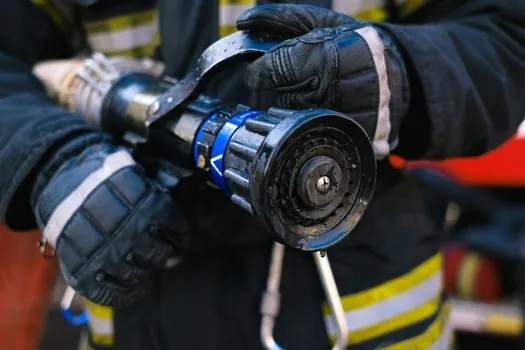
Room integrity is the part of the system that decides whether the design concentration is actually reached. Most specifications require a hold time of 10-20 minutes at design concentration, verified by a door-fan test or quantitative leakage test, with the protected envelope tested for pressure decay before commissioning and at defined intervals thereafter [S3][S5]. A 10-15 minute hold is the typical design band in current 2026 project guidance, and warning plus alarm systems must be specified to ensure occupant safety during the pre-discharge window [S6].
Pressure-relief venting must be sized so that discharge does not over-pressurize the enclosure, and inert systems in tight rooms in particular require correctly sized relief dampers because the discharge of a 200 bar or 300 bar cylinder bank raises room pressure faster than the agent can leak out [S5]. Third-party listing (UL, FM Approval, VdS) certifies the system as a whole rather than individual components, and the listed mark is the line that procurement should require at tender, not at commissioning, because rework on a non-listed system is the most common source of project delay in 2026 retrofit work [S1][S5]. For deeper detail on the detection-to-release control panel, the fire safety and fire extinguisher encyclopedia entries cover the manual-first-response side that any gas system complements rather than replaces, while the gas fire suppression reference page gives the full agent, concentration, and storage data table.
Applicable Standards and Procurement Gate
The dominant design standards are NFPA 2001 for clean agents, NFPA 12 for carbon dioxide, ISO 14520 for gaseous extinguishing systems, and EN 15004 for fixed firefighting systems using inert and halocarbon agents, with the Australian regional variant AS 4214-2002 governing installations in that jurisdiction [S2][S5]. The releasing control panel is normally procured as a listed releasing panel rather than a general fire alarm control panel, with EN 12094-2 cited in vendor guidance for the panel interface and abort, pre-discharge delay, and two-stage alarm functions [S3][S5]. At tender, the gate items are agent type and GWP, storage pressure and cylinder count, hold time and integrity test method, listing marks on the panel and on the system, and the agent refill cost at each 10-year hydrostatic retest, because those five items together fix both code compliance and 30-year TCO [S1][S3].</h2> <p>Closing: a trackable signal for the next quarter is whether the named HFC-227ea delisting dates under F-gas rules are ratified in additional jurisdictions beyond the early adopters, because that single regulatory event will move FK-5-1-12 from an option to the default on new European and US data-centre builds; the second signal is whether 300 bar inert banks cross 50% of new occupied server-room orders, since the 200-400 m³ crossover on installed cost has been the historical tipping point and the 2026 pipeline of >1,000 m³ hyperscale halls puts pressure on that threshold.