
Aeroderivative packages currently price at $1,000 to $1,200 per kW installed for the equipment and basic balance of plant, against heavy-duty frame units at $700 to $1,100 per kW for full 250 MW+ combined-cycle EPC scope, with 50 MW simple-cycle projects climbing to $1,200 to $1,800 per kW [S6][S2]. The 10 to 15 percent simple-cycle efficiency premium of the aeroderivative platform is the structural reason that upfront delta persists, even as OEM backlogs of 116 GW at GE Vernova and 69 GW at Siemens Energy have pushed delivery slots into 2031 and reshaped 2026 procurement math [S3][S4].
This article breaks down the per-kW economics for both architectures under 2026 market conditions, then matches each to the use cases where the price premium is recovered. For context on adjacent rotating-equipment life-cycle math, see the mechanical-seal total-cost-of-ownership analysis, which makes the same point for seals that holds here for prime movers: purchase price is a small slice of 20 to 30 year life-cycle cost.
$/kW Ranges by Architecture and Project Size, 2026
Aeroderivative equipment and basic balance of plant run about $1,000 to $1,200 per kW installed for a typical LM2500 or LM6000 package, while larger industrial frame units in a 250 MW+ utility-scale combined-cycle scope sit at $700 to $1,100 per kW [S6][S2]. The crossover happens at the 100 MW class, where a 100 MW combined-cycle project ranges $900 to $1,400 per kW installed and 50 MW simple-cycle natural gas work climbs to $1,200 to $1,800 per kW [S2].
For scale comparison, a 1 MW simple-cycle gas turbine equipment-only price is around $1,150 per kW, falling to roughly $171 per kW for the largest high-efficiency units approaching 600 MW, a 6.7x spread driven entirely by the kW denominator [S1]. Combined-cycle full-plant installed prices run from $1,579 per kW at 34 MW down to $670 per kW at 1,680 MW, the benchmark the EPC numbers in 2026 are still anchored to [S1]. The encyclopedia entry on variable-frequency drive duty motors covers the same denominator-driven cost compression when applied to induction machines, and the pattern transfers directly to turbine selection.
Why Aeroderivative Costs More per kW, and What It Buys
Aeroderivative gas turbines adapt an aircraft jet-engine core, typically the GE LM2500, LM6000, Siemens SGT-A35, SGT-A65, or retired CFM56 and CF6-80C2 cores, and use anti-friction rolling-element bearings in a modular architecture that lets the engine core be swapped without disassembling the package [S3]. That modularity, plus a higher pressure-ratio spool arrangement, lifts simple-cycle efficiency into a 34 to 42 percent band, roughly 10 to 15 percentage points above a comparable heavy-duty frame turbine running 30 to 38 percent simple-cycle [S3][S7].
The price premium funds three things buyers can verify: faster starts, faster ramps, and a smaller footprint. A Siemens SGT-A05 (4 to 6 MW class) is published at a 60-second start, the GE LM6000 (around 57 MW) is at 5 minutes for a simple-cycle fast start, and a fast-start aeroderivative can ramp at up to 30 MW per minute on a percentage-of-rated basis [S5]. Heavy-duty frames are not slow in absolute terms: the GE 7HA.03 (430 MW) publishes 10 minutes to full GT load and 75 MW per minute, with Siemens Energy's HL class at 85 MW per minute [S5]. The engineering judgement is therefore not about which technology is "fast", it is about whether you need a 5-minute offline-to-full-load capability for peaker duty or whether a 10-minute hot start covers your dispatch profile. The instrumentation that supports both, including the turbine flowmeter class used on fuel gas measurement, is specified the same way on either platform.
Heavy-Duty Frame Economics: Where the $/kW Advantage Lives
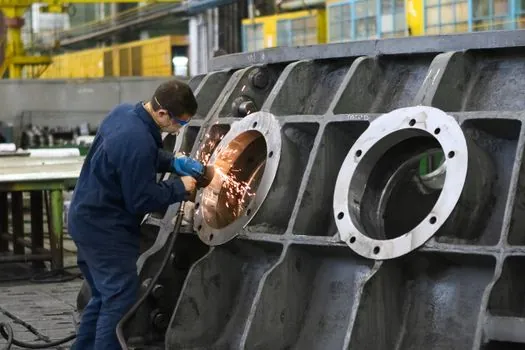
Heavy-duty frame turbines are purpose-built stationary machines with hydrodynamic fluid-film bearings, heavier structural sections, and inspection intervals measured in years rather than thousands of hours. GE Vernova's combined aeroderivative and heavy-duty line spans 34 MW to 571 MW, and frame units tolerate lower-quality fuels including hydrogen blends up to 90 percent in the 6B platform [S3]. Combined-cycle efficiency on the frame side lands at 55 to 58 percent, which is where the per-kWh value captures its premium back at the revenue meter.
Frame economics dominate where any of three conditions hold: the project needs hundreds of megawatts per unit, the host site can absorb a large steam bottoming cycle, or the plant will run as utility baseload with high annual energy production. USP&E's 2026 EPC breakdown places the prime mover at 35 to 45 percent of total EPC scope, balance of plant at 25 to 35 percent, and civil works at 15 to 25 percent, with the remaining band in engineering, contingency, and grid interconnection [S2]. Frame unit selection squeezes all three bands simultaneously because the larger single-unit output means fewer prime movers, less BOP repetition, and a smaller site footprint per MW. For an at-scale combined-cycle build, the $700 to $1,100 per kW installed range in 2026 is consistent with the $670 to $1,579 per kW reference band that 2024 handbook data established as the EPC benchmark, with escalation rather than structural change driving the upper end [S1][S2].
Comparison Matrix: Aeroderivative vs Heavy-Duty on Four Decision Criteria
The decision is not about which turbine is "better" in absolute terms. The four criteria that determine the procurement call in 2026 are efficiency, installed cost, start/ramp profile, and delivery availability. Aeroderivative wins simple-cycle efficiency (34 to 42 percent vs 30 to 38 percent) and percentage-of-rated ramp rate, but loses on installed $/kW ($1,000 to $1,200 vs $700 to $1,100) [S3][S6][S7]. Heavy-duty wins combined-cycle efficiency (55 to 58 percent vs 50 to 53 percent), absolute MW per unit, and the lowest plant complexity per installed MW [S3].
On the fourth criterion, delivery availability, the two architectures behave very differently in 2026. GE Vernova's gas turbine order backlog reached 116 GW in its July 2026 disclosure, with new orders now slotted for 2031; Siemens Energy's backlog sits at 69 GW; Mitsubishi Heavy Industries is sold out into 2028 [S3]. Aeroderivative lead times are typically shorter than H-class frame units, and modular engine-exchange maintenance lets an owner recover forced outages in days rather than weeks. For projects that need commissioning before 2028, the practical selection is often forced: any prime mover the OEM can actually deliver in time, including certified pre-owned units at 40 to 60 percent cost reduction with 5,000 to 15,000 hours remaining before major overhaul, which USP&E identifies as viable for 10 to 15 year project horizons [S2][S3].
Use-Case Mapping: Which Architecture Pays Back the Premium
Aeroderivative first when the project needs small-to-medium modular blocks, very fast offline starts (under 10 minutes), frequent start-stop duty, a compact or mobile package, offshore or mechanical-drive service, black-start capability, or an engine-exchange maintenance model that trades capex for opex flexibility [S5]. The combined-cycle aeroderivative segment is sized at USD 6.4 billion in 2025 and projected at USD 7.2 billion in 2026, growing to USD 19.1 billion by 2035 at an 11.5 percent CAGR, with GE Vernova at over 14 percent share and the top five OEMs holding 48 percent combined [S4].
Heavy-duty first when the project needs hundreds of MW per unit, maximum combined-cycle efficiency, a large steam host, high annual energy production, or the lowest plant complexity per installed MW [S5]. The broader aeroderivative market (not just combined-cycle) was valued at USD 3.81 billion in 2025 and is projected to reach USD 6.78 billion by 2035, with the Asia Pacific region the largest market and Middle East and Africa the fastest-growing [S8]. Frame units also have a longer OEM-supported design life (25 to 30 years) and are the default for large industrial cogeneration and combined heat and power plants where the steam host is the anchor load [S2][S3]. A useful sanity check before procurement: the encyclopedia overview of gas analyzer systems and the related gas cabinet reference describe the emissions monitoring that any new turbine installation in 2026 will need to integrate, with or without SCR, and the cost of that BOP is independent of the prime-mover choice.
What the 2026 Supply Shortage Does to the $/kW Math
OEM capacity output has lifted equipment prices by as much as 10 percent above 2024 reference levels, on top of the 2.5 percent year-on-year baseline escalation in the 2024 handbook update [S1]. USP&E flags a separate, more aggressive trend: 2026 pricing has been increasing by 2 to 3x in some cases due to extraordinary demand from AI-driven hyperscalers and other market forces, and the firm recommends buyers budget at the upper end of published ranges [S2]. Frontier-market projects add 15 to 35 percent to baseline costs, dual-fuel capability adds $150 to $250 per kW, and fast-track deployment under 18 months commands a 10 to 20 percent premium that pays back in earlier revenue [S2].
Two practical implications follow. First, the certified pre-owned and refurbished segments (40 to 60 percent and 50 to 70 percent cost reductions respectively) are no longer fallback options for cash-constrained buyers only, they are the only delivery channel for some 2026 commissioning windows [S2]. Second, dual-fuel pricing of $150 to $250 per kW is the cheapest insurance against future fuel-supply disruption, and is structurally more affordable on frame units that already accept hydrogen blends, which is the same fuel-flexibility logic described in the encyclopedia gas-chromatograph reference for the analytical side of fuel-gas certification. For spec-driven procurement, that means sizing the dual-fuel adder against the $/MWh revenue at risk during a single fuel curtailment event, not against the capex line alone.
Selection Workflow for 2026
Start with the dispatch profile, not the OEM catalog. If the plant will run 4,000+ hours per year at high load, the heavy-duty frame wins on combined-cycle efficiency (55 to 58 percent) and on the $700 to $1,100 per kW installed cost band for 250 MW+ EPC scope, and the 25 to 30 year design life is reachable [S2][S3]. If the plant will run fewer than 2,000 hours per year, peak in the merit order, or follow renewable output with frequent cycling, the aeroderivative wins on simple-cycle efficiency (34 to 42 percent), on start time (5 minutes for an LM6000 fast-start vs 10 minutes for a 7HA.03 to full GT load), and on engine-exchange maintenance that decouples overhaul duration from outage cost [S3][S5].
Then overlay the 2026 delivery reality: OEM backlog is the binding constraint for most new-build projects, and certified pre-owned inventory at 40 to 60 percent below new-equipment pricing, with 5,000 to 15,000 hours of major-overhaul life remaining, is the practical path for 2026 to 2028 commissioning on a 10 to 15 year payback horizon [S2][S3]. The SGT6-9000HL announcement for a 420 MW peaking plant in 2026 shows that even heavy-duty OEMs are now chasing the flexibility use case that historically belonged to aeroderivatives, which compresses the old "aero for peaker, frame for baseload" rule into a starting hypothesis rather than a final answer [S5]. For a parallel spec-driven comparison exercise, the process-engineer workflow on discrete event simulation covers the same dispatch modelling discipline that should be applied before locking a prime-mover selection.
The 2027 commissioning window for any project signed in Q4 2026 will be decided primarily by which OEM can deliver a complete unit, secondarily by the $/kW installed cost, and only thirdly by the per-kWh efficiency on the dispatch curve. Track GE Vernova's 116 GW backlog conversion rate, Siemens Energy's 69 GW delivery cadence, and any further hyperscaler-driven price escalation through the back half of 2026 as the three signals that will most directly move the per-kW economics over the next two procurement cycles [S3].