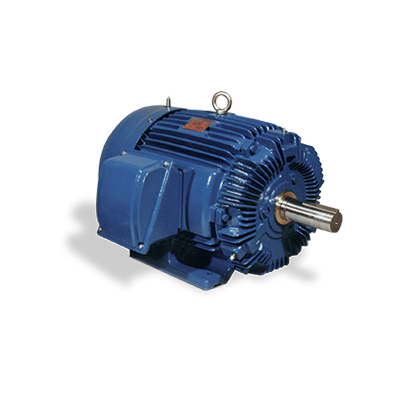
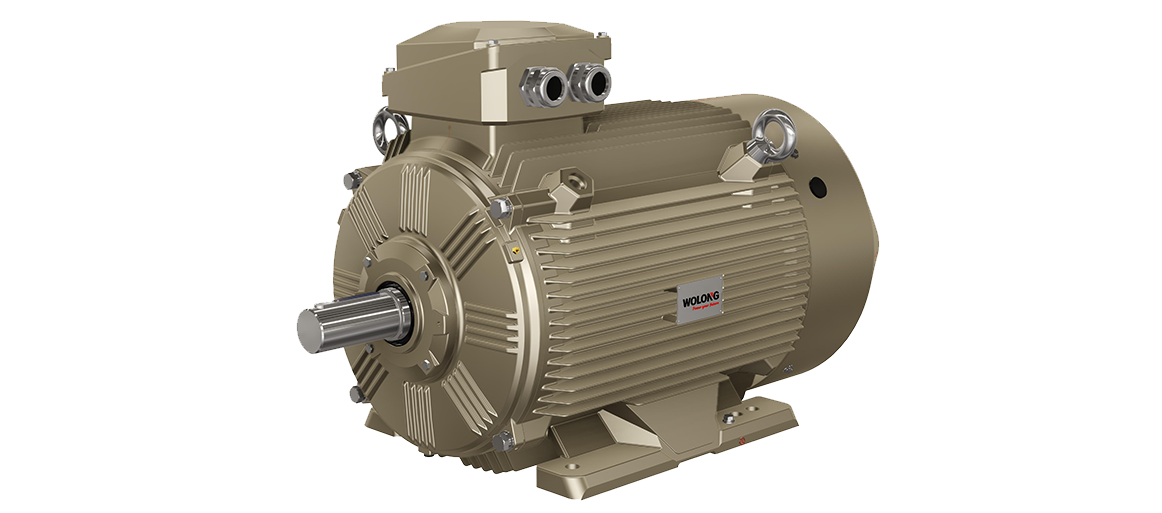
A VFD-duty motor, more formally an inverter-duty motor, is an AC induction motor engineered to run continuously and reliably on the pulse-width-modulated (PWM) output of a variable frequency drive. The defining difference from a general-purpose motor is the insulation system: built to NEMA MG-1 Part 31 (or qualified to IEC 60034-18-41), it withstands the fast, repetitive voltage spikes a drive produces, which can reach roughly 1,600 V peak on a 480 V system with rise times measured in tenths of a microsecond.
Beyond insulation, the inverter-duty designation bundles a set of features that ordinary motors lack: a wider constant-torque speed range, supplementary low-speed cooling, and provisions against the bearing currents that PWM supplies induce. These additions are what let the motor hold rated torque at near-zero speed without overheating or self-destructing.
This guide is written for procurement engineers and design engineers specifying motors for variable-speed systems. It covers 6 chapters, from what makes a motor inverter-duty, through torque classes, bearing-current physics, cooling and insulation standards, spec-sheet decoding, to the selection decision sequence, plus 7 selection FAQs and manufacturer comparisons. All parameters reference NEMA MG-1 Part 30 and Part 31, IEC 60034-18-41, IEC 60034-30-1, and IEEE 841 public standards.
Chapter 1 / 06
What is a VFD-Duty Motor
A VFD-duty motor is a three-phase AC induction motor purpose-built to be fed by a variable frequency drive rather than by a fixed-frequency sinusoidal line. The drive synthesizes its variable-voltage, variable-frequency output by switching power transistors, typically IGBTs, tens of thousands of times per second. The result is not a smooth sine wave but a train of rectangular voltage pulses whose average approximates the desired sinusoid. Those pulses, and especially their steep leading edges, impose electrical stresses that a motor built for a clean line supply was never designed to survive. The inverter-duty motor is the engineering answer to those stresses.
The terms vary by region and vendor but describe overlapping ideas. In North America the formal nameplate phrase is inverter-duty or vector-duty, governed by NEMA MG-1 Part 31. Internationally the relevant document is the IEC 60034-18-41 technical specification, which sets qualification and acceptance tests for the insulation of converter-fed machines. The phrase VFD-duty is the plain-language label common on purchase orders. A related but distinct term, vector-duty, implies the motor is additionally optimized for closed-loop flux-vector control with high dynamic response and a feedback encoder, usually overlapping the high-turndown inverter-duty designs.
Three mechanisms distinguish the operating environment of a VFD-fed motor from a line-fed one. First, the fast-rising PWM pulses, combined with reflected-wave effects on the motor cable, drive terminal voltage well above the nominal line value and stress the turn-to-turn and phase-to-ground insulation. Second, the high-frequency common-mode voltage couples capacitively onto the rotor and discharges through the bearings. Third, when the load demands torque at low shaft speed, the motor's own shaft-mounted fan turns too slowly to cool it. A genuine inverter-duty motor addresses all three: upgraded insulation, bearing-current mitigation, and supplementary cooling.
It is worth separating myth from requirement. A standard NEMA Premium motor will often run acceptably on a VFD across a narrow speed band, for example a fan or pump operating between 60 and 100 percent speed, where heating is light and the cable is short. The U.S. Department of Energy and several consulting-engineering references caution against over-specifying inverter-duty motors for such variable-torque service, because the premium pays for capability the load never uses. The inverter-duty motor earns its premium where torque must be held at low speed, where cable runs are long, or where the motor frame is large enough that bearing currents become destructive.
Historically, the modern inverter-duty motor emerged in the early 1990s as IGBT-based PWM drives replaced earlier GTO and transistor inverters. The faster IGBT switching, while improving drive efficiency and waveform quality, sharpened the voltage rise time at the motor terminals from microseconds toward tens of nanoseconds, exposing standard insulation systems to partial discharge and premature failure. NEMA responded with MG-1 Part 31 (first issued in the late 1990s and revised through the 2010s), and IEC followed with the 60034-18-41 series, formalizing the test regime that today separates a qualified inverter-duty machine from a general-purpose one.
Chapter 2 / 06
Duty Classes and Speed Range
The single most consequential selection decision is whether the load is variable-torque or constant-torque, because that determines how much torque the motor must hold at low speed, and therefore how much supplementary cooling and how wide a speed range the motor needs. Specifying the wrong class is the most common and most expensive mistake in variable-speed projects: a variable-torque motor on a constant-torque load overheats at low speed, while a constant-torque motor on a fan load is money spent on capability the affinity laws never call for.
Variable-torque loads obey the affinity laws of centrifugal machinery: torque varies with the square of speed and shaft power with the cube. At 50 percent speed a centrifugal pump demands only about a quarter of rated torque and an eighth of rated power, so winding heating at low speed is light and the shaft-mounted fan is adequate. Most general-purpose induction motors safely accommodate a 10:1 turndown on a variable-torque load. This is why fans and centrifugal pumps, the bulk of installed VFD horsepower, frequently run on standard motors with only a sensible cable length and grounding plan.
Constant-torque loads demand full rated torque regardless of speed: a loaded conveyor or a positive-displacement pump needs the same torque at 5 Hz as at 60 Hz. At low speed the shaft fan turns too slowly to remove the heat the winding still dissipates, so a genuine constant-torque inverter-duty motor adds a separately powered blower (the totally enclosed blower-cooled, or TEBC, enclosure) that runs at constant airflow independent of shaft speed. With that cooling, constant-torque speed ranges of 20:1 are routine and high-end designs reach 1,000:1.
Constant-horsepower operation occurs above base speed, in the field-weakening region: as frequency rises beyond the base point, available torque falls inversely with speed so that power stays roughly constant. Spindles and center-driven winders exploit this region. Vector-duty motors are the high-performance subset, optimized for closed-loop flux-vector or sensorless-vector control, delivering full torque down to zero speed with fast dynamic response; several manufacturers now publish constant-torque speed ranges of 1,000:1 and 2,000:1 for these machines, typically with a feedback encoder and TEBC cooling.
A practical caution applies to mixed ratings. Some catalog motors are labeled, for example, 10:1 variable speed with only 2:1 or 4:1 constant torque. That means the motor will turn smoothly across a 10:1 band but can hold full torque across only a 2:1 or 4:1 portion of it. Reading only the headline speed-range figure, without the qualifier, is a frequent source of undersized low-speed cooling. Always confirm the constant-torque speed range separately from the variable-speed range.
Chapter 3 / 06
Insulation, Standards, and Voltage Stress
The technical heart of an inverter-duty motor is its insulation system. A PWM drive does not deliver a sine wave; it delivers a string of steep-edged pulses, and on any non-trivial cable length the reflected wave can nearly double the pulse amplitude at the motor terminals. The insulation must survive both the elevated peak voltage and the extremely fast rise time, which concentrates voltage stress on the first few turns of each coil. The table below contrasts the governing limits of a standard motor and an inverter-duty motor.
Parameter
NEMA MG-1 Part 30 (standard)
NEMA MG-1 Part 31 (inverter-duty)
Scope
General-purpose, line or limited VFD
Definite-purpose inverter-fed
Peak terminal voltage
1,000 V
3.1 x rated rms (approx. 1,600 V at 480 V)
Minimum rise time
2 microseconds
0.1 microseconds
Shaft-voltage guidance
Not addressed
Bearings stressed above approx. 10 to 40 V peak
Typical insulation class
Class B or F
Class F, Class H on severe duty
International counterpart
IEC 60034-1
IEC 60034-18-41 / -18-42 qualification
NEMA MG-1 Part 30 governs general-purpose motors used on adjustable-speed supplies. It limits the peak voltage the winding must withstand to 1,000 V and the rise time to no faster than 2 microseconds. A 480 V drive feeding even a moderate cable run can exceed both limits, which is precisely why a standard motor is not a guaranteed safe choice for demanding VFD service.
NEMA MG-1 Part 31 is the definite-purpose inverter-fed section. Its key clause requires the winding to withstand repetitive voltage peaks equal to 3.1 times the rated rms line voltage with a rise time of not less than 0.1 microseconds; on a 460 to 480 V system that is approximately 1,600 V peak. Part 31 also flags shaft voltage as a hazard, observing that peaks of roughly 10 to 40 V can break down the bearing grease film and cause electrical-discharge damage, which leads directly into the bearing-current measures of Chapter 4.
IEC 60034-18-41 is the international technical specification for qualification and acceptance tests of converter-fed insulation systems, covering both random-wound and form-wound machines. Rather than a single voltage number, it defines a test regime: partial-discharge inception voltage (PDIV), surge testing, and dissipation-factor measurement establish whether the insulation will endure repetitive impulse stress over its service life. The companion 60034-18-42 covers Type II insulation expected to operate with partial discharge present. A datasheet that cites either NEMA Part 31 or IEC 60034-18-41 is making a verifiable claim; a motor that merely says "VFD compatible" without a standard reference is not.
The reflected-wave mechanism explains why these limits matter in the field. The PWM cable behaves as a transmission line; when its surge impedance does not match the motor's, each pulse partially reflects at the motor terminals and adds to the incoming pulse. Beyond roughly 30 m (about 100 ft) on a low-voltage drive, that addition can drive terminal voltage to nearly twice the DC-bus level, reaching 1,200 to 1,600 V on a 480 V system. Mitigations include a dv/dt filter, which lengthens the rise time and is rated for runs up to about 90 m (300 ft), or a sine-wave filter for very long runs beyond about 300 m (1,000 ft). A true Part 31 motor tolerates the spikes at moderate lengths without a filter, which is usually the cheaper system-level solution.
Chapter 4 / 06
Bearing Currents and Cooling
Two failure modes peculiar to VFD operation, electrical bearing damage and low-speed overheating, account for the majority of premature inverter-duty motor failures. Both are addressed by hardware that a standard motor does not include, and understanding them is essential to specifying the right options rather than discovering the gap after a bearing fails in service.
The bearing-current mechanism. A PWM inverter generates a common-mode voltage, the instantaneous sum of the three phase voltages, that is not zero as it would be on a balanced sine supply. This common-mode voltage couples capacitively across the air gap onto the rotor, charging the shaft like a capacitor. When the shaft voltage exceeds the dielectric strength of the thin grease film in the bearing, it discharges in a spark through the rolling elements, an electrical-discharge-machining event. Per NEMA MG-1 Part 31.4.4.3, shaft voltages of roughly 10 to 40 V peak are sufficient to trigger this. A single discharge leaves a microscopic pit; millions of them, over weeks or months, etch a regular washboard groove pattern called fluting into the raceway. Fluting raises noise and vibration and ends in bearing seizure, often within a fraction of the expected mechanical life.
The severity of bearing currents grows with drive switching frequency, motor frame size (larger air-gap capacitance), and cable length. Above roughly NEMA 280 / IEC 180 frame sizes, mitigation is no longer optional on continuously running drives. The table below summarizes the three mainstream remedies and where each applies.
Mitigation
How it works
Best applied at
Shaft grounding ring
Conductive microfibers give shaft current a low-impedance path to frame, bypassing the bearing
Drive-end, most frame sizes
Insulated / hybrid-ceramic bearing
Insulating layer or ceramic balls break the current path through that bearing
Non-drive end, larger frames
Bonded symmetrical VFD cable
Low-impedance ground holds frame at drive potential, reduces common-mode return
System wiring, all sizes
A shaft-grounding ring uses circumferential conductive microfibers riding on the shaft to provide a deliberate, low-impedance discharge path to the frame, diverting current away from the bearing. It is the most common single measure and is effective at the drive end. An insulated or hybrid-ceramic bearing places an insulating layer (or ceramic rolling elements) in the bearing to break the current path through it; this is the standard provision at the non-drive end of larger frames. A crucial caveat, noted by motor makers and NEMA alike: an insulated bearing alone does not remove shaft voltage, it only blocks one path. The current can still find another route, often through the driven load and its bearings. The robust practice on large machines is therefore a grounding ring at the drive end combined with an insulated non-drive-end bearing, plus a properly bonded symmetrical output cable.
Low-speed cooling. The second failure mode is thermal. A totally enclosed fan-cooled (TEFC) motor relies on a fan keyed to its own shaft; airflow falls with speed, so at low speed on a constant-torque load the motor dissipates rated heat with little cooling and the winding overheats. The remedy is the totally enclosed blower-cooled (TEBC) enclosure, which adds a small separately powered blower, commonly 230 / 460 V three-phase, that delivers constant airflow regardless of shaft speed. TEBC is what makes wide constant-torque speed ranges thermally possible. A totally enclosed non-ventilated (TENV) enclosure, with no fan at all, suits intermittent or low-output duty. For variable-torque fan and pump loads, standard TEFC self-cooling remains adequate because the load itself is light at low speed.
Chapter 5 / 06
Key Specification Parameters
An inverter-duty motor datasheet carries the usual induction-motor parameters plus several that exist only because of VFD operation. The parameters below are the ones that actually drive a selection decision, organized so a purchasing engineer can read any vendor's sheet against a common checklist.
Rated power, voltage, and frequency. Power is stated in kW or HP, voltage commonly 230 / 460 V (NEMA) or 400 V (IEC) three-phase, and base frequency 50 or 60 Hz. Note the base speed: the inverter-duty motor holds rated torque up to base speed and enters the constant-horsepower (field-weakening) region above it. Confirm the maximum permissible frequency, since many designs allow operation above 60 Hz only within mechanical and bearing limits.
Constant-torque and variable-speed range. As stressed in Chapter 2, these are two separate numbers. The constant-torque speed range (for example 20:1, 100:1, 1,000:1) is the band over which full rated torque is available with the specified cooling; the variable-speed range is the wider band over which the motor turns smoothly at reduced torque. Always confirm both, and confirm whether the constant-torque figure assumes a blower.
Insulation class and temperature rise. Most quality inverter-duty motors use Class F insulation (155 degrees C limit) with a Class B temperature rise (80 K), the spare margin absorbing the extra harmonic heating of a PWM supply. Severe-duty and high-turndown designs may use Class H (180 degrees C). The pairing of a high insulation class with a conservative rise is a reliability signal worth looking for.
Efficiency class (IEC 60034-30-1 / NEMA Premium). Efficiency is graded as IE1 (Standard), IE2 (High), IE3 (Premium), and IE4 (Super Premium); the North American equivalent is NEMA Premium. Regional minimum-efficiency regulations now generally mandate IE3 or higher for general-purpose motors, so most current inverter-duty offerings are IE3 or IE4. The Part 31 rating and the IE class are independent: pick the IE class your regulation and energy payback justify.
Enclosure and ingress protection. Common enclosures are TEFC (self-cooled), TEBC (blower-cooled for constant torque), and TENV (non-ventilated). Ingress protection is rated to IEC 60529 as IP55 for general industrial duty and IP56 / IP66 for washdown or harsh outdoor sites. Severe-duty lines such as WEG W22 add cast-iron frames and IEEE 841 low-vibration construction.
The remaining sheet items decide field reliability and integration:
Bearing protection: shaft-grounding ring, insulated or ceramic-hybrid non-drive-end bearing, or both, per Chapter 4. Confirm which are standard and which are options.
Service factor: commonly 1.0 on inverter supply (the harmonic heating consumes the margin a 1.15 line service factor would otherwise provide); verify the value on a VFD, not just on a sine supply.
Feedback provisions: encoder or resolver mounting for vector and closed-loop duty, plus winding RTDs or thermistors (PTC) for thermal protection.
Cable and dv/dt rating: the maximum motor-cable length the winding tolerates without a filter; beyond it, plan a dv/dt or sine-wave filter per Chapter 3.
Compliance statement: an explicit NEMA MG-1 Part 31 or IEC 60034-18-41 reference, not a vague "VFD compatible" note.
Chapter 6 / 06
Selection Decision Factors
To turn the preceding five chapters into a specific model, follow the decision sequence below. The order matters: most selection errors come not from a single wrong value but from settling a downstream choice (enclosure, bearing options) before the upstream one (duty class, speed range) is fixed. These eight steps double as a fixed RFQ template.
Load duty class first: classify the driven load as variable-torque (pumps, fans), constant-torque (conveyors, extruders, PD pumps), or constant-horsepower (spindles, winders). This single decision governs cooling and speed range. For variable-torque loads with a narrow speed band, a standard NEMA Premium motor may suffice; do not over-specify.
Constant-torque speed range: determine the lowest speed at which full torque is required, and confirm the motor's constant-torque speed range covers it, separately from the variable-speed range. If full torque is needed near zero speed, plan on TEBC cooling and possibly a vector-duty motor with encoder.
Power, voltage, and base speed: size kW or HP for the worst-case load point, select 230 / 460 V or 400 V, and set base frequency. Decide whether operation above base speed (constant-horsepower) is needed and verify the maximum permissible frequency.
Insulation and compliance: require Class F minimum (Class H for severe or high-turndown duty) and an explicit NEMA MG-1 Part 31 or IEC 60034-18-41 statement on the datasheet. Treat a motor without a standard reference as not inverter-duty.
Bearing protection: for frames above roughly NEMA 280 / IEC 180 on continuous drives, specify a shaft-grounding ring at the drive end plus an insulated or ceramic-hybrid non-drive-end bearing. Remember that an insulated bearing alone does not eliminate shaft voltage.
Enclosure, ingress, and environment: TEFC for self-cooled variable-torque, TEBC for constant-torque low-speed duty, TENV for intermittent loads. Set IP55 for general industry, IP56 / IP66 for washdown or outdoor; add cast-iron severe-duty (IEEE 841) for hostile sites.
Cable, filters, and grounding: calculate the drive-to-motor cable length. Beyond about 30 m (100 ft), plan reflected-wave mitigation; specify a dv/dt filter up to about 90 m (300 ft) or a sine-wave filter beyond 300 m (1,000 ft), and require a bonded symmetrical VFD cable.
Efficiency and total cost of ownership: choose the IE class (IE3 or IE4) that regional regulation and energy payback justify, then total purchase, blower power, filters, bearing-protection hardware, and downtime risk. A motor that saves a little upfront but fails a bearing in a year can cost far more in unplanned production loss.
One dimension is routinely overlooked: manufacturer serviceability. Local stock of grounding rings and insulated bearings, availability of field rewind to the original insulation specification, encoder and blower spares, and documented Part 31 test reports all determine how quickly the motor returns to service after a fault five or ten years into its life. ABB Baldor-Reliance (RPM AC and V*S Master), WEG (W22 severe duty), Siemens (SIMOTICS SD), and Nidec/Leroy-Somer maintain service networks and published inverter-duty test data, which makes them dependable choices for projects where uptime governs the cost equation.
FAQ
What is the difference between a standard motor and an inverter-duty motor?
A standard general-purpose motor is built to NEMA MG-1 Part 30, which assumes a sinusoidal supply and limits peak terminal voltage to 1,000 V with a rise time no faster than 2 microseconds. An inverter-duty (VFD-duty) motor is built to NEMA MG-1 Part 31, with an upgraded insulation system that withstands repetitive peaks up to 3.1 times rated rms voltage, roughly 1,600 V on a 480 V system, with rise times as short as 0.1 microseconds. Inverter-duty motors also add features that standard motors lack: a wider constant-torque speed range, a separately powered blower for low-speed cooling, and provisions against bearing currents. A standard motor can sometimes run on a VFD over a narrow speed band, but it is not qualified for the fast voltage transients a PWM drive produces.
What does NEMA MG-1 Part 31 actually require?
NEMA MG-1 Part 31 is the section governing definite-purpose inverter-fed motors. Its central insulation requirement, in clause 31.4.4.2, is that the winding must withstand maximum repetitive voltage peaks at the motor terminals equal to 3.1 times the rated rms line voltage, with a rise time of not less than 0.1 microseconds. On a 460 to 480 V supply this corresponds to roughly 1,600 V peak. Part 31 also addresses shaft voltage, noting in 31.4.4.3 that voltages above about 10 to 40 V peak can discharge through bearings and cause damage. The international counterpart is IEC 60034-18-41, which defines qualification and acceptance tests, including partial-discharge inception voltage, for converter-fed insulation systems.
What is the difference between constant-torque and variable-torque duty?
Variable-torque loads, such as centrifugal pumps and fans, follow the affinity laws: torque rises with the square of speed and power with the cube, so the motor sees almost no load at low speed and self-cooling is rarely a problem. These applications need only a modest constant-torque speed range, often 10:1 variable speed with 2:1 or 4:1 constant torque. Constant-torque loads, such as conveyors, extruders, and positive-displacement pumps, demand full rated torque at very low speed where a shaft-mounted fan moves little air. True inverter-duty motors built for constant torque therefore use a separately powered blower (TEBC) and can reach a constant-torque speed range of 20:1, 100:1, or even 1,000:1. Specifying the wrong duty class either overheats the winding or wastes money.
Why do VFD-driven motors suffer bearing currents and fluting?
A PWM inverter produces a common-mode voltage that is capacitively coupled across the air gap onto the rotor. The rotor charges up like a capacitor until the shaft voltage exceeds the dielectric strength of the bearing grease film, then discharges through the bearing in a spark, an electrical-discharge-machining (EDM) event. Each discharge pits the rolling elements and raceways; millions of events produce a washboard groove pattern called fluting, which raises noise and vibration and ends in premature bearing failure. Per NEMA MG-1 Part 31.4.4.3, peak shaft voltages of roughly 10 to 40 V are enough to break down the film. The problem grows with drive switching frequency, motor size, and cable length.
How do I protect motor bearings from VFD shaft voltage?
The mainstream measures are: (1) a conductive shaft-grounding ring, with circumferential microfibers that give shaft current a low-impedance path to the frame and bypass the bearing; (2) an insulated or ceramic-hybrid bearing at the non-drive end, which blocks the circulating current path through that bearing; and (3) a properly bonded symmetrical VFD output cable plus a low-impedance equipment-grounding conductor that holds the frame at the same potential as the drive. Insulated bearings alone do not remove shaft voltage: the current can still find a path through the driven load, so on larger machines a grounding ring is usually combined with an insulated non-drive-end bearing. NEMA MG-1 Part 31 lists shaft grounding and insulated bearings as accepted mitigation.
When do I need a dv/dt filter or a sine-wave filter?
On a low-voltage drive, reflected-wave overvoltage at the motor terminals becomes a concern once the cable run exceeds roughly 30 m (about 100 ft), because the reflected pulse adds to the incoming pulse and can nearly double terminal voltage, reaching 1,200 to 1,600 V on a 480 V system. A dv/dt filter (a small series reactor plus damping network) slows the rise time and is typically rated for runs up to about 90 m (300 ft). For very long runs, often beyond 300 m (1,000 ft), or where a non-inverter-duty motor must be protected, a sine-wave filter reconstructs a near-sinusoidal waveform at the motor. A genuine Part 31 inverter-duty motor tolerates the spikes without a filter at moderate cable lengths, which is the cheaper system solution.
Does an inverter-duty motor need a higher efficiency or insulation class?
Insulation and efficiency are separate axes. Most quality inverter-duty motors use Class F insulation (155 degrees C) with a Class B temperature rise (80 K), leaving thermal margin for the extra harmonic heating a PWM supply adds; severe-duty and high-turndown designs may step up to Class H (180 degrees C). Efficiency is graded under IEC 60034-30-1 as IE2, IE3 (Premium), and IE4 (Super Premium), or to NEMA Premium in North America. A Part 31 rating does not by itself dictate an IE class, but most current inverter-duty motors are offered at IE3 or IE4 because regional minimum-efficiency regulations require it. Match insulation to thermal stress and pick the IE class your energy regulation and payback analysis justify.
VFD-Duty Motor Manufacturers
Source-backed product routes. Open a company dossier for procurement scope and cited evidence.