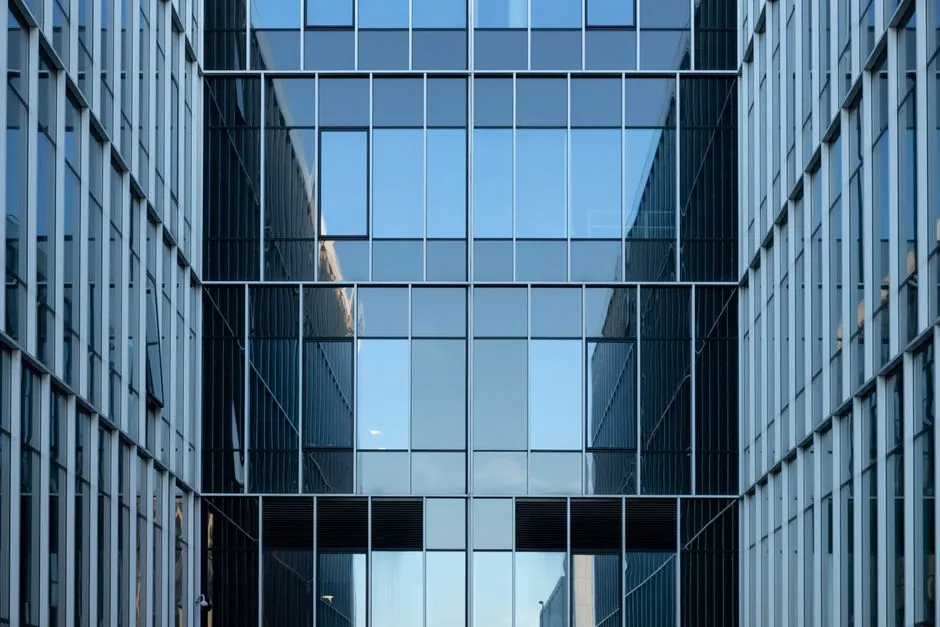
Data center curtain wall specification in 2026 is no longer a single-discipline choice of glass and frame, it is a five-gate engineering exercise spanning fire compartmentation, ballistic and forced-entry resistance, airtightness, dynamic solar control, and BMS interoperability [S1][S2][S3][S4].
For hyperscale, colocation, and edge builds, the building envelope directly drives Power Usage Effectiveness (PUE), uptime class, and physical-security tier, so the spec is now written by a combined team of fire consultant, structural engineer, security consultant and DCIM lead rather than the architect alone [S3]. The glass curtain wall category on its own covers stick, unitized and modular sub-families, each with different tolerance bands on thermal break, mullion depth and panel weight.
Five Spec Gates That Drive the 2026 Data Center Curtain Wall
Data center projects are now routinely scored against five quantitative spec gates before a glass system is released for quotation: fire rating tier (EI60 / EI90 / EI120), unitized vs stick framing, ballistic and forced-entry class, airtightness at 50/75/100 Pa, and dynamic-tint control range [S1][S3][S4].
Fire rating is the first filter. Server rooms, UPS rooms, battery rooms and main electrical rooms typically require EI60, EI90 or EI120 fire-rated glazing confirmed jointly by architect, fire consultant and facility engineering before tender, with EI90 and EI120 being common on hyperscale white-space boundaries and battery rooms [S1]. Standard office-rated glass is rejected at this gate because the fire compartmentation, smoke control, and cable-room layout demands of technical spaces are stricter than for commercial space [S1].
Framing system is the second filter. Unitized curtain wall systems are now the default for new hyperscale builds because all components are pre-assembled and tested in workshop, then delivered for on-site hoisting, which shortens the weathertight enclosure window from months to weeks [S3][S4]. Stick systems remain in scope only for retrofit, low-rise edge nodes, or where a unitized hoist is physically impossible on a constrained site.
Airtightness, ballistic and forced-entry class form gates three and four. Modular data center curtain wall systems designed to UL criteria are specifically engineered for high thermal insulation, airtightness, fire resistance and structural stability under continuous IT load [S4]. On a desert Saudi Arabia deployment, the unitized envelope simultaneously delivered ultra-high dust isolation, constant-temperature performance, ballistic protection and fire safety in a single modular unit [S3].
Dynamic-tint control is gate five. Electrochromic, SPD, PDLC, and thermochromic glazing each map to different data center use cases, with EC (1–3 min switch, very low power) for large facades, SPD (~1 s, high privacy) for control rooms and skylights, PDLC (instant, full privacy) for interior partitions, and thermochromic (passive) for shaded zones [S2].
Fire-Rated Glass: Ratings, Glazing System, and What to Specify
Fire-rated glass in data centers must be specified as a complete system (glass, metal frame, fireproof seals, glazing beads, gaskets, closers, locks, access control) rather than as a single glass thickness value, because the rating is only valid when the whole assembly is tested together [S1].
For high-risk technical rooms (server halls, UPS rooms, battery rooms, main switchgear), the typical rating band cited by Pyronano's 2026 data center application note is EI60–EI120, with EI90 being the common middle choice for white-space / corridor boundaries and EI120 reserved for battery rooms and transformer enclosures [S1]. The same source flags visibility as a non-negotiable driver: transparent fire-rated glass lets facility staff check status of running equipment, BMS panels, and security zones without opening fire doors and breaking compartmentation [S1].
For data center and electrical-room projects, the buyer RFQ should explicitly include: room type, application area (door / partition / observation window / control room wall), required fire rating (EI60, EI90 or EI120), glass size and thickness, frame type, door opening direction, hardware list (closer, lock, access control, panic bar), and any smoke-control, impact or acoustic adders [S1]. Selecting glass only by thickness or unit price is the single most common procurement error and is called out directly in the same 2026 buyer-guidance note [S1].
Smart Glass and Dynamic Tint: Where the Energy Payback Lives

Dynamic-tint smart glass in data centers is specified primarily for solar heat gain reduction on large facades, with secondary roles in glare control near monitoring screens, visual privacy in controlled areas, and circadian tuning for shift workers [S2].
The four technology families behave very differently and the spec should match technology to use case, not the other way around. EC (electrochromic) suits large facades thanks to 1–3 min switching and very low power draw, SPD (suspended particle device) suits control rooms and skylights with ~1 s switching and high privacy, PDLC (polymer dispersed liquid crystal) is the right answer for interior partitions that need instant full-opacity switching, and thermochromic is a passive no-power option for shaded elevations where switching speed is irrelevant [S2].
Quantified savings bands reported for smart glass on commercial and technical facades are 15–45% HVAC load reduction, up to 20% lighting energy reduction via daylight harvesting, and ROI of 3–4 years in hot/humid climates, 4–6 years in temperate zones, and 6–7 years in cold climates [S2]. Integration is via standard BMS protocols, with BACnet, Modbus and SNMP cited as the interoperability backbone for predictive tinting and IoT-driven scheduling [S2].
Unitized Modular Systems: Why Hyperscale Builds Standardized on Them
Unitized curtain wall systems for data centers consolidate fire prevention, ballistic resistance, anti-theft protection, weatherproofing and thermal break into a single factory-prefabricated module, removing the need for site-trade coordination between separate fire, glazing and security subcontractors [S3].
The structural recipe is consistent across 2026 vendor offerings: customizable ballistic laminated safety glass, thickened high-rigidity aluminum mullions, built-in reinforced steel lining, multi-point interlocking security locks, and specialized fire-sealed structural cavities filled with high-grade fire-rated material [S3]. The system is typically specified alongside a heavy-duty impact-resistant profile to reach military and government protection tiers rather than only EN 1627 commercial RC classes [S3].
For a comparison lens, the three main curtain wall sub-families line up against data center priorities as follows. Stick systems: lowest unit cost, longest site program, hardest to QA airtightness, used on retrofit and small edge nodes. Unitized systems: factory QA on every module, 2–4x faster weathertight enclosure, consistent ballistic and fire ratings, default for hyperscale [S3][S4]. Modular UL-listed systems: explicit UL compliance path, integrated high thermal insulation and airtightness, used where the AHJ or client standard mandates a UL-listed envelope for insurance or co-tenant compliance [S4]. The door and window curtain wall family overlaps with the above and is often the right reference for the vision-glass and access-door sub-components.
Who This Spec Is For, and Where the Limits Bite

Unitized, UL-listed, fire-rated curtain wall systems with optional dynamic-tint layers are specified for new-build hyperscale and colocation halls, modular prefabricated data centers, edge sites above ~2 MW IT load, and any facility in a climate-severe (desert, tropical coastal, high-dust) or high-security (government, defense, financial) location [S3][S4].
They are typically not the right answer for sub-500 kW edge containers, retrofits into existing load-bearing masonry, or heritage-façade sites where the AHJ forbids unitized module hoists, and on those scopes stick systems with localized fire-rated glazing remain the pragmatic choice. Smart-glass layers should be omitted on small footprints where the 6–7 year cold-climate ROI exceeds the typical 5-year capex horizon, and ballistic upgrades should be specified only after a site threat assessment confirms the residual risk warrants the cost premium [S2][S3].
Sourcing and Standards Checklist for 2026 Tenders
Buyers should anchor the 2026 tender on four reference items: a fire-rating matrix (EI60 / EI90 / EI120) per room type, a framing system decision (stick / unitized / modular UL-listed) tied to program and AHJ, a dynamic-tint layer decision (EC / SPD / PDLC / thermochromic) tied to climate and ROI, and a hardware list that includes closer, lock, access control, panic bar, smoke control and acoustic performance adders [S1][S2][S3][S4].
Trackable signals to watch over the next procurement cycle include: data center projects standardizing on EI90 as the new white-space baseline instead of EI60, unitized curtain wall systems replacing stick on most hyperscale RFPs, electrochromic dynamic-tint glass dropping in unit cost as production scales, and BMS-driven predictive tinting becoming a default rather than an optional extra on tropical and desert sites. For related spec mapping on industrial envelopes, the metal curtain wall panel reference covers the opaque spandrel and louver sub-assemblies that typically pair with vision glass on data center facades.
For related coverage, see Arc Welding Machine Selection for Bridge Construction: 2026 Spec Map.