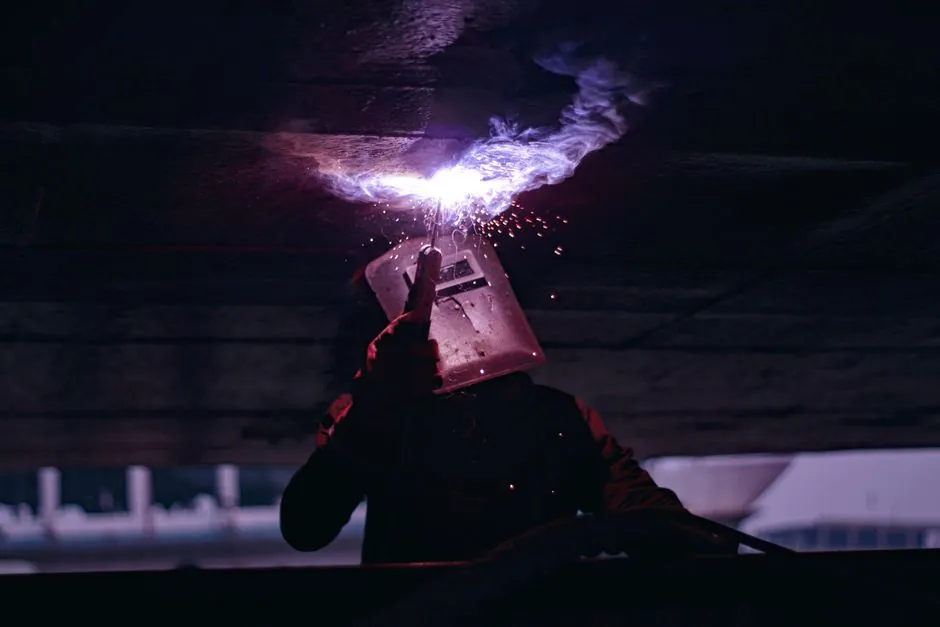
Bridge steel fabrication and field erection in 2026 spec the welding set by current class, dual-arc capability, and code pedigree, not by sticker price. Engine-driven welders in the 380-800A range now dominate remote bridge sites because they deliver 15-35 kW of auxiliary three-phase power alongside the welding arc, a combination grid-fed inverters cannot match on a river crossing or a mountain span [S1][S2].
The decision comes down to four binding constraints: AWS D1.1/D1.5 and JT/T 722-2023 compliance, plate thickness (25-80mm typical for main girders and box sections), ambient exposure (-15 to 35°C in published bridge deployments), and process mix (SMAW + FCAW + GMAW + SAW on a single project). The reference equipment families and process matrix below are pulled from manufacturer technical guidance and welding-process comparisons published in 2025-2026 [S1][S2][S4][S5].
Code and Process Binding: AWS D1.1, D1.5, and JT/T 722-2023
AWS D1.1 welding equipment for bridge steel must deliver precise control over heat input, travel speed, and joint positioning to satisfy the structural steel bridge code's demands on groove welds, fillet welds, and procedure qualification [S7]. The bridge-specific AWS D1.5 Bridge Welding Code layers additional WPS, welder qualification, and inspection obligations on top of D1.1, with the practical effect that procedure sheets are written against 25-80mm plate, controlled preheat, and interpass windows of 150-250°C [S2].
On the Chinese standard side, JT/T 722-2023 is named explicitly as the bridge welding specification for long-span steel box beams and trusses, paired with weathering-steel consumables such as AWS A5.28 ER110S-G and a -40°C low-temperature impact toughness requirement on the weld metal [S4]. The two code systems converge on the same engineering reality: heat-input control, hydrogen management, and NDT-ready bead profile are non-negotiable, so the power source must hold a stable arc across long cable runs and wind-exposed positions.
Equipment Class Matrix: 380A to 800A Engine-Driven Welders
Published engine-driven welder model lines for bridge work cluster into four current classes with matched auxiliary power ratings. The mid-range HW380D delivers 380A welding output and 15 kW auxiliary for medium bridge components, the HW450D/HW450DS add dual-arc outputs in the 40-450A window with 20-22 kVA auxiliary, the HW600DS steps to 50-600A dual-arc with 30 kVA auxiliary, and the HW800DS reaches 50-800A dual-arc with 35 kVA auxiliary for orthotropic decks and suspension components [S1][S2][S5].
The dual-arc capability is the differentiator that grid-fed inverters cannot replicate on a remote pier: one diesel-driven generator feeds two weld cells simultaneously, letting a web-to-flange joint be welded on both sides at once, or letting one operator tack while another runs a fillet pass. Published bridge deployments use HW600DS dual-operator output to power 110°C induction preheat on 40mm Q345D girders in -15°C ambient, with the same 30 kVA three-phase output running digital interpass temperature indicators [S2].
Process Match: SMAW, FCAW, GMAW, SAW by Plate Thickness
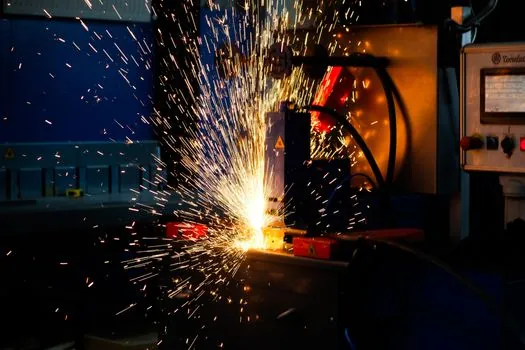
Process selection on a bridge site tracks plate thickness and position, with the engine-driven generator acting as the universal power source behind all four. Submerged arc welding (SAW) covers the 6-150mm range at 40-120 cm/min and 8-12 kg/h deposition, and is the workhorse for box-column longitudinal seams and tank circumferential seams where gantry automation is available [S4]. Gas-shielded MAG/GMAW is the right pick for 1-50mm work at 15-50 cm/min and 3-6 kg/h, especially beam-column joints and on-site installation welds where 80% Ar + 20% CO₂ gives clean bead profile under wind protection [S4].
Field welds on bridge girders typically use a hybrid stack: gas-shielded root for gap control, submerged-arc fill and cap for deposition rate, and self-shielded FCAW for outdoor passes where wind defeats gas shielding. The HW600DS stable DC arc characteristics are documented as a deliberate enabler of self-shielded FCAW at sustained 8 m/s winds on a Central Asia highway bridge project, with the same unit running induction preheat on the side [S2]. SMAW remains the fallback for tack welds and positional work where the cell layout cannot accommodate wire feed equipment, which is why every bridge-rated engine-driven welder in the published matrix is multi-process capable rather than dedicated to a single mode [S1][S3][S5].
Field Conditions: Ambient Range, Wind, and Preheat
Bridge construction welding is an outdoor activity by definition, and the equipment class is selected against the worst-case ambient envelope. Published bridge deployments document continuous operation from -15°C to 35°C on regional railway bridge projects in northern China, with the diesel-driven welding generator sized so that cold-starting and voltage sag under load do not push the arc out of the WPS envelope [S1][S2].
Wind is the second environmental gate: SAW flux recovery systems and windproof sheds are named as essential kit for outdoor box girder work, while FCAW self-shielded wire is the practical answer for field passes above 6-8 m/s sustained wind where a tent is impractical [S2][S4]. Preheat and interpass control are the third gate: induction preheat coils drawing 30 kVA three-phase from the welder's auxiliary bus raised 40mm Q345D joints to 110°C, and digital temperature indicators on the same bus held the interpass window to 150-250°C on the same Central Asia project [S2].
Selection Criteria Comparison: Engine-Driven vs Grid-Fed Inverter
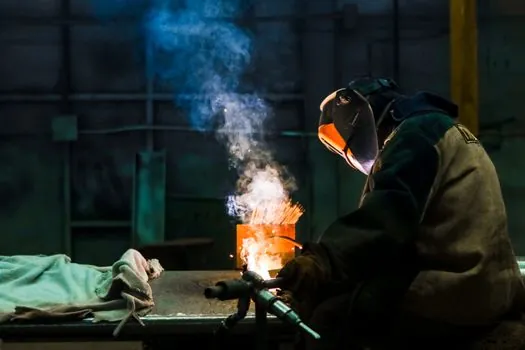
For a remote bridge site, four decision criteria separate the engine-driven dual-arc welder from a grid-fed inverter package. (1) Mobility: the engine-driven unit is a single trailer-mounted package with no grid dependence, while inverters require a generator plus distribution on greenfield sites [S1][S2]. (2) Dual-arc output: HW450DS/HW600DS/HW800DS deliver true dual-operator 40-450A, 50-600A, and 50-800A outputs from one engine, an inverter stack cannot match without paralleling two cabinets and a sync module [S2]. (3) Auxiliary three-phase power: 15-35 kVA at 400V from the same engine feeds preheat coils, lighting, and grinders, a capability absent on a pure welding inverter [S1][S2]. (4) Code pedigree: published bridge deployments name specific engine-driven models in AWS D1.1/D1.5 and JT/T 722-2023 procedure packs, with documented WPS heat-input windows and interpass protocols [S2][S4][S7].
Grid-fed inverter packages remain the right pick only for shop fabrication in a covered box-girder production line, where SAW gantries on rails and stable incoming power beat a diesel engine on fuel cost and noise. For field erection, deck-level assembly, and any work outside the shop envelope, the engine-driven dual-arc class is the published default.
Who It Is For and Who It Is Not For
Engine-driven 380-800A dual-arc welders are the right spec for bridge general contractors, steel fabricators running outdoor box-girder or truss assembly, and rental fleets serving highway and railway construction in regions with weak grid coverage. The HW380D class fits medium bridge components and tacking, the HW450D/DS class fits highway overpass and railway bridge projects where the 20-22 kVA auxiliary balances grinder and lighting load against welding output, and the HW600DS/HW800DS class is reserved for long-span suspension, cable-stayed anchorage welds, and orthotropic deck panels [S1][S2][S5].
The same class is the wrong spec for indoor shop-only fabrication running SAW gantries on a fixed grid, for thin-sheet architectural metalwork below 3mm where pulse MIG gives better cosmetic results, and for any process where the welding heat input would push the plate outside the 150-250°C interpass window the WPS requires. Selecting an 800A class for routine 6mm tack welding is over-spec and burns fuel, while selecting a 200A portable inverter for a 60mm box-girder groove weld is under-spec and will fail procedure qualification on the first PQR.
Limitations, Failure Modes, and Maintenance Gates
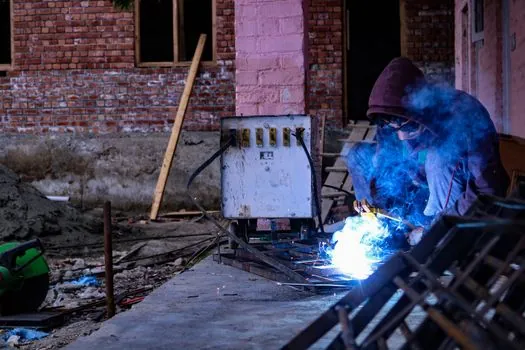
The documented failure modes on engine-driven welders in bridge service are familiar: voltage sag under simultaneous dual-arc + auxiliary load, wet electrodes causing hydrogen-induced cracking in restrained joints, and fuel filter choking in dusty site conditions. The published mitigation is procedural, with daily visual inspection of welding cables, 250-hour fuel filter service intervals, ground-cable integrity checks before each shift, and dry electrode storage to prevent hydrogen embrittlement in Q345D and similar high-strength bridge steels [S1][S2].
Two operational limits are worth flagging. First, SAW on outdoor bridge work is wind-sensitive and needs a windproof shed plus flux recovery, otherwise porosity and slag inclusion rates climb and the weld fails NDT [S4]. Second, dual-arc output at 50-600A or 50-800A is a thermal load on the diesel engine that does not appear on the welding spec sheet, and the published bridge projects that ran HW600DS dual-operator continuously sized the engine block and radiator for the ambient envelope rather than the nameplate current [S2][S5].
Cross-Reference to Production Tools
For a broader view of welding and cutting tool selection on infrastructure sites, the arc welder reference covers process families and current ranges, while the welding cutting tool page maps consumable handling and joint prep. Shop-side box girder work often runs alongside a coding machine for traceability, and a facility-scale overhead bridge crane handles the heavy girder lifts referenced in the box-beam welding workflow. Field-side teams that also run structural fabrication should cross-check the construction tools and construction machinery and equipment catalogues for grinders, positioners, and generators that share the same duty cycle. [S2]
Two trackable signals for the next quarter: (1) AWS D1.5M revision activity on bridge-specific procedure qualification, and (2) JT/T 722-2023 implementation feedback from Chinese long-span bridge projects through end-2026, both of which will tighten or relax the WPS heat-input windows that drive engine-driven welder sizing today. Field procurement teams should also watch diesel-driven dual-arc model releases in the 600-800A bracket, where the published product lines expanded through 2025-2026 to cover the long-span and orthotropic-deck segments [S1][S2][S5][S9].
See also our earlier report, System Window and Door Selection for Hospitals: 2026 Spec Map.