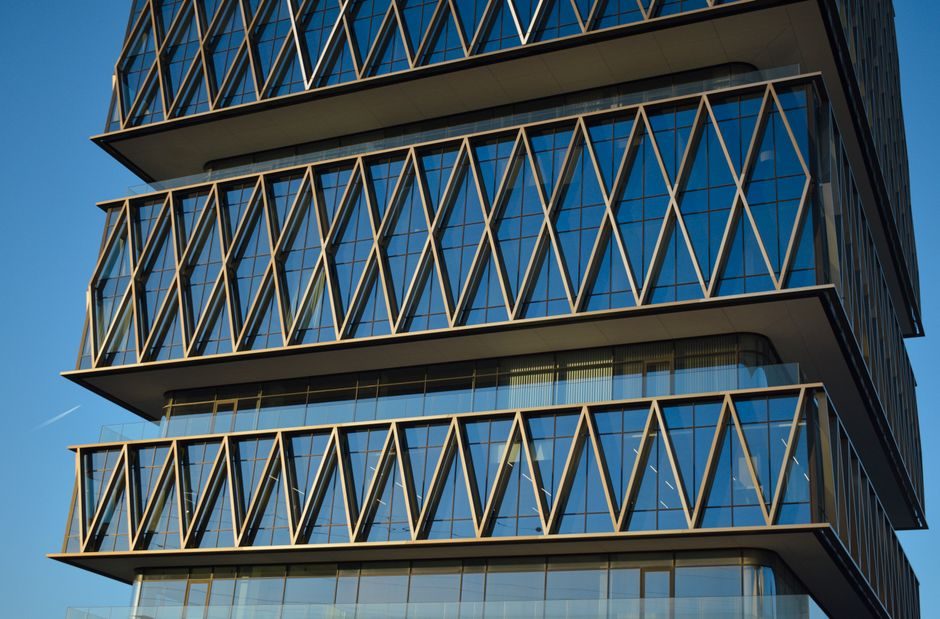
Glass curtain wall and aluminum window-door share an aluminum profile supply chain, but they serve different structural functions on a building envelope, and Foshan is a documented export hub for suppliers offering both product lines on Made-in-China [S1][S2][S7].
Both categories are produced on the same Guangdong cluster (Foshan, Wuxi, Shanghai) by ISO 9001-audited factories, with curtain-wall orders typically running 30 m² MOQ and aluminum window-door single-piece MOQ around 1-2 m² [S2][S7][S8]. This is the practical decision boundary specifiers and EPC procurement teams work against on a 2026 commercial facade package.
Definitions and Structural Scope
构件式玻璃幕墙 (stick-built glass curtain wall) is defined as a system in which the factory-fabricated components — individual mullions, transoms and glass panels — are shipped to site and assembled piece-by-piece onto the primary structure; it splits into exposed-frame, hidden-frame and semi-hidden-frame variants [S9].
Aluminum window-door is a factory-assembled opening unit (casement, sliding, tilt-turn) with its own frame, sash, hardware (handles, rollers, gears, locks, stay bars) and glazing, designed to be fixed into a pre-formed structural opening [S4]. A curtain wall is the building skin; a window-door is a hole in the wall, and the structural behaviour, mullion spacing and deflection limits are sized accordingly [S1][S3].
For encyclopedia reference, the broader glass curtain wall family covers unitised, stick and unit-and-stick hybrid systems, while aluminum window-door covers residential-grade and commercial-grade opening products built on 6063-T5/T6 aluminium profiles.
2026 Price Bands and MOQ Reality
Made-in-China listings on 2026-05-15 show curtain-wall-plus-window packages from Foshan Rolay at US$69-99/m² (30 m² MOQ) and custom curtain-wall units starting around US$1200/piece at industrial dock-door suppliers [S5][S7]. Deshion lists high-end residential curtain wall at the upper end of the cluster range, with 6063-T5 profiles and Low-E double-glazing as standard inclusions [S1].
ACG Windows & Doors and Wuxi Hengfa (founded 1979) both quote FOB-Foshan and FOB-Shanghai on a 1-piece MOQ basis for window-door SKUs, with the Hengfa fabrication line running curtain wall, aluminium door-window, accessories and a metal-fabrication sister line from the same Wangyuhe Road plant [S2][S8].
Selection Criteria: Span, Load and Movement

Curtain wall mullions are typically spaced 1.5-2.4 m on centre and engineered to carry self-weight plus 0.5-1.0 kPa wind load back to the floor slab; window-door frames sit inside a structural opening and the surrounding wall carries the wind load [S1][S9]. For floor-to-floor spans above 3 m, a stick curtain wall is the structurally economic answer; below that, an aluminum window-door punched into a conventional wall is cheaper and faster to install [S3][S9].
Thermal performance is set by the glazing spec, not the framing system. Both product families can be ordered with Low-E double-glazed units giving U-values in the 1.6-2.2 W/m²·K range, but the curtain-wall package adds a pressure-equalised rainscreen cavity that a window-door opening cannot match [S1][S3]. This is why commercial towers (Deshion, Hengfa, ACG export portfolios) pair a stick curtain wall on the slab edge with aluminum window-doors only at the ground floor and service cores [S1][S2][S8].
For the building-envelope specifier weighing facade system selection, the system window-door class is the third option worth pricing when the openings are regular and the wall is not load-bearing.
Material, Hardware and Standards
6063-T5 and 6063-T6 aluminium extrusions dominate both categories, with surface treatments in anodised (AA15/AA20), powder-coat (60-80 μm) and PVDF fluorocarbon for the curtain-wall grade [S1][S3]. Hardware on window-door units — handles, rollers, gears, locks, keepers, stay bars — is typically sourced as a hardware-fittings subassembly, while curtain-wall anchors and brackets are engineered to project-specific loads [S4].
Fire, bullet, hurricane and burglar ratings are a curtain-wall and security-window sub-line at Hwarrior, with explicit KFORTS-branded tested systems for fire-rated, anti-explosion and heat-resistance performance [S3]. The same vendor lists burglarproof, bulletproof and anti-explosion SKUs in the security-glass sub-family — a category that does not exist as a standard window-door product line [S3].
Decision Comparison: Curtain Wall vs Aluminum Window-Door

For a 2026 commercial facade package, the four criteria that move the decision are span, MOQ economics, opening function, and performance package. Glass curtain wall wins on spans above ~3 m and on pressure-equalised rainscreen performance; aluminum window-door wins on sub-3 m punched openings, on single-piece MOQ flexibility, and on operable ventilation [S1][S7][S9].
On price, FOB-Foshan curtain wall runs US$69-120/m² for standard Low-E packages and US$200-450/m² for unitised or fire-rated systems, while aluminum window-door residential casements list US$45-110/m² and commercial tilt-turn US$80-180/m² [S7]. Hengfa, Deshion and ACG all supply both lines from the same parent profiles, so a single vendor can deliver a mixed package, but the engineering packages are quoted separately [S1][S2][S8].
For a facade system paired with metal cladding, the metal curtain wall panel reference covers the ACP and solid-aluminium back-pan option that often replaces glass on the spandrel zones of the same envelope.
Use Cases and Failure Modes
Stick curtain wall is the standard for commercial towers, hotels and shopping malls with regular floor-to-floor geometry, while aluminum window-door is the default for residential, school and hospital punched openings and for the ground floor of any building [S1][S6][S8]. HomesDeco's project casework is 100% commercial curtain wall for tower and podium work; ACG's export book splits roughly 60/40 between residential window-door and small commercial curtain-wall jobs [S2][S6].
The dominant field failure for stick curtain wall is sealant and gasketed-glass joint failure under thermal cycling, typically at the 8-12 year mark, while aluminum window-door failures cluster at the hardware (roller, lock, stay-bar) and drainage paths inside the sash [S3][S4]. Specifying a 60-80 μm powder coat or PVDF finish on the curtain wall extends the re-seal interval by roughly 30-50% versus a standard anodised AA15 finish [S1][S3].
Who Each System Is For

Glass curtain wall is for the building-envelope specifier working on a 30 m²-plus commercial tower or podium where the wall is the structure, where wind load must be engineered back to the slab, and where a 20-30% cost premium over window-door is acceptable for the rainscreen performance [S1][S3][S8].
Aluminum window-door is for the residential developer, school, hospital and ground-floor specifier buying opening products at 1-2 m² MOQ with hardware included, and for any retrofit where the structural opening already exists [S2][S4]. It is not for a 4 m floor-to-floor commercial facade, and that is the line every Foshan-export quotation on the 2026-05-15 Made-in-China listings draws [S7].
On a 2026 mixed-use project, the practical answer is usually both: a stick curtain wall on the tower face, system aluminum window-door on the residential floors and service cores — and the same vendor (Deshion, ACG, Hengfa, HomesDeco) can supply both packages from one PO with separate engineering submittals [S1][S2][S6][S8]. For procurement teams comparing facade packages against other building-product decisions, the system window-door vs metal curtain wall panel 2026 spec cut covers the spandrel-and-cladding trade-off on the same envelope.