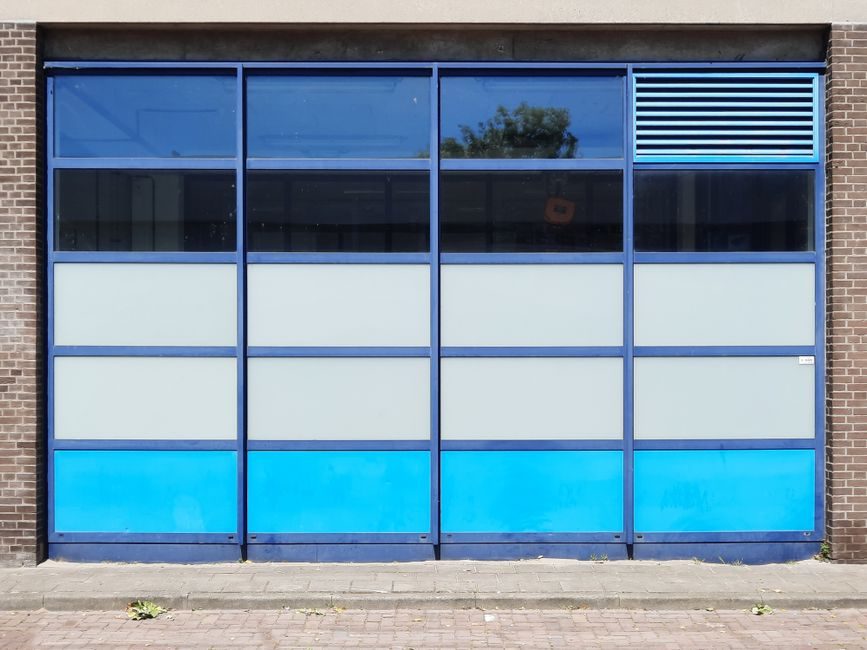
Curtain wall systems and metal curtain wall panels are both aluminum-dominated envelope families, but they sit at different points on the spec spectrum: unitized curtain walls ship as pre-assembled frame-and-glass modules sized to a single floor, while metal curtain wall panels (ACP, aluminum solid panel, honeycomb-backed cladding) ship as flat sheets that get fixed to a separate secondary structure on site [S1][S2][S3].
System window-door suites (also called window wall, unitized window-door systems) bridge the two: they use the same factory-prefab logic as unitized curtain walls but carry operable sashes and swing/sliding doors for residential and low-rise commercial envelopes, with typical module widths in the 1.2-1.8 m range per Chinese supplier catalogues [S1][S3].
Definition and Scope: What Each System Actually Is
Unitized curtain wall is a factory-assembled frame system in which mullions, transoms, glass or spandrel panels, gaskets and sometimes operable vents are pre-installed into a single cassette that is crane-lifted floor-by-floor and hung on pre-set anchors [S1][S3]. Guangya Curtain Wall & Window Door System lists unitized systems, stick curtain wall and window wall as three separate product lines on the same engineering platform [S3].
Metal curtain wall panel is the cladding skin: aluminum composite panel (ACP), single-sheet aluminum, aluminum honeycomb-backed panel and similar flat-stock products. Topbright and Made-in-China factory data put standard ACP sheet widths at 1220-1570 mm, lengths 2440-6000 mm, and aluminum skin thickness 0.06-0.5 mm over a PE or FR core [S2][S6]. The panel is a weather-and-decor skin; the load path is carried by a separate steel or aluminum sub-frame that the specifier must design independently.
System window-door is the operable cousin of unitized curtain wall: pre-glazed frames delivered with hinges, rollers, multi-point locks and weatherstrip pre-installed, then stacked vertically and horizontally on site. It is the dominant choice for residential towers under ~30 stories, hotel rooms and offices where natural ventilation is required by code [S1][S3].
Selection Criteria: Building Height, Wind Load, Panel Span
Building height is the first fork. Stick curtain wall is economical up to roughly 4-5 stories because all assembly happens on the scaffold; unitized curtain wall becomes cost-competitive from about 15-20 stories upward, where on-site labor cost for stick glazing outruns the factory-premium per module [S1][S3]. Above 30 stories unitized is the de-facto choice, with floor-by-floor install cycles of typically 200-400 m² per day per crew on Chinese supertall projects [S3].
Wind load and panel deflection drive the second fork. Unitized frames carry glass directly in the captured or SSG (structural silicone glazing) rebate, so mullion deflection under wind is limited by the framing section, not by the panel itself. Metal curtain wall panels do not carry glass: they ride on a separate sub-grid, and deflection is governed by the panel sheet thickness, stiffener spacing and the standing-seam or tray-fix pattern. ACP at 4 mm total thickness with 0.5 mm skins typically needs stiffener purlins at 600-900 mm centers; aluminum honeycomb panel at 25 mm total needs much less, often 1200-1500 mm spans for the same wind pressure [S2][S6].
Thermal performance is the third fork. Unitized curtain wall frames are now routinely built with thermal-break polyamide strips (typically 14.8-24 mm wide, fibreglass-reinforced PA66) achieving frame U-factors around 1.6-2.2 W/m²K for the frame-only zone. Metal panels carry thermal performance through the backing insulation (mineral wool 50-100 mm, k=0.035-0.040 W/mK), not through the panel face itself [S1][S3].
Who Each System Is For — and Who It Is Not

Specifying unitized curtain wall is justified for office towers, hotels and mixed-use buildings above ~15 stories, projects with tight construction schedules, or sites where on-site labor is expensive or scarce. Factory QC on a stationary jig beats field assembly for air-water-structural (AAMA/ASTM) test compliance [S1][S3].
Specifying stick curtain wall still wins for low-rise facades with complex geometry: atriums, sloped glazing, ribbon windows that wrap a corner. It is also the right call when the design keeps changing during construction; revising a stick frame is a drawing change, revising a unitized cassette is a factory re-tool.
Metal curtain wall panels are the right call for cladding a structural backup (concrete shear wall, steel column-and-slab, or a separate tube-frame) where the architectural intent is opaque, perforated, or 3-D formed (folded plate, louvre fin). They are not a substitute for a glazed envelope: ACP and aluminum solid panel are weather barriers, not daylight apertures. If daylight is the brief, you are back to a glazed curtain wall or a system window-door module with vision glass and operable vents.
System window-door is the right call for residential towers, serviced apartments, hotels and K-12/university dormitories. It is not a high-rise curtain wall: most window-wall systems top out around 30 stories of stack because they rely on floor-edge slab-to-slab spans and do not have a separate perimeter tube structure. Above that, switch to unitized curtain wall [S1][S3].
Criteria Comparison: Four Decision Variables Side by Side
On four decision variables the two families line up as follows. (1) Typical floor-to-floor module height: unitized curtain wall 3.0-4.5 m, system window-door 2.8-3.3 m, metal curtain wall panel N/A (cladding only, spans 0.6-1.5 m to sub-grid). (2) Factory pre-assembly content: unitized 80-95%, system window-door 70-85%, metal panel ~10-20% (panel is a finished good; framing is field-built). (3) Air-water-structural test basis: unitized and system window-door run AAMA 501 / ASTM E283/E330/E331 pre-qualification per project; metal panel systems rely on the cladding-only standards plus the structural backup designer's package. (4) On-site install rate: unitized ~200-400 m²/crew-day, system window-door ~150-250 m²/crew-day, metal panel ~300-500 m²/crew-day because no glass handling is involved [S1][S2][S3].
The trade-off is straightforward. Unitized and window-door carry their own framing and weather seal; the metal panel does not, so the cost of the secondary steel or aluminum sub-frame must be added to the specifier's apples-to-apples comparison. A bare ACP quote of US$15-30/m² [S6] understates the installed cost by 2-3x once the sub-grid, anchors, insulation and weather membrane are included; the equivalent pre-glazed unitized cassette is usually quoted inclusive of frame, glass and gaskets, with anchor brackets as the only major field item [S1][S3].
Material and Finish Spec Levers That Move the Price
Aluminum alloy grade is the baseline. 6063-T5/T6 is the extrusion default for both curtain wall mullions and window-door frames because of its extrudability and anodizing response; 6061-T6 appears where higher mechanical performance is needed (long-span transoms, seismic moments). Powder-coat finishes (PVDF, FEVE) are standard for exterior: PVDF 70% Kynar 500 / Hylar 500 base, typical 25-35 µm dry film thickness, with 20+ year chalk/fade resistance on properly pre-treated substrate [S1][S3].
For metal curtain wall panels, two spec traps repeat. First, ACP FR (fire-retardant) versus PE core: PE-core ACP is banned for tall-building external cladding in many jurisdictions after the 2017-2019 high-rise fire events; specifiers should require A2-s1,d0 or at minimum B-s1,d0 rated cores per EN 13501-1 for projects above ~18 m, with mineral-filled FR core as the typical commercial solution [S2][S6]. Second, skin thickness: the 0.06-0.08 mm skins common on price-driven ACP are too thin for flat-panel architectural sight lines; 0.30-0.50 mm skins are the architectural-grade baseline that holds panel flatness between stiffeners and survives wind cycling without oil-canning [S2][S6].
Hardware on system window-door suites is a different lever. Multi-point locking, hinge cycle ratings (typically 20,000-100,000 cycles for residential to commercial grades), and weatherstrip compression-set behavior drive both airtightness and call-back cost. Chinese OEM catalogues list duplex stainless 304 hardware as standard, with 316 as the coastal upgrade [S1][S3].
Failure Modes and Limits the Specifier Must Engineer Around
Unitized curtain wall and system window-door share a common limit: stack joint movement under seismic drift and thermal expansion. The standard stack joint uses a sleeve and EPDM gasket that absorbs ±10-15 mm of inter-story drift and accommodates thermal growth of the aluminum frame (24 × 10⁻⁶ /°C for 6063-T6) without losing water-tightness. Specifying inter-story drift demand higher than the gasket design range forces a sliding-head detail or a seismic-movement joint, both of which are project-specific engineering, not catalogue line items [S1][S3].
Metal curtain wall panel failure modes are different and mostly cosmetic or weather-tightness issues, not structural collapse. (1) Oil-canning: visible panel bowing between stiffeners, driven by skin/core differential thermal expansion, sub-grid tolerance stack-up, and over-driving fasteners. (2) Drum noise: wind-induced panel vibration at 0.5-3 Hz, fixable with stiffener density or constrained-layer damping. (3) Delamination of ACP: PE or FR core separating from skin under heat, almost always tied to skin-bonder quality or sustained temperatures above ~70°C, which can occur on dark-color south-facing facades [S2][S6].
A second shared limit is water management. Both unitized curtain wall and metal panel systems must integrate with the floor-slab fire-stop and air-barrier; field deviations at the floor edge are the most common source of leakage call-backs. The pre-engineered, pre-assembled nature of unitized and system window-door modules reduces this risk because the floor-edge interface is also pre-engineered; stick-erected metal panel systems on field-built sub-grid leave more room for installer error [S1][S3].
Standards, Sourcing and Project Application Signals
The standards baseline for unitized and stick curtain wall in most international projects is AAMA 501 (幕墙系统现场性能测试方法) plus ASTM E283 (空气泄漏), E330 (结构荷载), E331 (水渗透) for the four pre-qualification tests. European projects layer on EN 12152/12153/12154 (空气渗透/水密性/风压抵抗) and EN 14019 (幕墙抗冲击与抗冲击后残余变形). System window-door falls under EN 14351-1 (windows and doors - product standard) for CE marking, plus AAMA/WDMA/CSA 101/I.S.2/A440 (NAFS) for North American projects [S1][S3].
Metal curtain wall panels reference EN 13501-1 (防火等级) for the FR-core requirement, AAMA 2603/2604/2605 (有机涂层性能) for the PVDF paint system, and ASTM E84 (表面燃烧特性) for North American code compliance. The panel itself is tested per EN 13501 plus project-specific wind-load and impact tests once the sub-grid is locked in [S2][S6].
Sourcing is heavily China-anchored for both families. Topbright's SED series curtain wall, Guangya's unitized curtain wall, and the Made-in-China factory cluster (Curtain Wall Clading Factory and its peers) all export to North America, the Middle East, Southeast Asia and Africa, with SED case studies including the SPA-THE PIER Arizona project in the US [S1][S2][S3]. Unit pricing benchmarks from Made-in-China in mid-2026: ACP at US$15-30/m² FOB, aluminum solid panel at US$25-55/m² FOB, full unitized curtain wall at US$120-280/m² CIF depending on glass spec and frame finish [S6].
For the specifier choosing between these families, the decision-tree is short. If the brief is a glazed envelope above 15 stories with predictable floor plates, specify unitized curtain wall. If the brief is operable windows in a residential or hotel tower under 30 stories, specify system window-door. If the brief is opaque cladding on a structural backup, or a complex 3-D metal surface, specify metal curtain wall panels on an engineered sub-grid. Treating these as interchangeable is the single most common spec error in 2026 envelope packages, and it is the one that costs the most in field rework when a project is forced to cross families mid-design [S1][S2][S3].
For projects that also need a glazed entrance assembly or storefront alongside the curtain wall or panel cladding, the adjacent aluminum window-door and glass curtain wall product families cover the matching door and frame details; framing, finish and gasket families typically share the same PVDF coating line and the same EPDM suppliers as the panel system, which simplifies mock-up and QC across packages.
For related coverage, see Waterstop vs Modified Bitumen Membrane: 2026 Spec Cut for Concrete Joints and Deck.