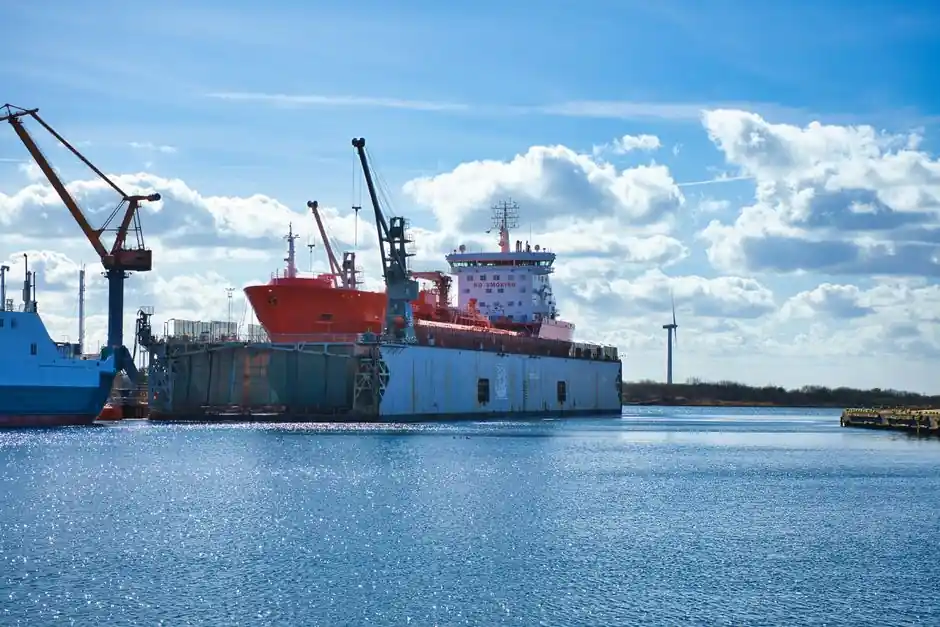
E-glass remains the workhorse reinforcement for marine composite structures, with a maximum tensile strength of about 2200 MPa and a strength-to-weight ratio that has kept it dominant since the post-WWII transition away from wood and corroding metals [S4].
Selection on a marine project is not a single parameter decision: it is a stack trade between fiber type, resin system, laminate architecture, fire/smoke performance, and class-society rules. Hulls, decks, gratings, radomes, and underwater enclosures all sit on the same family of reinforcements but use different sub-grades and finishes.
Fiber Type Comparison: E, S, C, AR, Basalt, and Carbon
E-glass, S-glass, C-glass, and AR-glass each occupy a defined slot: E-glass is the general-purpose baseline with balanced cost and mechanical performance, S-glass delivers higher tensile strength and better fatigue for racing and military hulls, C-glass offers improved chemical resistance for tanks and piping exposed to corrosive media, and AR-glass is reserved for cementitious matrices where alkali resistance is required [S4].
Beyond glass, marine decks and superstructures increasingly use basalt, aramid, and carbon hybrids where weight or stiffness is the bottleneck. The fiber selection framework on our reference index lays out the same four-axis decision (tensile, modulus, corrosion, cost) that shipyards apply on a daily basis. Basalt sits between E-glass and S-glass on cost and offers good fire and chemical behaviour; aramid brings impact toughness but absorbs moisture and is rarely used as the primary marine reinforcement; carbon gives the highest specific stiffness but at a price multiple that confines it to racing yachts, naval superstructures, and selective stiffeners.
Resin System Compatibility and Hydrothermal Behaviour
Thermoset matrices, especially epoxy and vinyl ester, dominate marine laminates because of their mechanical robustness, processing maturity, and proven long-term seawater resistance [S1]. Polyester is still common for low-cost hulls and non-structural parts, but vinyl ester is the default where osmotic blistering and hydrolytic stability are concerns, and epoxy is preferred for primary structural laminates and prepreg stacks.
Thermoplastic matrices such as PEEK and PEKK offer recyclability and better hydrothermal performance, but the higher processing temperature and cost keep them confined to niche submarine and offshore applications [S1]. For any marine spec, the resin choice is locked to the fiber sizing: an E-glass roving sold for epoxy prepreg is not a drop-in for a polyester hand lay-up, and the coupling agent (silane) on the roving must match the resin chemistry or the laminate will fail at the interface long before the fiber reaches its published strength.
Laminate Architecture: Woven Roving, Mat, and 3D Woven Textiles
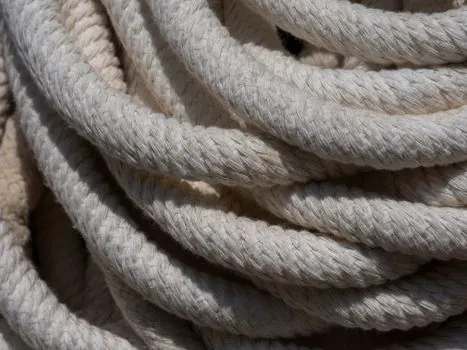
Within marine glass fiber textiles, woven roving is forecast as the fastest-growing product form through 2030, with boat hulls as the largest application segment and the Asia-Pacific region leading growth at a 4.3% CAGR from 2024 to 2030 [S5].
The shift is driven by manufacturing changes: 3D weaving and automated composite layup systems now deliver higher fibre-volume fractions, shorter cycles, and less waste than legacy hand lay-up with chopped strand mat [S5]. For a specifier, the practical reading is that a 3D-woven E-glass laminate delivers more isotropic strength and better impact tolerance than a stitched biaxial + mat stack at comparable areal weight, but the tooling cost and minimum order quantities still push it toward yards building in volume rather than one-off custom boats.
Failure Modes Engineers Must Spec Against
The five durability risks that drive marine glass fiber selection are seawater-induced degradation, moisture absorption, interfacial debonding, galvanic corrosion in FRP-metal hybrids, and biofouling [S1]. Each maps to a different spec line: moisture absorption pushes the choice toward vinyl ester or epoxy rather than polyester; galvanic corrosion drives the use of insulating barrier layers or non-metallic fixings wherever a stainless or coated steel fastener passes through a FRP laminate; and biofouling drives surface coating and gel-coat specification rather than the fiber choice itself.
Fire, smoke, and toxicity (FST) behaviour is a separate spec line that usually forces the resin rather than the glass selection. Class rules from Lloyd's Register, DNV, and the IMO FTP Code treat glass as essentially non-combustible reinforcement and focus the regulatory load on the resin system, the surface veil, and the laminate fire barriers. Specifiers working on naval or offshore topside structures should confirm the FST target (typically IMO FTP Code Part 2/5 or equivalent) before locking the reinforcement, because the same E-glass roving can sit inside a compliant or non-compliant panel depending on what is around it.
Where Glass Fiber Is the Right Call, and Where It Is Not
Glass fiber is the right reinforcement for patrol boats, yachts, ferries, offshore gratings and ladders, walkways, coastal infrastructure (seawalls, docks, fenders), radomes, sonar domes, and underwater equipment enclosures that need corrosion resistance plus acoustic or RF transparency [S3]. It is also the default for piping, ducting, valves, and other subsea structures that have been a steady composite application since the 1960s [S4].
Glass fiber is the wrong call when the design driver is absolute minimum weight at given stiffness, where carbon or carbon-glass hybrid will pay back despite cost; when the part is a highly loaded primary structural member with tight deflection limits, where carbon's modulus advantage is decisive; or when the part will see sustained temperatures above the wet glass transition of the chosen resin, where the reinforcement choice matters less than the matrix. Hybrid stacks (glass with selective carbon plies) are the usual compromise for high-end recreational and racing hulls, and the analysis on marine optical glass tradeoffs is a useful parallel for the same depth-rated, corrosion-loaded decision pattern.
Sourcing, Standards, and Trackable Signals
Procurement teams should require fiber certificates to a recognised standard (ISO 2078 for glass fiber composition, ASTM D578/D2343 for roving and yarn properties, and the relevant class-society rules such as DNV GL or Lloyd's Register for the end product) and resin system data sheets with confirmed compatibility with the fiber sizing supplied [S1][S4]. For any hybrid composite that includes engineering plastic inserts, non-metallic valves, or polymer piping components, the spec chain needs to be cross-checked against the same class rules, because a mismatch between the FRP and the polymer detail is a common audit finding.
Two signals to track over the next 12 months: published updates to the class-society rules on recycled glass fiber content in marine laminates, and field data on vinyl ester versus epoxy performance in warm-water service as more fleets move into tropical operating routes. The industrial flooring selection criteria piece follows the same spec-first, standard-anchored logic and is a useful cross-check for renovation yards standardising their FRP and grating bills of material.
Component reference pages worth checking: marine hvac.