For 3/8" (9.52 mm) 7-wire strand manufactured to ASTM A475, Extra High Strength grade carries a minimum breaking strength of 15,400 lbf (68.503 kN) at 4% minimum elongation, while Common grade on the same diameter is rated at only 4,250 lbf (18.905 kN) with 10% minimum elongation, a 3.6× strength delta and a 2.5× stiffness gap on identical geometry [S4].
That single spec sheet is the basis for every downstream decision on a guy line: hardware class, splice allowance, hand-forming on site, and which ANSI/TIA-222 or NESC loading case the anchor can absorb before yielding. EHS and Common are not "stronger and weaker versions of the same product"; they are different working materials with different installation rules, and the wrong choice either wastes money or leaves a tower under-tensioned for the next ice-loading event.
ASTM A475 Grade Stack: Five Strength Tiers on One Diameter
ASTM A475 standardizes zinc-coated steel wire strand into five named grades that share the same wire construction rules but diverge sharply on mechanical performance. For 3/8" 1×7 strand, the published minimum breaking strengths are Utilities (UTIL) 11,500 lbf, Common 4,250 lbf, Siemens-Martin 6,950 lbf, High Strength (HS) 10,800 lbf, and EHS 15,400 lbf; minimum elongations over a 24" (610 mm) gauge drop from 10% at Common to 4% at EHS as strength climbs [S4]. The inverse relationship between strength and elongation is the metallurgical signature of higher carbon content and cold work, not a manufacturing defect.
Zinc coating weight is graded independently of the strength grade, so the same EHS wire can ship as Class A at 0.85 oz/ft² (259 g/m²) or Class B at 1.70 oz/ft² (519 g/m²), which roughly doubles the corrosion reserve for the same breaking strength [S4]. National Strand publishes diameters from 3/16" 7-wire up to 1" 19-wire in their galvanized catalog, and EHS in 1/4" 7-wire construction is rated at 6,650 lbf breaking strength with a Class A coating as the standard offering [S2][S6]. Buyers who lock in the grade name without checking the coating class routinely under-spec corrosion allowance on coastal or industrial sites.
Why EHS Cannot Be Hand-Spliced: Carbon Content and Termination
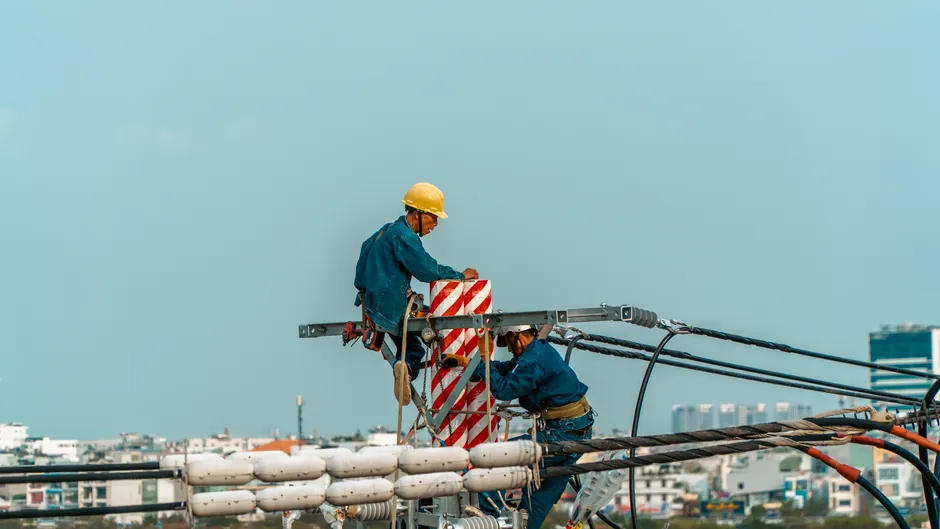
EHS guy strand requires dead-end grips or mechanical tensioners, not wrapped-and-taped splices, because the higher carbon wire is significantly harder and will not form a reliable hand splice without fracturing outer wires [S5]. Common grade, by contrast, is spliceable and can be wrapped around a thimble for terminations that a lineworker can complete in the field with hand tools, which is why utilities still stock Common for repairs, temporary guys, and anchor shacks where ultimate load is modest [S1]. The trade is not "more convenient vs less convenient" but "wrench-and-dispensable hardware vs hand-formed and inspectable," and that affects crew skill, kit weight, and outage time on every tower.
Madison Steel's process write-up confirms the material route: high-carbon steel wire rod is drawn through progressive dies, annealed for ductility, cleaned, and hot-dip or electro-galvanized before the seven wires are helically laid into the final strand [S3]. The annealing step is what gives Common grade its 10% elongation budget; EHS skips or shortens the final anneal to retain tensile strength, and that same microstructural decision is why field-forming EHS around a thimble is a crack-initiation event rather than a serviceable bend.
Corrosion, Galvanizing, and Where Common Grade Earns Its Keep

Galvanized coatings form a mainly zinc barrier that protects the steel substrate in atmospheric exposure, including rain, storm, and high humidity, which is why galvanized strand dominates utility, telecom, and overhead ground wire use over stainless in cost-driven builds [S7][S2]. For guy wire, overhead ground (static) wire on transmission lines, and messenger cable supporting communication conductors, the zinc layer is specified because it sacrificially protects cut ends and scratches, behavior stainless Type 304 cannot match [S2][S9]. Where stainless wins is bare corrosion resistance in chloride-rich or chemically aggressive atmospheres, but the published comparison is unambiguous: stainless is generally not as strong per diameter as galvanized, so any move to stainless typically requires upsizing the strand and re-checking anchor loads [S9].
For galvanized stock, the A475 Class A coating (0.85 oz/ft²) is the default and the one carried as standard on most EHS SKUs; Class B (1.70 oz/ft²) and Class C (2.55 oz/ft²) are the specified upgrade for coastal, industrial, or acidic-soil anchor conditions, and the coating class is selected independently of the strength grade [S4]. A common procurement error is to order "EHS galvanized guy strand" without naming the coating class, which lands Class A hardware on a site that needed Class B, and the resulting under-thickness zinc drives a 30-year replacement cycle down to 12-15 years in C4 atmospheres.
Selection Matrix: Match the Grade to Load Case and Crew
Specifying the right A475 grade comes down to four decision criteria, and the right answer changes case by case. EHS (15,400 lbf at 3/8") is the correct pick for permanent tower guys, transmission static wire on long spans, and any anchor where ice and wind load combinations push the line past 10,000 lbf service load, accepting the cost of dead-end hardware and factory-formed terminations [S4][S5]. HS (10,800 lbf) and Siemens-Martin (6,950 lbf) are the middle options for distribution guys, mid-span messengers, and temporary structures where the load case is real but not extreme; they accept standard strand fittings and give the lineworker more elongation headroom [S4].
Common grade (4,250 lbf) is the right pick for service drops, anchor guys on wood poles with modest loading, temporary guying during construction, and any repair where the lineworker needs to form a wrap splice or a thimble termination by hand [S1][S4]. UTIL grade (11,500 lbf) sits between HS and EHS and is the workhorse spec for many utility-pole guy sets where the utility's own distribution standard is written around it rather than around the ASTM strength names [S4]. If a crew is being asked to form EHS in the field, the answer is to stop and re-terminate with proper hardware, not to work the wire harder, because the wire will fail before the hardware does.
Standards, Hardware, and Procurement Checkpoints
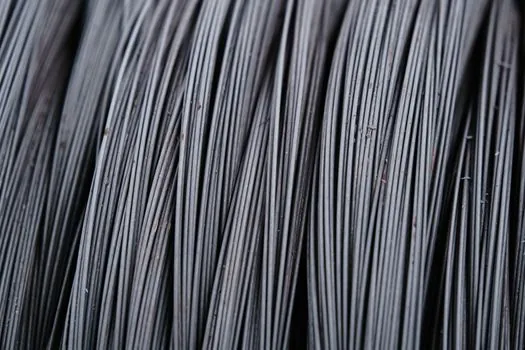
ASTM A475 is the controlling material standard for zinc-coated steel wire strand in this product class, and the grade names (Utilities, Common, Siemens-Martin, High Strength, Extra High Strength) plus the coating classes (1, A, B, C) are the two independent dials that have to both appear on the purchase order [S4]. Left-lay stranding is the default unless otherwise specified, and individual wire nominal diameter (0.120" on 3/8" 7-wire) ties the strand to a specific hardware family, so changing wire diameter mid-project invalidates the dead-end and grip SKUs already on the truck.
For a related engineering decision on galvanized strand versus higher-performance alloy wire in connector strip form, the spec tradeoffs shift toward conductivity and spring behavior, covered in a side-by-side BeCu vs phosphor bronze connector strip spec and cost comparison. For inspection thickness on heavy steel sections that anchor these guy lines, the kV range selection for thick steel castings write-up maps directly onto the anchor base and clevis quality checks that follow a guy-wire pull test. The next trackable signal on this product class is any ASTM A475 revision ballot that re-bins the elongation floors or adds a higher coating class, which would reset both the procurement template and the field-termination guidance above.
For the relevant spec sheets and selection criteria, see steel strand, prestressing strand, and alloy steel.