A defensible budget should account for the blade, cutting time, slab thickness, edge treatment, and risk of slab damage rather than rely on a fixed labor rate [S2][S4].
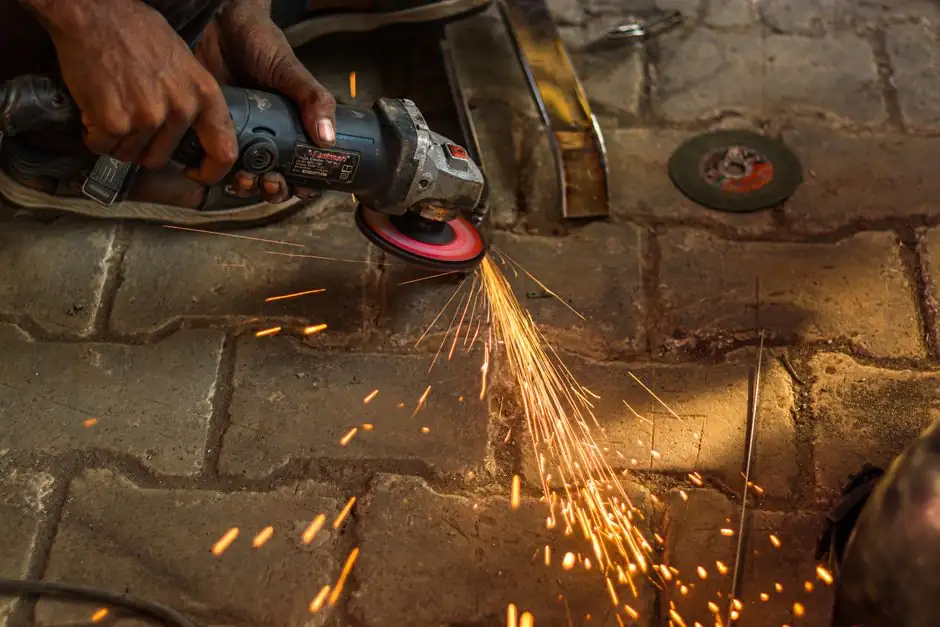
A 4-inch or 4.5-inch angle grinder with a continuous-rim wet/dry diamond blade can handle straight cuts in marble up to about 20 mm thick, while L-cuts, radius corners, and sink openings are better left to a fabricator with a CNC or bridge saw [S2].
What Cost Per Linear Meter Actually Includes
A valid linear-meter comparison must separate the cutting operation from slab supply, edge finishing, template work, sink openings, installation, and offcut loss. A 1 m cut through a 20 mm slab removes about 0.020 m³ of stone before kerf, while the same nominal length through a 30 mm slab removes about 0.030 m³ [S2][S4].
Stone shops may quote by square foot because diamond-blade wear depends on the quantity of material crossed by the cut. One historical example priced labor at $30 per square foot for a 7/8-inch-thick fireplace hearth [S4]. These figures are dated reference points, not 2026 quotations, but they explain why a length-only rate can conceal the main cost driver.
The usable conversion is material area divided by 144 in² per ft². A 1 m cut through a 20 mm slab presents about 1.31 ft² of cut area, so a $30/ft² labor reference would equal about $39.30 per linear meter before thickness multipliers, finishing, setup, or repair risk.
Blade and Machine Cost Drivers
Marble is best cut with a wet saw or angle grinder fitted with a continuous-rim diamond blade, and a 4-inch or 4.5-inch grinder can handle straight cuts in marble up to about 20 mm thick [S2]. Continuous-rim diamond blades cut without chipping, whereas segmented turbo blades cut faster but chip soft, crystalline materials such as marble badly [S2].
Blade life is the cost item that converts equipment price into cost per meter. Published market listings show new wet/dry granite, marble, and tile cutters at $80.99, which illustrates that a basic powered machine can cost less than the replacement blades and support equipment required for controlled stone work [S6]. An automatic edge-cutting machine for stone, granite, and marble is available as production equipment [S1].
For handheld work, an angle grinder or wet saw can handle a straight cut, but unsupported spans, poor clamping, or a missing water supply raise chipping and cracking risk. A 4-inch or 4.5-inch grinder is suited to marble up to about 20 mm thick, while a table-mounted wet saw gives better control for 20 mm slabs and a bridge saw is the production choice for full slabs [S2].
Handheld Versus Shop and Waterjet Cutting
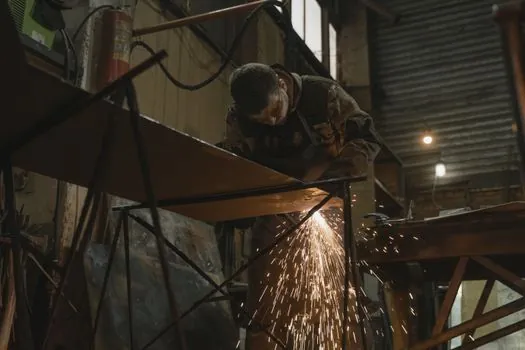
Handheld cutting wins when the job is short, straight, accessible, and tolerance permits a locally finished edge. Shop cutting wins where repeatability, square geometry, polished edges, sink cutouts, or liability for the original slab matter. Waterjet cutting is suitable for complex granite-cutting applications, can cut stone up to 12 inches thick, and uses a cold-cutting process that avoids heat distortion [S5].
The comparison below isolates the commercial and technical variables that determine unit cost. The figures are decision benchmarks, not universal quotations.
Handheld cutting has the lowest equipment entry cost, with blades at $15-$35 for a 4.5-inch grinder, but it carries the highest labor and breakage exposure. Shop cutting adds quoted fabrication charges, including $50-$150 per custom cut and $75 for a sink cutout, while providing controlled access to wet saws, bridge saws, templates, and edge-finishing equipment [S2]. A waterjet can cut stone up to 12 inches thick and performs the cut without generating heat, helping avoid heat distortion in granite [S5].
For a homeowner cutting one straight dimension, handheld equipment may be rational. For a contractor pricing a kitchen with multiple cutouts and polished edges, one shop fabrication event is generally easier to budget than separate handheld operations.
Labor and Throughput Behind the Meter Rate
For marble, score 1 to 2 mm deep first and then make the full pass at a feed rate of 20 to 30 mm/min while running water or a misting system to control dust and heat [S2]. At 20 mm/min, one linear meter of cutting occupies at least 50 minutes of active pass time, while 30 mm/min reduces that to 33 minutes 20 seconds. These are cutting-only times and exclude setup, repositioning, blade changes, polishing, cleanup, and inspection.
Labor should be valued at the full shop rate rather than at the tool feed rate. A machine that completes the pass in 40 minutes may still require 20 minutes for setup and 30 minutes for cleanup, edge work, or handling. Unsupported spans can cause cracking during the cut, and a failure at that point can turn a low hourly tool cost into a full-slab replacement event [S2].
Granite requires wet cutting to control heat and dust, while marble is calcium carbonate but still produces fine dust that is a lung irritant. An N95-rated respirator, eye protection, hearing protection, water supply, tape, straightedge, and full slab support are part of the cost of compliant work rather than optional accessories [S2].
Edge Finish, Access, and Failure Cost
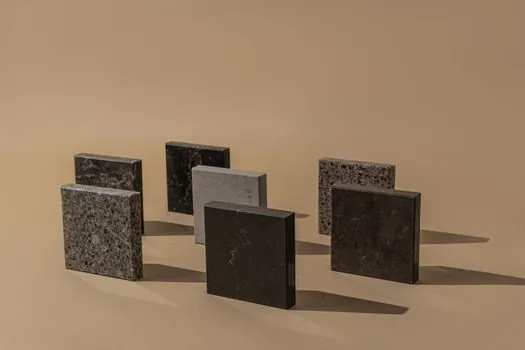
Edge treatment can move the quote more than the cutting pass itself. A fireplace example included a 1/8-inch roundover on a 7/8-inch-thick slab, while a 2023 fabrication guide positions continuous-rim diamond blades as the core consumable and identifies polishing or grinding as separate operations [S2][S4]. The comparison with angle grinder equipment is therefore incomplete unless edge finish is held constant.
Long cuts are economical only if the saw can travel over the full slab without unloading it. A 1 m straight cut through a 20 mm slab weighs about 56 kg per linear meter before the kerf, so a handheld operation needs a table or sufficient support to prevent the stone from shifting. If the slab cannot be supported, moving it to a fabrication shop may cost more than the cutting labor but still reduce total loss risk [S2][S4].
Waterjet cutting changes the failure profile. Its abrasive jet does not create the heat distortion associated with some mechanical cutting methods, and the process can produce a smooth edge without secondary finishing. The trade-off is a higher machine and operating system cost, with pressure selected according to granite thickness and uniformly sized garnet abrasive used for hard stone [S5].
Build a Comparable Cost Estimate
For a 1 m straight cut in 20 mm granite, record the blade price, machine depreciation, active cutting minutes, setup and finishing minutes, labor rate, water and power, abrasive or blade allowance, offcut loss, and expected rework. Use the published 20-30 mm/min feed band for marble as a baseline and treat granite as a separate field trial unless the blade supplier provides a validated feed rate [S2].
Compare three totals. The handheld total includes blade wear, consumables, setup, active cutting, cleanup, labor, and a risk allowance. The shop total includes fabrication labor, the quoted $50-$150 per custom cut where applicable, $75 for a sink cutout, and any separately priced polished edge [S2]. The waterjet total includes machine time, abrasive, water treatment, energy, and path complexity, with secondary finishing omitted only when the specification accepts the as-cut edge [S5].
Published price points support the equipment side of the estimate: $4,800 for an automatic edge cutter, $7,800 for a multi-blade granite machine, $80.99 for a basic wet/dry cutter listing, $15-$35 for a 4.5-inch turbo-rim blade, and $25-$60 for a 10-inch continuous-rim blade [S1][S2][S6]. These values cannot be divided directly into a universal meter rate because output, utilization, labor, thickness, finish, and breakage risk remain project-specific.
The next procurement check is a one-meter trial cut on the actual granite, using the selected blade and water supply, with edge finish measured separately. Record elapsed time, blade wear, chipping, water consumption, and total labor; without those five observations, any cost per linear meter remains a quotation rather than a controlled unit rate.