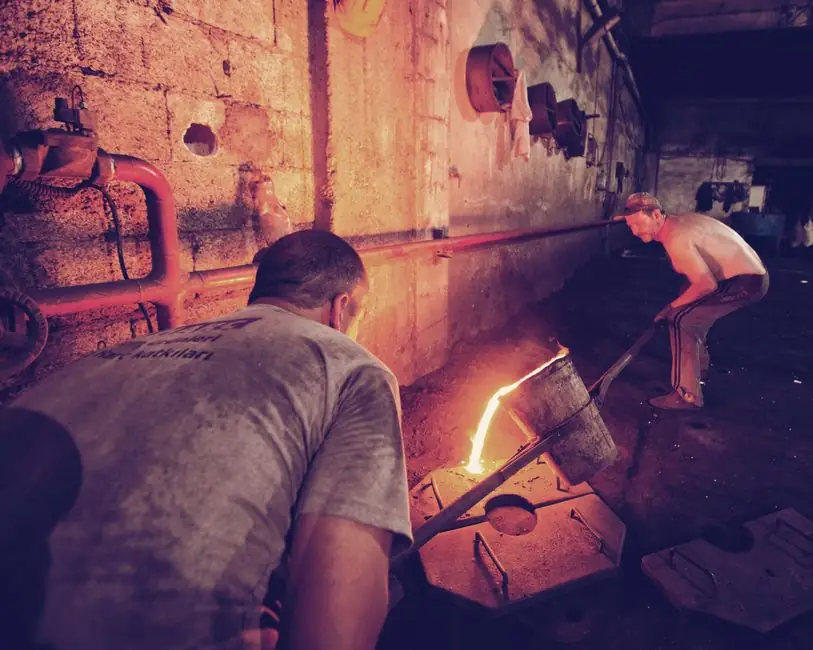
Gravity permanent mold casting fills reusable iron or steel molds without imposed pressure, while low-pressure permanent mold casting drives molten metal into the cavity from below through a pressure-controlled furnace.
Both processes suit aluminum permanent-mold work, but they differ in fill control, tooling complexity, thermal uniformity, and the production range where their added equipment can be justified.
Process Definition and Fill Mechanism
Gravity permanent mold casting uses gravity to fill a reusable iron or steel mold through a gating system. In static pouring, the mold remains vertical; in tilt pour, molten metal enters pouring cups and the mold rotates to make the cavity fill at a controlled rate [S1].
Low-pressure permanent mold casting also uses a reusable metal mold, but the cavity is filled from below under controlled gas pressure rather than by a free or tilted gravity head. Permanent-mold castings are generally more stable and repeatable than expendable-mold processes because the same metal tooling is reused [S1][S2].
The gravity die casting machine therefore represents a different production architecture from a low-pressure die casting machine: the former relies mainly on mold orientation and pouring control, while the latter requires a pressure vessel, pressurizing medium, and controlled metal delivery [S1][S2].
Fill Quality, Porosity, and Structural Performance
Permanent-mold casting uses slower, controlled filling, while die casting uses high-speed, high-pressure filling, a difference associated with expected porosity and mechanical properties [S2].
Permanent-mold tooling acts as a chill, and permanent mold and some types of die casting offer superior mechanical properties because of this effect [S5].
Low pressure is commonly the more controlled permanent-mold filling route, but the supplied material does not establish a universal porosity percentage or a guaranteed pressure-tightness rating. Those requirements should therefore be validated on representative castings with the selected alloy and gating system rather than inferred from the process name alone.
Tooling, Equipment, and Cycle-Time Trade-offs
Gravity permanent mold tooling generally has the simpler fill system and lower initial investment because it does not require the pressure vessel used by low-pressure equipment. Permanent-mold tooling is described as less expensive and simpler than high-pressure die casting tooling, while die casting requires higher-precision, pressure-resistant dies with more elaborate venting [S2].
Low-pressure casting adds capital complexity through the pressurized furnace and riser tube, but it removes the need to tip the mold for filling. Gravity and tilt pour use a simpler mold-handling arrangement, although tilt pour still needs controlled positioning during filling [S1].
No sourced cycle-time range was provided for either permanent-mold route, so a production claim should not be made without a foundry trial. In comparison with high-pressure die casting, however, both routes have slower filling and are more economically suited to medium volumes, while die casting is faster at high volume after its higher tooling cost is amortized [S2].
Comparison by Geometry, Volume, and Unit Economics
Permanent-mold casting is more efficient at medium volumes, and most permanent-mold castings are tilt poured using a gravity-fed, machine-controlled filling method [S2][S3].
Low-pressure permanent mold casting fills a reusable metal mold under low pressure, while gravity permanent mold casting fills it by gravity [S2].
Permanent-mold tooling is generally less expensive and simpler than die-casting tooling, and low-pressure permanent-mold machines provide a filling option without tilting the mold [S2][S1]. Die casting is usually associated with small parts and thin sections [S5].
Where Each Process Fits

Tilt pour is especially useful where controlled filling and sound castings justify mold rotation and metal-mold equipment [S4].
Low-pressure permanent mold is best reserved for a component whose geometry, thermal consistency, or internal quality requirement benefits from controlled filling and the production program can support the equipment investment. Typical documented aluminum grades poured by a permanent-mold producer include A356, 356, 319, 333, C355, 355, and 413 [S1].
The process is not the right choice for very low-volume prototyping or one-off validation. Below roughly 500 pieces per year, permanent mold has weak tooling return and expendable sand tooling is generally more suitable; a few thousand pieces per year makes permanent mold more defensible [S3]. A casting mold should also not be selected before the foundry confirms draft, minimum section, filling path, and core strategy.
Inspection, Validation, and Process Control
Permanent-mold aluminum castings can use metallurgical testing, X-ray inspection, liquid-penetrant inspection, and heat treatment within the supplier's process [S1]. The mold is coated with insulating or chill coatings before service, and coating condition is part of both heat-transfer control and casting quality [S1][S4].
Linear tolerance examples for aluminum permanent mold are 0.015 in for the first inch on features from the same side of the mold, plus 0.002 in for each additional inch. Concentricity starts at 0.025 in for diameters up to 5 in, adding 0.003 in per additional inch, while as-cast surface finish is typically 200 to 420 RMS [S3].
These figures are design guidelines, not acceptance criteria. Drawing tolerances, pressure leak limits, radiographic acceptance, alloy chemistry, heat-treatment response, and fill-temperature control must be established in the product specification and verified on production-intent samples.
Selection Rules for Procurement and Engineering

Specify gravity permanent mold when annual demand supports reusable tooling, the cavity can fill without excessive pressure, and the cost of tilt or simple pouring equipment is acceptable. Specify low-pressure permanent mold when controlled upward filling or thermal consistency has measurable value and the capital cost can be justified by production volume and quality risk [S1][S2].
Do not choose between them from cycle-time promises or generic porosity claims. Obtain a foundry process comparison covering annual volume, alloy, minimum wall, fill-path simulation, tooling price, cycle time, heat treatment, weld repair, and leak-test requirements. Prototype the selected route and document the acceptance criteria before committing to a production order.