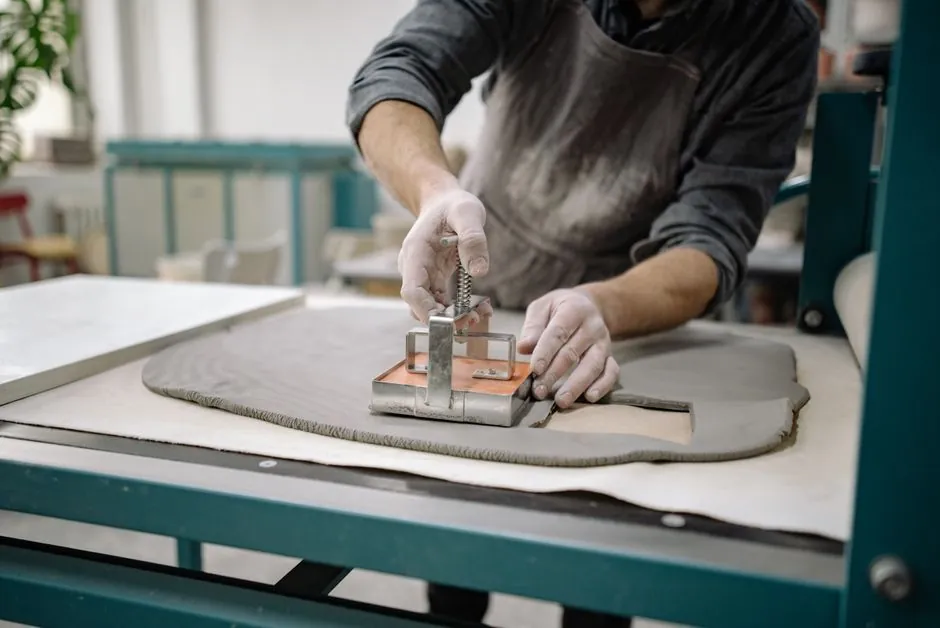
Ground mold base plates suit close-tolerance, low-roughness machining, while milled or rough-cut plates minimize initial stock removal and cost when the shop will perform major machining operations.
Mold base plates are used in injection molding, compression molding, and resin transfer molding, where plate size, steel grade, machining condition, and assembly tolerance determine downstream fit, workflow, and cost [S1][S3].
Ground vs rough or milled: what changes
A finished ground blank is supplied with a machined surface suitable for further machining to the mold maker’s drawing.
Rough, ground, and fully finished conditions describe different stages of plate preparation. Mac-Mold offers rough, ground, and finished plates, with further options including cooling channels, heating circuits, and fully 3D-machined bases [S3].
The practical distinction is stock removal and setup cost, not a different steel grade. A ground plate normally leaves less material to remove than a rough plate, while a fully finished or 3D-machined plate has more geometry completed before assembly [S2][S3].
Decision criteria for plate finish
PCS offers standard and rapid mold bases alongside special custom-order mold bases, and each product area is available as a shuttle base [S2].
Choose a rough or milled plate when the mold maker needs substantial material removal from a large plate, when several cavities or inserts will be machined into it, or when the supplier will perform custom roughing before finishing. Mac-Mold’s stated capacity includes plate handling up to 18 tons using horizontal boring, horizontal palletized machining centers, and bridge mills [S3].
For repeat production molds, base condition should be matched to the machining plan. A ground plate reduces the need to establish datum surfaces and clean up large areas, but it does not remove the need to machine pockets, bores, cooling passages, and cavity details [S1][S3].
Material grade and plate condition

Finish selection is separate from material selection. Mac-Mold offers mold bases with steel, stainless steel, aluminum, and P20 pre-hard steel [S3].
Hot-rolled steel, chrome-moly materials, and stainless steel are three broad mold-base material categories. P20 is pre-hardened steel, while stainless steel is one of the three general categories of mold-base material [S3][S5].
Ground surfaces do not eliminate heat-treatment or stress-relief requirements. Plate selection must account for material, final geometry, machining sequence, and assembly fit, particularly because excessive stock removal can release residual stress [S3][S5].
Who should use each finish
Ground plates are appropriate for mold makers that value predictable reference surfaces, small machining allowances, and accurate assembly features. Mac-Mold provides mold bases for prototype molds and can supply a basic plate order or an A-Series base with or without inserts [S3].
Rough or milled plates are appropriate for high-volume machining capacity, large custom molds, and designs with deep cavities or extensive insert layouts. The supplier can rough, cut, grind, machine, plumb, wire, and assemble a custom base to the drawing [S3].
These finishes are not the right choice when the supplier lacks the capacity to remove the planned stock cleanly. A rough plate with insufficient machining allowance can leave insufficient material for the specified features, while an already-ground plate can require extensive rework if the original geometry does not match the mold design [S2][S3].
Failure modes and inspection controls

The main ground-plate risk is treating the ground surface as a finished datum without confirming flatness, parallelism, stress condition, and actual stock. Inspection should verify critical tolerances, assembly fit, cleanup, and component installation before final inspection [S3].
The main rough-plate risk is assuming that nominal dimensions guarantee adequate machining stock. Any local thinning, waviness, or insufficient depth can leave a feature below its required wall thickness or fail to reach the specified tolerance [S2][S3].
Mac-Mold’s quality-control program monitors critical tolerances, proper assembly, fit-up, cleanup, and component installation through final inspection [S3].
Cost and lead-time tradeoffs
Cost follows the operation sequence: rough stock costs less, grinding costs more, and fully 3D machining, cooling, heating, plumbing, wiring, and assembly add further work [S2][S3]. The cheaper plate is not necessarily the cheaper mold when the machining rate, fixture time, and rework risk are included.
PCS distinguishes standard, rapid, and special custom-order mold bases, and each product area is available as a shuttle base [S2].
The most economical choice is therefore the least-finished condition that reliably supports the drawing. For a standard base, use a ground blank when the shop will machine the required details. For a large custom base with extensive stock removal, start rough and complete machining under one controlled workflow [S2][S3].
Sourcing specification checklist

A purchase specification should state plate condition, material grade, dimensions, thickness tolerance, parallelism, flatness, machining allowance, and which faces require finishing. It should also identify datum surfaces, hole positions, guide-bushing fits, and the required plate-to-plate alignment before the base is assembled [S2][S3].
Request inspection records tied to those drawing requirements and require the supplier to define whether the quoted condition is ground blank, rough-cut plate, fully machined plate, or an assembled mold base. Mac-Mold describes quality control across critical tolerances, assembly, fit-up, cleanup, and final component installation [S3].
The final call is straightforward: specify a ground plate for lower machining burden and close setup control; specify a rough or milled plate for heavy stock removal and custom geometry. Confirm the condition against the actual mold-making plan, not against the plate price alone [S1][S2][S3].