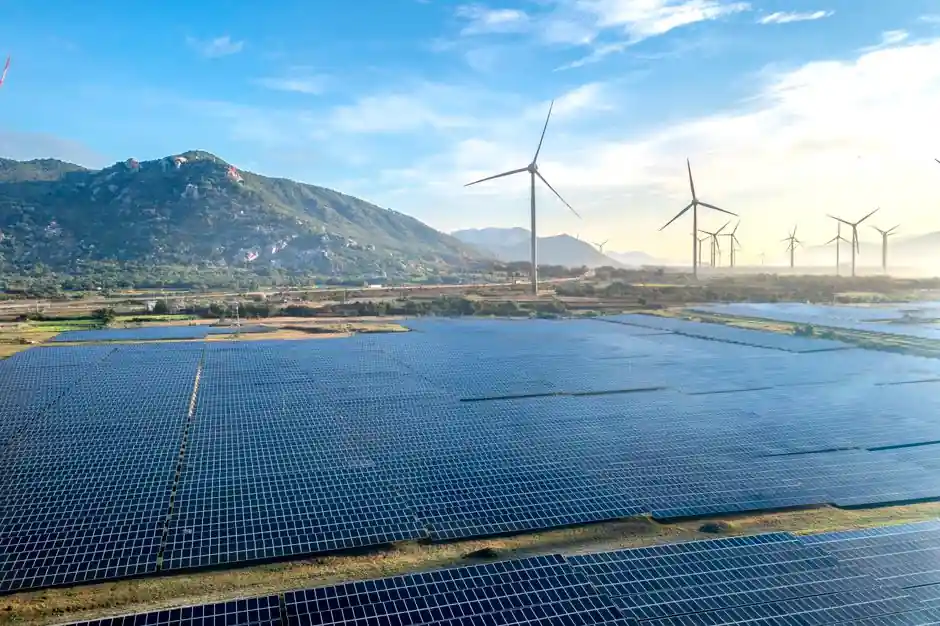
Global green hydrogen demand is forecast to reach 10.78 million tons by 2031, up from 0.47 million tons in 2026, an 87.12% CAGR that reframes electrolyzer capacity from a pilot market into a commodity-scale industrial input [S1].
Demand is bifurcating by region: Asia-Pacific held 48.23% of 2025 volume while Europe is projected to post the fastest regional CAGR at 94.19% through 2031, with refining at 35.45% of 2025 share and chemicals expanding at a 97.22% CAGR [S1]. The headline number masks a harder execution layer in the EU, where the binding constraint has shifted from announced electrolyser capacity to contracted offtake at terms that keep debt service coverage intact [S4].
Volume baseline and technology mix heading into 2026
Alkaline electrolysis captured 55.13% of 2025 green hydrogen volume, while PEM technology is forecast to post a 92.35% CAGR through 2031, reflecting demand for higher current density and dynamic load-following on curtailed renewable power [S1]. Refining still anchors near-term demand at 35.45% of 2025 share, but chemicals (97.22% CAGR to 2031) and green-ammonia bunkering are pulling the curve forward as maritime fuel rules take effect [S1].
Five electrolyzer manufacturers still handle the majority of orders, which keeps competitive intensity moderate; Chinese alkaline units are pressuring margins and may reset price expectations once export volumes scale [S1]. A typical flow meter specification on a new electrolyzer skid has to handle hydrogen at 30-80 bar outlet with 0.5-1.5% uncertainty, since custody transfer in offtake contracts is increasingly tied to metered mass rather than nameplate throughput.
China 15th Five-Year Plan: five-fold hydrogen expansion under dual carbon control
China's 15th Five-Year Plan, agreed in March 2026, explicitly targets a five-fold expansion of green hydrogen production over 2026-2030, with green hydrogen and new-type batteries ranked among the top 10 priority new industries [S2]. The plan anchors the move to dual control of carbon, including absolute carbon emission control, even though the headline intensity target eased to 17% from 18% in the 14th FYP [S2].
Industrial decarbonization language in the 15th FYP is described as lacking ambition by independent analysts, focusing on relocating production toward high-renewable regions and new green industrial zones rather than mandating absolute cuts [S2]. Annual green energy additions are projected to fall by more than half compared with the 14th FYP, while fossil fuel energy consumption is expected to rise 8-10% over the same window, a context that makes electrolyzer siting decisions and PPA economics more important than central quotas [S2]. The Environmental and Ecological Code, passed on 12 March 2026, codifies more than 30 laws into one umbrella and will shape enforcement of green-hydrogen project compliance over the plan period [S2].
EU offtake economics: from announced capacity to contract-and-constraint ramp
EU green hydrogen underwriting in 2026-2030 is now governed by a contract-and-constraint ramp model rather than nameplate utilization, with permits-to-offtake conversion, grid access sequencing, and renewable supply shape treated as the primary risk variables [S4]. The European Union's own enabling-conditions assessment estimates at least 700 heavy-duty hydrogen refuelling stations are needed to support meaningful fleet transition, a figure that frames the long-tail infrastructure capex behind offtake contracts [S3].
Key citable underwriting signals: when contracting lags permitting, downside hits DSCR timing first; when compliance proof becomes a contract condition, projects with fragile audit pathways stall even under strong policy headlines; when grid connection sequencing slips, commissioning becomes staged and LD exposure rises [S4]. The base case should anchor to contracted volume economics, not merchant upside, because merchant-dependent ramps become brittle under power price stress [S4]. For industrial offtakers, this shifts specification weight toward pressure transmitter accuracy classes and industrial valve sealing materials that survive variable H2 purity and pressure-cycling profiles, not just nominal pressure ratings.
Mobility pull: hydrogen trucks and the demand side for fuel cells
Global hydrogen truck market revenue is projected to grow from USD 2.80 billion in 2025 to USD 6.97 billion by 2030 at a 20.00% CAGR, with Europe as the largest market and long-haul freight as the fastest growing application [S3]. Cumulative global hydrogen fuel-cell truck deployments remained below 13,200 units by end-2025, and Hyundai's XCIENT programme reported 165 trucks deployed across five European countries as of January 2026 with over 20 million cumulative kilometres driven [S3].
Heavy-duty, long-haul applications remain the primary use case where extended range and fast refuelling beat battery-electric alternatives, while fuel-cell system and vehicle chassis costs stay grant-dependent in most current commercial deployments [S3]. This is consistent with the EU heavy-duty station requirement and with maritime demand for green ammonia bunkering, where fuel-cell and stationary power both depend on the same offtake pipeline. Independent sizing of this truck market is deliberately bottom-up from verified fleet data rather than top-down extrapolation, since registration systems in most countries do not reliably separate hydrogen fuel-cell trucks from other zero-emission powertrains [S3].
Decision criteria: which green hydrogen projects clear 2026-2030 underwriting
For a project to clear IC screens over 2026-2030, four criteria have moved to the front of the checklist: enforceable volume floors in offtake contracts, audit-ready compliance pathways under additionality rules, grid connection sequencing with a defined queue position, and a power-supply shape model that treats renewable volatility as a core variable rather than a flat cost [S4]. Projects relying on merchant upside to justify ramp are explicitly flagged as having brittle financing under stress, and EPC screens are linking queue delay bands to covenant calendars to size LD exposure [S4].
On the supply side, the 87.12% global volume CAGR is heavily dependent on renewable LCOE declines in high-irradiance regions (estimated +18.5% impact on CAGR), EU industrial decarbonization mandates for steel and fertilizer (+17.2%), maritime fuel rules for green-ammonia bunkering (+16.1%), electrolyzer gigafactory scale (+15.8%), and curtailed wind/solar PPAs enabling near-zero input H2 cost (+14.3%) [S1]. The combination of China's five-fold policy push and EU contract-and-constraint underwriting means that engineering specification effort in 2026-2030 should weight pressure sensor and PLC selection toward dynamic load-following, hydrogen-embrittlement-resistant materials, and audit-grade telemetry rather than nominal process ratings.
What to track through 2027: bankable offtake, station build, and Chinese export pricing
Trackable signals for 2026-2030: the count of EU projects converting permits into bankable offtake with enforceable volume floors, the actual commissioning curve of the 700+ heavy-duty hydrogen refuelling stations flagged in the EU enabling-conditions assessment, and Chinese alkaline electrolyzer export pricing once volumes scale beyond the domestic five-fold target [S4][S3][S2]. The first signal determines which 2026-2027 projects keep DSCR intact; the second determines whether heavy-duty truck deployments cross the 13,200-unit baseline meaningfully; the third determines whether global LCOH curves bend in line with the 87.12% volume forecast or stall at the alkaline-versus-PEM margin line [S1].
Natural gas production capacity planning decisions in incumbent refining hubs will increasingly co-evolve with green hydrogen siting, since blue-grey displacement economics depend on the same offtake and metering infrastructure layer.