Green hydrogen is defined as hydrogen produced by electrolysis of water using electricity sourced from renewables such as wind, solar, hydro-electric, and nuclear, splitting H2O into separate hydrogen and oxygen streams at the stack outlet [S1].
The resulting hydrogen feeds material handling equipment such as forklifts, stationary power systems, and ammonia synthesis applications [S1][S6]. The U.S. Department of Energy's 2022 IRA framework set a public target of 10 million metric tons per year of green hydrogen by 2030, backed by a production tax credit of up to $3/kg for the lowest-carbon pathways.
Electrolyzer Technologies: Alkaline, PEM, Solid-Oxide Side-by-Side
Three electrolyzer architectures dominate the 2026 commercial pipeline: liquid alkaline, proton exchange membrane (PEM), and solid-oxide (SOEC) — each with a different operating temperature window, current density, and catalyst load [S4].
Liquid alkaline cells run at 60–90 °C with a 25–30 wt% KOH electrolyte and nickel-based catalysts, delivering 0.2–0.5 A/cm² and stack lifetimes commonly quoted above 80,000 hours, which is why most multi-hundred-MW projects signed in 2024–2025 still anchor on alkaline for the baseload [S4]. PEM stacks operate at 50–80 °C, push 1.0–2.5 A/cm², and use platinum-group catalysts on the cathode plus iridium oxide on the anode — the iridium load is the supply-chain pinch point flagged in recyclability studies [S4]. SOEC units push to 700–850 °C and exploit waste-heat integration to push stack efficiency above 80% LHV in published reviews, but their commercialization trail is still pre-GW.
Process Map: Water Treatment, Stack Train, Gas Drying, Compression
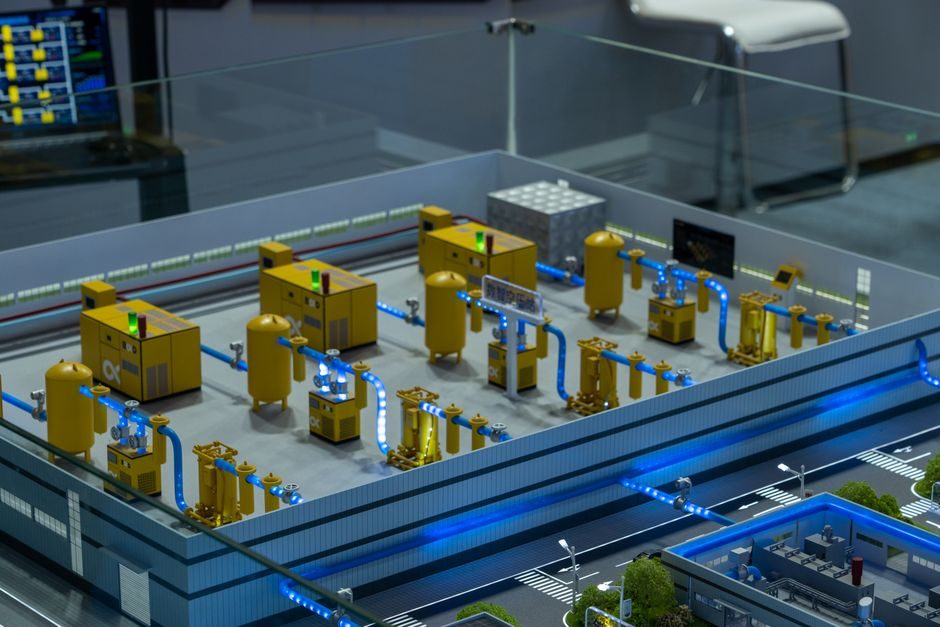
A green hydrogen plant is not "an electrolyzer in a field" — it is a multi-block process with deionized-water polishing, the stack hall, a PSA or membrane gas-separation train, and a compression or liquefaction block whose flow meter and pressure transmitter population dominates the I/O count [S5][S3].
Feed water is first demineralized to below 1 µS/cm (often to ASTM D1193 Type II or better) to protect membrane lifetime; the electrolyzer then splits roughly 9 kg of water per kg of H2 produced, with co-produced oxygen vented or liquefied for medical/industrial sale. The hydrogen stream leaves the stack water-saturated, passes through a knock-out drum, and goes into a pressure-swing adsorption unit that brings purity to 99.99%+, before the industrial valve manifold feeds either a diaphragm compressor (up to ~200 bar for trailer loading) or a piston compressor (450–900 bar for refueling stations) [S5]. Plug Power's published reference projects pair GenEco electrolyzer skids with dedicated liquefier blocks where end-use is mobility, indicating that cryogenic storage is now a default option for any site shipping more than 10 t/day [S1].
Selection Criteria: Purity, Turndown, Footprint, Catalyst Risk
Buyers in 2026 are scoring electrolyzers on four engineering axes that map directly to total installed cost: H2 purity at stack outlet, turndown ratio (the minimum load the stack holds without tripping), footprint in m² per MW, and the multifunction process calibrator burden during stack commissioning [S2][S3].
Alkaline wins on catalyst cost and lifetime but loses on turndown — most units must stay above ~25% of nameplate to avoid hydrogen-in-oxygen crossover faults; PEM swings 0–100% in under 10 seconds, which is why utility-scale projects pairing solar PV directly with electrolysis almost always specify PEM for the variable-load block and alkaline for the baseload block [S4]. SOEC's high temperature window lets it consume waste heat from upstream steel or ammonia units, but the hot-box balance-of-plant pulls footprint per MW in the opposite direction until stack sizes cross 5 MW per unit.
Plant Scale, Subsidy Stack and Offtake Reality
The U.S. Regional Clean Hydrogen Hub program allocated $7 billion in 2023 across seven regional hubs, each designed around a captive offtake — refining, ammonia, methanol, or direct-reduction iron — to absorb multi-hundred-tons-per-day output. [S1]
The IHEC demonstration zone in Baotou, Inner Mongolia, is a concrete example: the project, led by the International Hydrogen Energy Centre with UNIDO support, is designed to feed green hydrogen into green-ammonia synthesis, the same downstream model Plug Power's North-Sea HOPE project uses to bind electrolysis output to a single industrial sink [S6][S1]. Analysts on both sides of the subsidy debate — including a 2024 Manhattan Institute critique — note that the binding constraint on plant economics is no longer electrolyzer capex (which has fallen roughly 30% between 2022 and 2025 across alkaline and PEM) but the bankability of the renewable power purchase agreement behind the meter.
Failure Modes, Safety and Standards Reference Frame
Plant safety cases for green hydrogen follow the IEC 60079 family for hazardous-area zoning (the vent stack and PSA are almost always Zone 1, Group IIC) and ASME B31.3 for the process piping that carries the wet H2 stream from stack to dryer [S2][S5].
The most-cited failure modes in 2024–2026 incident reports are membrane dry-out during sudden load steps, hydrogen embrittlement of high-strength fittings downstream of the compressor, and oxygen-side hotspots in alkaline cells operated below their minimum current density [S4]. Recyclability studies on PEM stacks have flagged iridium and platinum recovery rates below 50% at current end-of-life processing routes, which is one driver behind the push for closed-loop catalyst refining contracts signed alongside new electrolyzer orders [S4].
Instrumentation, Controls and the Digital Thread
A 100-MW green hydrogen plant typically carries 1,500–2,500 I/O points, dominated by the pressure transmitter count on the gas train and the Coriolis flow meter loops on water and product hydrogen — that ratio is what drives the engineering-data-platform conversation more than the stack itself [S3][S5].
EPCs and owner-operators are now standardizing the data model across FEED, commissioning, and operation on a single object-oriented platform so that the same tag database feeds the multifunction process calibrator loop sheets, the HAZOP register, and the operator HMI — Topsoe has reported around 10% cost savings after consolidating onto such a platform, and similar numbers are showing up in Sunfire's high-temperature-electrolysis module factory [S3].
The 2026 build-out will turn on three trackable signals: the cadence of large-scale alkaline + PEM hybrid trains signing 25-year offtakes, the publication of a bankable standard for SOEC hot-box inspection, and the first commercial-scale platinum-group catalyst recovery plant commissioning in parallel with a multi-GW electrolyzer deployment. For downstream manufacturing, the lessons from cell-stack assembly and MEA integration in adjacent fuel cell stack manufacturing lines are being ported directly into PEM electrolyzer dry-room layouts, and the same data-centric engineering backbone is being applied to anode material manufacturing for next-generation alkaline cells.