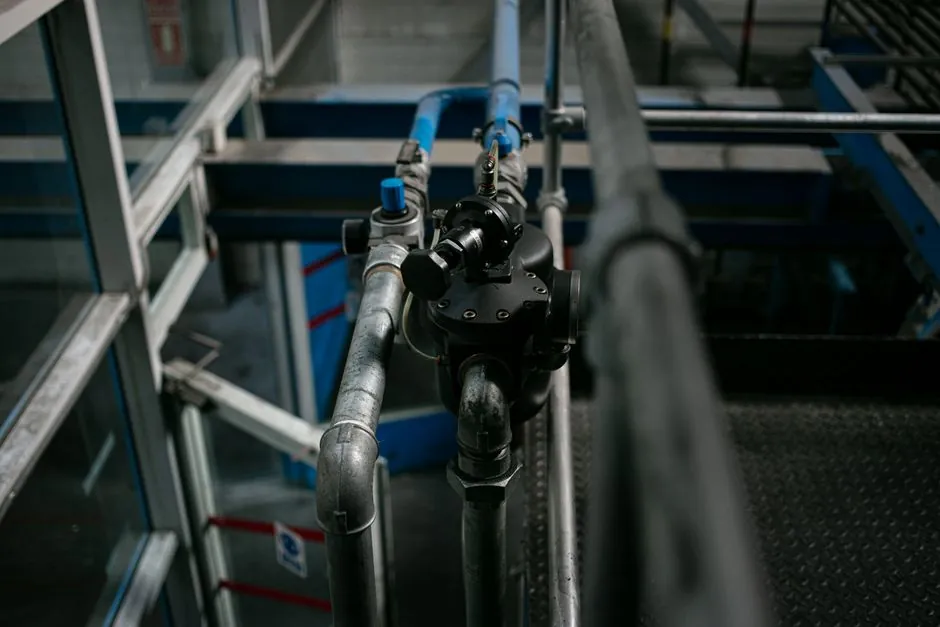
On a fire sprinkler main, a grooved-end butterfly valve installs roughly three times faster than a wafer type and can be removed as a drop-out unit without spreading the pipe, while a wafer butterfly valve cuts face-to-face length, weight, and unit cost where flanges are already in the run [S2].
Both styles are quarter-turn supervised control valves listed for fire protection, typically rated to 300 PSI (about 21 bar) and supplied with ductile-iron bodies, EPDM seats, and a supervisory (tamper) switch that ties into the building fire alarm per NFPA supervising-station requirements [S4][S7]. A quick look at the butterfly valve reference confirms why the body geometry, not just the connection, drives spec choices on a sprinkler system main.
Connection Geometry and How Each Valve Seats
A wafer butterfly valve is a flangeless, thin-profile body that is sandwiched between two pipe flanges; long through-bolts compress the valve against the flange faces and the EPDM seat to form the seal, with no tapped holes in the valve body [S2][S4]. A grooved-end butterfly valve is dimensioned to drop between two roll-grooved pipe ends and is locked in by a two-bolt victaulic-style mechanical coupling that houses an EPDM gasket and engages the pipe grooves [S2][S5].
For fire-protection duty the body is almost always ductile iron to handle the coupling bolt load or the flange clamp load, with a disc in ductile iron, bronze, or stainless steel and a vulcanized EPDM liner that carries the UL/FM listing on most 2.5 in to 12 in (DN65 to DN300) sizes [S4][S7]. The fire-protection variant also requires a factory- or field-installed supervisory switch so the open/closed position can be monitored at the fire alarm control unit, a requirement that applies to both wafer and grooved bodies and is independent of the connection style [S4].
Installation Speed, Labor, and Pipe Handling
Wafer valves require accurate alignment of two flanges, two gaskets, and the body, plus a star-pattern bolt torque to seat the EPDM liner evenly, which is the slowest step on any 6 in or larger run [S2]. Grooved valves cut that step out: a single coupling housing with two bolts clamps the joint, and field installation time is reported at up to 3x faster than an equivalent flanged wafer assembly [S2].
On long sprinkler mains in occupied buildings, the labor saving is the single biggest cost argument for grooved, because most fire-protection pipe is already roll-grooved to speed hanger spacing and cut-in work. For more on the trade-off between rubber sealing geometry and bolted-joint discipline, see the Shore A gasket selection chart. Where the main transitions to flanged equipment (fire pump, check valve, OS&Y gate valve), the contractor usually keeps a wafer butterfly in that short flanged spool, so a single project routinely mixes both styles on the same riser [S2][S4].
Space, Weight, and Hanger Load
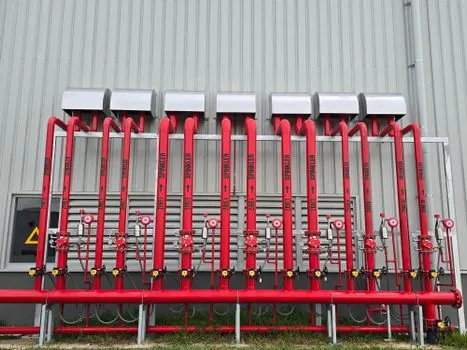
The wafer body is the shorter, lighter option, and on crowded pump-room skids, retrofit work, or above-ceiling risers the compact face-to-face dimension often makes it the only practical fit [S2][S4]. A grooved joint, by contrast, needs extra clearance for the coupling housings, which increase the outer diameter at every valve and fitting, so layout drawings need more swing room around the valve and the handle or gear operator [S2].
On hangers, the weight difference is real but modest: a 6 in (DN150) ductile-iron wafer typically runs lighter than its grooved counterpart because the body is shorter, and that weight hits the pipe support directly. A fire pump room that already calculates hanger spacing for a heavy OS&Y riser can usually accept either valve without re-engineering the supports, but a ceiling-hung sprinkler main on long rod hangers is a different problem, and the wafer body is the lower-load choice [S2][S4].
Maintenance Access and Future Alterations
Removing a wafer butterfly from a live main is painful: the system must be drained (or isolated and a bypass opened) and the upstream and downstream flanges spread apart to clear the body, which usually means moving the pipe [S2]. A grooved butterfly is a true drop-out, the couplings are unbolted and the valve slides out of the line, and the rest of the grooved main stays undisturbed, which is why maintenance-heavy facilities (data centers, hospitals, warehouses with frequent tenant fit-outs) prefer grooved [S2].
For tamper switches, the supervisory contact on either valve type should be ordered with the valve and wired back to the fire alarm control unit as a supervisory signal, not an alarm, and the switch must be tested annually per the same NFPA supervisory rules that apply to any fire safety control valve [S4].
Pressure Rating, Approvals, and Code Fit

Most fire-protection butterfly valves in the 2.5 in to 12 in range carry a 300 PSI (about 21 bar) working pressure rating and are UL Listed and FM Approved for fire service when ordered in the dedicated fire-protection SKU, not the general industrial SKU [S4]. The listing governs body material, seat elastomer, disc, shaft, and tamper-switch arrangement, and it is what allows the AHJ to accept the valve on a supervised sprinkler or standpipe system under the applicable NFPA installation standard [S1][S4].
Wafer and grooved bodies are typically listed to the same 300 PSI pressure class in the fire-protection catalog, so pressure rating is rarely the deciding factor; the deciding factor is the connection already on the pipe, flanged or grooved, because mixing styles means adding a flange adapter or a grooved flange adapter at the valve, which costs more than picking the right body in the first place [S2][S4]. As one OEM guide puts it, the body of a grooved fire-protection butterfly is ductile iron to withstand the forces exerted by the coupling, which is also why field-swapping a wafer into a grooved run without a proper grooved flange adapter is a leak path waiting to happen [S7].
Decision Matrix: Wafer vs Grooved on a Sprinkler Main
Across the four decision criteria that drive most project specs, wafer and grooved butterfly valves line up as follows on a fire-protection main. (1) Connection fit: wafer requires flanged pipe, grooved requires roll-grooved pipe; trying to mismatch either style costs a flange adapter and two extra gaskets [S2][S4]. (2) Installation speed: grooved is up to 3x faster on the joint itself, wafer is slower because of the flange alignment and star-pattern torque [S2]. (3) Maintenance: grooved is drop-out, wafer requires draining and spreading the pipe; grooved wins on retrofit-heavy sites [S2]. (4) Space and weight: wafer is the shortest, lightest body and fits tight pump-room skids and ceiling-hung risers; grooved needs coupling clearance [S2][S4]. (5) Unit cost: wafer is generally the lower list price for the same size and pressure class, grooved carries a coupling premium but offsets it in field labor on large mains [S1][S6]. (6) UL/FM and tamper switch: both styles are available in UL/FM-listed fire-protection SKUs at 300 PSI with supervisory switches, so approval is a wash [S4].
Pick grooved when the main is roll-grooved, the schedule is tight, and future valve replacement or system alteration is expected. Pick wafer when the main is already flanged (pump suction and discharge, check-valve spools, OS&Y risers), the pump room is space-limited, or the budget favors lower unit cost over labor savings [S2][S4][S6].
When Neither Is the Right Answer

Neither style is correct on a fire-service main that exceeds 12 in or that needs a dead-end shutoff without downstream restraint: in those cases the project spec moves to a lug butterfly (threaded bolt holes, dead-end duty) or a fully flanged gate or OS&Y valve per the AHJ [S4]. A wafer butterfly also should not be specified as the last valve before a closed system if the downstream pipe cannot take the full pressure differential when the disc is closed, because the wafer body has no independent bolted lugs to lock against the pipe, and the flanges alone have to react the line pressure [S2].
For chemical or seawater fire mains, the EPDM seat that ships standard on most UL/FM fire-protection bodies may not be acceptable, and the project should step up to a fully lugged or double-flanged body with a seawater-rated elastomer, again independent of the wafer-vs-grooved decision [S4].
Trackable Signals to Watch
Three signals on a 2026 project spec will tell you whether the wafer-or-grooved debate has shifted: (1) more AHJs accepting UL/FM-listed wafer bodies on fire-pump discharge where grooved used to be required by default, (2) more contractors standardizing on a single connection style (grooved) for the entire riser to cut the flange-adapter count, and (3) the next revision of the governing NFPA fire-protection installation standard clarifying supervisory-switch wiring on wireless tamper switches. [S4]