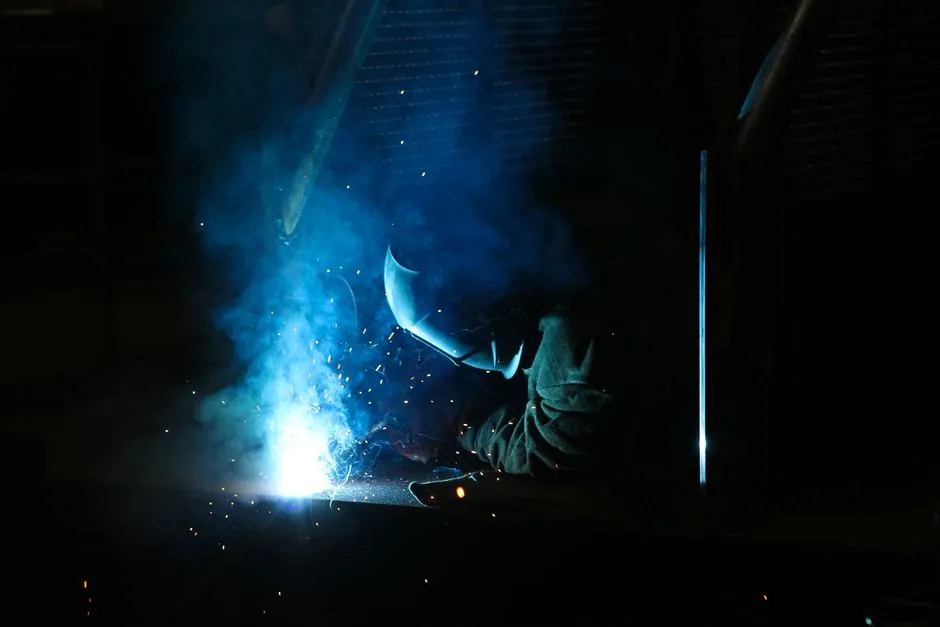
TIG welding is the common trade name for gas tungsten arc welding, designated GTAW by the American Welding Society, and historically called Heliarc when helium is the shielding gas [S1][S2][S7]. All three labels describe the same arc welding process in which a non-consumable tungsten electrode strikes an arc inside a blanket of inert shielding gas, typically argon or helium [S1][S3][S4].
The process produces stronger, higher-quality welds than shielded metal arc welding or gas metal arc welding on thin sections of stainless steel, aluminium, magnesium, and copper alloys, at the cost of slower travel speed and a steeper operator skill curve [S1]. For an encyclopedic entry on the equipment side, see the TIG welder reference, and for the broader cutting/welding tooling category, the welding and cutting tool page.
Why three names exist: Heliarc, TIG, and the AWS term GTAW
The name Heliarc dates to the early 1940s, when Russell Meredith patented a torch for Northrop Aircraft's XP-56 magnesium airframe program; the word combined the tungsten electrode arc with helium as the shielding gas [S1]. The process was later rebranded tungsten inert gas (TIG) welding, a label that remains dominant in Europe, while the American Welding Society adopted the technically descriptive term gas tungsten arc welding (GTAW) as its official designation [S1][S5][S7].
Multiple manufacturer and training sources confirm the three-name equivalence: Fronius lists "TIG welding also known as GTAW," Miller notes TIG is "technically called gas tungsten arc welding," and TWI Global's Job Knowledge article 6 opens with "Tungsten Inert Gas (TIG) welding, also known as Gas Tungsten Arc Welding (GTAW)" [S3][S5][S6]. Wikipedia adds that when helium is the specific shielding gas the older Heliarc terminology is still encountered in some industrial documents [S1].
Process mechanics: electrode, shielding gas, and power source
GTAW uses a non-consumable tungsten electrode, a constant-current welding power supply, and an inert shielding gas delivered through an annular nozzle surrounding the electrode, with filler metal fed separately as a wire when required [S1][S4]. The arc is established between the tungsten tip and the workpiece, melting the base metal under the protective gas blanket, and the process can also produce autogenous (fusion) welds without filler on thin material [S1][S4].
Direct current electrode negative (DCEN) is the most common polarity because it concentrates heat in the workpiece, while alternating current (AC) is used for aluminium and magnesium to break up the oxide layer through cathodic cleaning [S4]. High-frequency oscillation is standard on AC machines for arc stability, and high-frequency start on DC allows a "no-touch" arc initiation that avoids tungsten contamination of the weld start [S4]. Argon is the default shielding gas; helium delivers deeper penetration when used with DC and is the gas behind the original Heliarc name [S1][S4].
Where GTAW is specified, and where it is the wrong tool
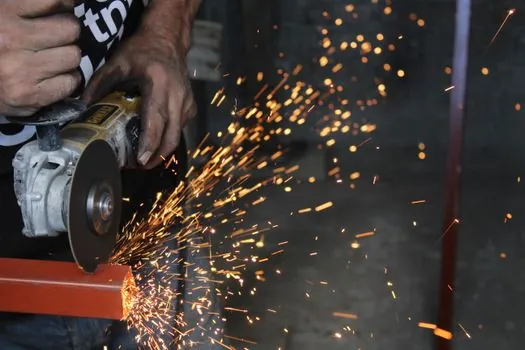
GTAW is the default choice for root passes on welds that cannot be back-welded, such as vessel-closure welds, small-diameter pipe, and tube-to-tubesheet joints, and it is widely used for thin stainless steel components like vessel internals [S4]. It is also preferred for non-ferrous alloys (aluminium, magnesium, copper) where flux residues from stick welding would be unacceptable [S1][S4]. The process is predominantly manual, which limits its economics on thick welds and high-deposition production runs [S4].
Field deployment is constrained by a 5 mph (about 8 km/h) maximum ambient air movement, above which the inert gas blanket breaks down and porosity increases, so GTAW is generally better suited to shop fabrication than open-site work [S4]. Manual welding is also slow, and confined-space joints may not be feasible because the process requires both of the welder's hands (one on the torch, one on the filler) [S4]. When higher deposition is needed, mechanised and orbital GTAW variants are used for boiler tubes, tube sheets, pipeline girth welds, and cladding of valve and pump internals [S1][S4].
Shielding gas and current selection: a practical comparison
The three main shielding/current combinations a process engineer will choose between on a GTAW job are DC with argon, DC with helium, and AC with argon, each mapping to a different material and weld profile [S1][S4]:
DCEN argon, the default for steel and stainless steel, gives a stable, narrow arc with moderate penetration and the lowest shielding-gas cost. DCEN helium delivers a hotter arc and noticeably deeper penetration on copper, stainless, and nickel alloys, at higher gas cost and a slightly wider heat-affected zone [S1][S4]. AC argon is the only option for aluminium and magnesium, because the alternating polarity provides cathodic cleaning of the surface oxide while the electrode positive half-cycle still allows the arc to sustain on a tungsten tip that would otherwise overheat on DC [S1][S4].
For comparison with related arc processes on the same shop floor, the arc welder reference covers shielded metal arc and other consumable-electrode methods that trade GTAW's cleanliness for higher deposition rate.
Standards, training, and sourcing
The American Welding Society assigns the official process designation GTAW; European standards bodies and most EU-based training materials use the abbreviation TIG; and historical American aerospace documents still use Heliarc for helium-shielded variants [S1][S5][S6]. Manufacturer and training portals, including Miller Welds, Fronius, TWI Global, and UTI's welding program documentation, treat the three names as interchangeable on technical and curriculum pages [S2][S3][S5][S6].
When the question turns to gas purity, flow measurement, or shielding-gas mix verification on a production line, the gas analyzer and gas cabinet reference pages cover the upstream delivery and QC side, while gas chromatograph covers higher-precision composition checks for shielding-gas certification. For an adjacent decision-map on safety footwear used during welding and grinding work, see ASTM F2413 vs EN ISO 20345: hazard-matched spec decision map.
Trackable signal to watch: any future AWS renumbering or harmonisation of the GTAW designation under a revised AWS A3.0 master chart, and any shop-floor shift from DCEN helium to argon-helium mixes on thin-wall stainless tube, both of which would change shielding-gas consumption figures quoted for new GTAW cells.