For an aluminum entry line, total installed cost of a gravity die casting machine plus ancillary equipment sits in a band of roughly $80,000 to $250,000, with the permanent mold, melt furnace, and trim press doing most of the work on the bill of materials.
Compared with high-pressure die casting machine cells, a gravity cell trades injection speed and complexity for lower tonnage, simpler controls, and cheaper dies; a generic 2023 market valuation puts the broader die casting machine market at USD 4.42 billion [S4], while a 2025-segmented view pegs the gravity-specific subset at USD 3.2 billion growing to USD 5.4 billion by 2034 at a 6.0% CAGR [S2]. For a shop weighing its first cell, those headline numbers matter less than the per-line cost stack.
Five cost drivers that move the line price
Material is the largest variable line on a per-part basis: a 300 kg lot of LM6 aluminum at Rs. 235/kg works out to Rs. 70,500 in feedstock alone, before any energy or labor is added, per a 2024 material-flow cost study of an aluminum gravity line [S7]. The same study tracks that the per-kg figure, not the per-batch figure, is what scrap rate, gating yield, and riser design all attack.
Alloy choice is a direct price lever, not a footnote. Commodity A380 and ADC12 variants are the cheap baseline; high-thermal-conductivity or high-ductility grades such as AlSi10Mg, used for EV inverter housings and battery enclosures, carry a premium [S3]. Because aluminum trades on the LME, many long-running supply contracts include a price-adjustment clause tied to the index, so a quote issued in January is not the same landed cost as one in June [S3].
Tooling is the second pillar, and it is the one cost line that is amortized, not avoided. A 2026 process comparison puts gravity die molds in a $10,000 to $22,000 range per cavity, with yields of 50% to 65% in production [S5]. That tooling is a one-shot capital hit, but it is also the line item that determines cycle time, scrap rate, and dimensional tolerance for the next several years of the program.
Gravity vs low-pressure vs high-pressure on the same shop floor
Low-pressure die casting machine cells cost 40% to 60% more in mold spend ($15,000 to $35,000 per mold) than gravity cells once annual volume clears 2,000 to 5,000 parts, but they buy a 20% to 35% unit-cost reduction through 85% to 92% yield and porosity under 0.5% [S5]. The break-even math therefore depends almost entirely on volume tier, and at sub-1,000-part runs the gravity die stays the cheaper permanent-mold route.
On the tolerance side the two processes do not compete head-to-head: LPDC holds ISO 8062 CT5 (about ±0.3 mm) with gas content under 0.1 cm³ per 100 g of aluminum, while gravity sits at CT7 to CT8 (about ±0.8 mm) with gas content 0.5 to 1.5 cm³ per 100 g [S5]. A real-world A356 pump housing case hit ±0.15 mm on a gravity die at 720±10 °C pour and 220 °C die preheat, but that required holding hydrogen under 0.15 ml per 100 g of aluminum, or tolerance slipped from CT8 toward CT10 [S5]. Buyers should read any "gravity holds CT7" claim with the hydrogen spec attached.
What is and is not in the equipment line
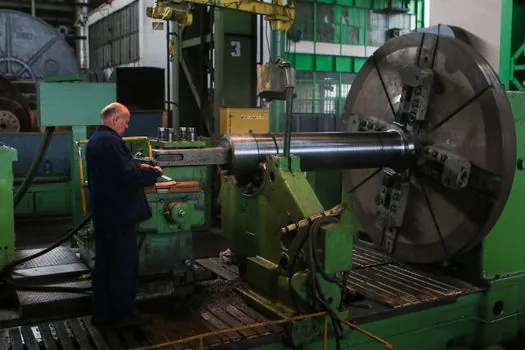
An entry-level cell is not one machine; it is a coordinated set. The gravity die casting machine itself, a tilting or fixed-table unit rated between roughly 50 kN and 800 kN clamp force depending on part size, is typically 30% to 50% of the installed cost. The remaining stack includes a crucible or reverberatory melt furnace, ladle and pouring equipment, die preheat stations, an extraction and trim press, and a basic PLC or relay control panel. [S3]
Gravity machines range from "very simple devices" up to quite complex automated cells, and that range is precisely what an entry-level buyer has to bracket [S6]. The simplest manually poured units, with a single operator ladling melt into a hand-loaded die, sit at the low end of the $80,000 installed figure; servo-tilt, PLC-indexed cells with auto-extraction sit at the upper end and into the $250,000 range before any secondary machining cells are added.
Where the hidden costs land on the P&L
Energy and remelt are the under-modeled cost lines. That remelt fraction is also why European Aluminium guidance keeps permanent-mold gravity casting in its recommended envelope for 250 to 50,000 units per year, where scrap economics actually work [S5].
Secondary operations are the second hidden cost stack. Machining, surface treatment, leak testing, and assembly are all variable-cost adders that move the per-part price more than most buyers expect; the 2026 process guide shows that 5% to 8% of gravity-cast parts are scrapped at the heat-treatment stage when blistering hits around 525 °C, a failure mode LPDC avoids because of its lower gas content [S5]. For a buyer sourcing a turnkey quote, asking the supplier to break out the secondary-ops line as a separate row is the single most effective way to make two quotes comparable.
Process economics and alloy recovery on a live line
The 2024 material-flow cost study on an aluminum gravity cell using LM6 is a useful real-world reference: 300 kg of raw material at Rs. 235/kg equals Rs. 70,500 in feedstock, and the rest of the cost stack (energy, labor, tooling amortization, post-cast operations) gets layered on top to produce a true per-kg cost that is consistently 1.6x to 2.2x the bare alloy figure once yield is applied [S7]. This is the same multiplier most commercial gravity shops quote, and it is the multiplier to push back on when a vendor's alloy line looks too good.
For shops coming from a sand-casting background, the gravity die casting machine is the smallest step up in capital that still gives permanent-mold repeatability, and the aluminum die casting machine category sits between hand-pour and a high-pressure cold-chamber cell in both price and required operator skill. Shops casting magnesium or zinc should evaluate magnesium die casting machine and zinc die casting machine lines separately, since melt handling, crucible materials, and protective atmosphere requirements change the cost stack in ways that the gravity-aluminum numbers above do not capture.
Who an entry-level gravity line is for, and who should skip it
An entry-level gravity cell fits a shop that needs 250 to roughly 10,000 aluminum parts per year of a single or low-SKU mix, with part weights in the 0.5 kg to 12 kg range where A356 and LM6 dominate, and where the buyer is willing to accept CT7 to CT8 tolerance and live with the blistering risk on T6 heat treatment [S5]. It also fits a job shop that is taking on a long-term OEM program and wants a $10,000 to $22,000 die rather than the $50,000-plus steel die a high-pressure cell demands [S5].
It is the wrong starting point for thin-wall work under 4 mm, for any program that needs porosity below 0.5% without impregnation, for airtight parts that must pass leak tests above 1.0 MPa, and for any annual volume above 5,000 parts per cavity where LPDC's higher mold spend is recovered through yield and reduced scrap [S5]. A related purchasing signal to track: the global die casting machine market sits at 3.9% CAGR over 2026 to 2034 with a forecast value of USD 4.77 billion, and Asia Pacific takes the largest share of demand growth on the back of automotive and EV lightweighting [S4], which is the same trend that is pulling new LPDC and vacuum-assisted cells online, and that will tighten delivery on entry-level gravity units into 2027.
For related coverage, see Replace, Bridge, or Overlay a Legacy PLC: Migration Decision Map.