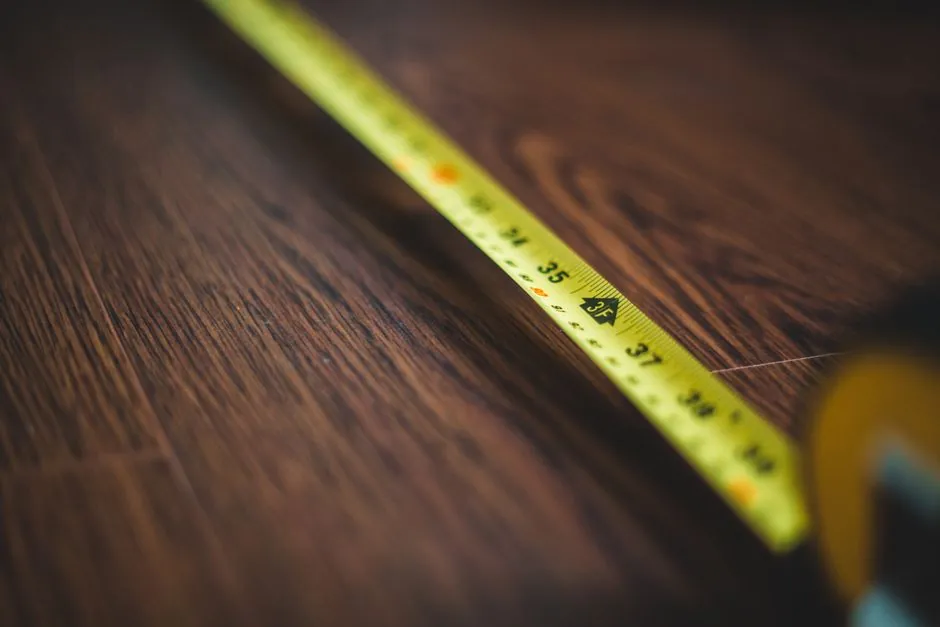
Handheld laser distance meters serve portable distance, area, volume, and Pythagorean calculations, while industrial laser distance sensors provide connected measurements for automation, robotics, logistics, and quality inspection [S2].
The practical distinction is system integration: a handheld meter is an operator tool with a display, whereas an industrial sensor is mounted as an automation component and integrated through interfaces such as IO-Link, RS485, USB-to-TTL, or fieldbus connections [S2][S3].
Choose by measurement role and integration requirement
A handheld laser distance meter is suited to construction, surveying and mapping, interior decoration, carpentry, door and window measurement, furniture installation, and construction inspection [S2]. Its display presents the measurement result, and its portable format supports field work where an operator moves between measurement points.
An industrial laser distance sensor is suited to factory automation, agricultural automation, warehouse logistics, intelligent robots, cranes, collision avoidance, positioning, and process monitoring [S2][S3][S5]. These devices can provide measurement data to another device through serial or industrial communication interfaces rather than relying on a person reading a display.
For a non-contact dimensional check on a production line, use an industrial laser distance sensor. For a one-off field survey or installation measurement, use a laser distance meter. The selection should follow the required output, not simply the largest advertised range.
Compare range, precision, speed, and interfaces
Available ifm sensing ranges include 2 m, 3 m, and 10 m, with listed accuracy at 300 mm ranging from 3 mm to 14 mm and linearity deviations as low as ±0.03% MR documented for Baumer products [S1][S3]. Baumer models include standard devices measuring up to 2,500 mm, miniature devices up to 550 mm, and precision devices up to 1,700 mm, with specified measurement frequencies up to 5 kHz [S3].
Handheld meters are optimized for portable range measurement and derived calculations such as area, volume, and Pythagorean dimensions [S2]. They are not the automatic substitute for a sensor with a defined output voltage, serial data stream, or fieldbus connection. The available research does not provide a universal handheld accuracy, range, or update-rate specification, so those values must be taken from the exact meter model rather than generalized across the product category.
For connected short-range models, ifm lists 2 m sensors with accuracy of 3 mm at 300 mm and 5 mm at 1 m, a 3 m model with 10 mm accuracy at 1 m, and a 10 m model with 47 mm accuracy at 10 m [S1]. These examples show why maximum range alone is a poor criterion. A 10 m sensor can be less precise near the target than a 2 m model, so working distance and required accuracy must be checked together.
As a practical comparison, a handheld meter wins on portability, operator display, and field calculation; an industrial sensor wins on mounting, automatic data exchange, programmable behavior, and production integration [S2]. An industrial triangulation sensor wins on sub-millimeter work when the range is short, while a time-of-flight sensor is generally more suitable when longer range is required [S1][S3].
Match the sensor to the inspection or positioning task
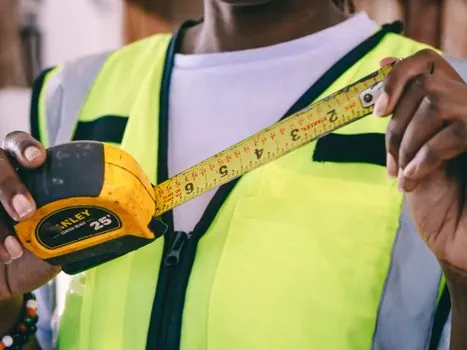
This is a different requirement from measuring a room length with a handheld device.
Long-range object detection and outdoor positioning require a different specification set from precision inspection. Meskernel divides industrial measurement into short range of 0.1–5 m, mid-range of 5–50 m, and long-range above 50 m, and identifies UART, RS232, RS485, CAN, and I2C as possible embedded or automation interfaces [S5]. If a process must reject, stop, count, or reposition material automatically, specify an industrial sensor with the required protocol and environmental rating.
For point positioning on a machine, an industrial laser sensor is normally the better choice because it can be fixed, parameterized, and connected to control equipment. A handheld laser level serves a different layout function and should not be selected merely because both devices project or measure with laser light.
Environmental protection changes the installation decision
Listed ifm models include variants rated IP65 and IP67, while the 10 m model shown is rated IP67 [S1]. These designations cover specific environmental conditions and must be checked against the required enclosure rating, not treated as interchangeable descriptions of ruggedness.
Meskernel identifies indoor versus outdoor use, waterproofing, and dustproofing as primary selection factors for industrial sensors [S5]. Applicable ratings include IP67, while some 2 m industrial models add IP68 and IP69K protection [S1]. A handheld meter is easier to remove from washdown or dusty zones, but that does not remove the need to respect its specified operating limits.
Ambient light, target color, surface texture, mounting angle, contamination, and laser safety all affect optical performance. Industrial sensors can be mounted at steep or unusual angles and are designed to identify varied textures and colors, with ambient-light suppression and surface-independent measurement available in the ifm lineup [S1]. For a permanent machine installation, environmental protection, mounting stability, and target behavior are more important than the convenience of a carrying case.
Know which functions and users each device serves

Industrial sensors are for users who need an electrical measurement output, automatic control, or continuous process integration. They support functions such as distance, displacement, and position measurement, and can provide additional process data for condition monitoring [S1][S3]. Industrial examples include IO-Link, Modbus RTU, PROFINET, EtherNet/IP, OPC UA, Modbus TCP, and UDP streaming [S3].
Handheld meters are for operators who need point measurements, local results, and portable geometric calculations. They are commonly used in construction, engineering surveying and mapping, decoration, carpentry, installation, and inspection [S2]. A Bluetooth-equipped handheld model may add wireless convenience, but wireless communication does not turn it into a fixed industrial sensor with process interfaces and machine mounting.
Neither category is automatically suitable for every task. A handheld meter is a poor choice for continuous conveyor positioning because it depends on manual aiming and does not provide the industrial interface required by the control system. An industrial sensor can be excessive for checking a doorway once, particularly when no controller, mounting bracket, or fieldbus connection is needed.
Define the data output before selecting hardware
Industrial sensors may expose measurement data through IO-Link, RS485, Ethernet, or other protocols, and their parameterization can be handled through vendor software or an integrated web interface [S2][S3]. This gives commissioning personnel access to operating parameters and condition data that a handheld display normally does not provide.
Selection records should specify the measurement range, required accuracy at the actual working distance, update or measurement frequency, output protocol, electrical supply, enclosure rating, mounting geometry, target surface, and ambient conditions. The ifm comparison also gives accuracy at 300 mm, 500 mm, 1 m, 2 m, and 10 m for selected models, demonstrating that accuracy is distance-dependent [S1].
For output selection, IO-Link suits point-to-point sensor integration, RS485 supports multi-drop industrial networks, and Ethernet protocols support higher-level factory data exchange. If a fiber-optic sensor is required because of electrical isolation or severe ambient conditions, it is a separate technology class and should be evaluated on its own operating principles.
Verify supplier claims against the exact model
No universal specification can rank all handheld meters and industrial sensors because the product families span sub-millimeter inspection devices, multi-metre positioning sensors, and long-range detectors. The useful evidence is the model datasheet: ifm publishes range, accuracy at defined distances, IP rating, interface, and display for each family, while Baumer publishes range, linearity, measurement frequency, and supported interfaces for its product groups [S1][S3].
For laser color selection, the distinction between 515 nm green and 635 nm red is covered in 515 nm Green vs 635 nm Red Laser Distance Meters. That wavelength comparison should be treated as a model-level accessory decision, separate from the primary decision between a portable meter and an integrated sensor.
Before purchase, record the target distance and allowable error, then verify them against the manufacturer data for that model. Confirm the electrical output and protocol, the required measurement rate, the enclosure rating, and any operating-temperature limits. For a handheld instrument, verify its specified range, accuracy, wavelength class, memory functions, power method, and applicable safety documentation.
The decision boundary is clear: use a handheld laser distance meter when a person must move, aim, read, or calculate in the field, and use an industrial laser distance sensor when equipment must obtain repeatable distance data automatically through a supported interface. The next verifiable checkpoint is the exact model datasheet at the intended working distance, because industrial accuracy can change from 3 mm at 300 mm to 47 mm at 10 m within one listed 10 m family [S1].