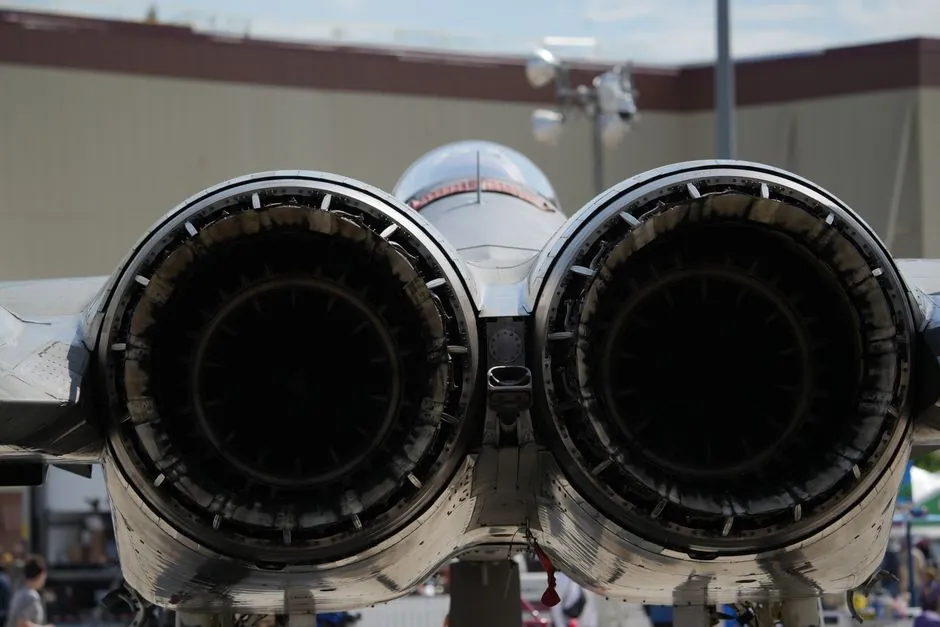
An air impact wrench routes exhaust through the handle or rear housing, so the exhaust layout determines access, sound, hose interference, and contamination risk.
Through-handle and rear-exhaust tools suit different work zones, with the correct choice determined by fastener size, available clearance, operating duration, and the need to keep discharged air away from the workpiece.
Exhaust layout changes the work envelope
A through-handle air impact wrench discharges air through the grip or handle area, while a rear-exhaust design vents through the opposite end of the tool near the drive axis. The distinction is physical, not cosmetic: the exhaust path can point toward the operator, toward the workpiece, or sideways into the working envelope. [S4]
Through-handle exhaust is generally easier to clear over a bench, inside a wheel well, or beside a vehicle panel because the main air discharge leaves through the grip rather than the anvil end. A rear-exhaust layout can place discharged air behind the socket, which is useful when the socket is close to a bulkhead, wheel, engine side, or other obstruction.
Compare handle exhaust with rear exhaust
For an overhead vehicle job, a handle-exhaust layout usually provides more room below the socket than a rear-exhaust layout, because the rear outlet is directly behind the anvil. For work against a wheel or frame member, rear exhaust may provide more clearance beside the socket, although the exact outlet direction must be checked for each model. [S1]
Noise and contamination are the principal tradeoffs. Handle exhaust sends the main discharge through the grip, close to the operator's hand. Rear exhaust sends it behind the tool, potentially toward the operator's face, nearby components, a vehicle body panel, or an open workpiece. Neither layout alone establishes an occupational noise limit, because the measured sound pressure also depends on the model, regulator, hose, load, and exposure time.
The AIRCAT 1295-XL is identified as a 1/2-inch composite impact wrench with 900 ft-lb [S3]. This model-level combination illustrates why quiet exhaust does not automatically identify the outlet direction or guarantee that discharge air is absent from the immediate work area.
Use cases and tool fit
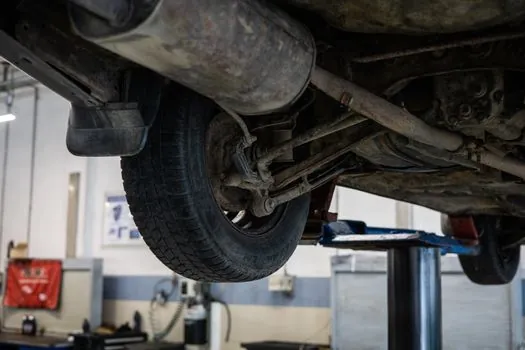
Rear-exhaust tools are strongest candidates for confined lateral access where the anvil must enter a narrow space and the space behind the socket is open. Handle-exhaust tools fit overhead work, suspension tasks, and applications where air must not be directed at the operator or toward a freshly serviced component. The choice changes with tool orientation, so a design that works beneath a hood may perform poorly in a wheel-well inspection. [S1]
For high-torque disassembly, an impact wrench is appropriate; for smaller fasteners and controlled reassembly, an air ratchet gives better tactile feedback and reduces the risk of rounded or stripped fasteners [S1]. Experienced workshop guidance places impacts on larger, high-torque fasteners and ratchets on smaller assemblies, with hand tools preferred for smaller fasteners where the additional running time is acceptable [S1].
The correct tool class changes with the fastener, not merely with the exhaust layout.
The exhaust arrangement is also secondary to drive size, torque capacity, and control method. For application-specific guidance, compare impact sockets with their retained-spec requirements and review breakaway torque for rusted fasteners before assigning a wrench to a joint.
Failure modes and operating checks
Air escaping from the exhaust while the tool does not turn is not normal operating behavior. A workshop troubleshooting case recorded a tool that blew air from its exhaust without attempting to move, even though its internal components moved freely [S4].
A non-turning wrench should be disconnected from the air supply before inspection, and the regulator, hose, controls, drive mechanism, and socket retention should be checked before the tool returns to service.
Exhaust direction can also expose a design weakness. Handle exhaust may draw discharged air across the operator's fingers when the grip is close to the fastener. Rear exhaust can send debris, moisture, or oil mist toward the work area. Neither outcome should be normalized, particularly when the tool is used above a workpiece, near fresh paint, or around precision assemblies.
Selection criteria for procurement

Specify the outlet configuration against the actual access envelope rather than by general preference. Record the required drive size, minimum usable clearance behind and beside the socket, maximum allowable sound level, expected duty cycle, and whether exhaust air may contact the operator or workpiece. [S2]
For handle exhaust, prioritize a sealed composite or elastomer grip, a positive trigger, a serviceable regulator, and a model rated for the required fastener class. AIRCAT describes its composite tools as using an ergonomically engineered handle intended to reduce stress and fatigue on the operator's hands, wrists, and arms [S2]. For rear exhaust, prioritize confirmed outlet direction, clearance behind the anvil, nozzle control, and a housing that prevents exhaust from striking sensitive components.
A qualified comparison must also include torque class, square drive, weight, noise rating, air consumption, and warranty. Exhaust layout cannot compensate for an undersized wrench, an over-torqued fastener, or an inappropriate socket. For head bolts and main-cap bolts, workshop guidance calls for hand tools, while impacts are generally suitable for larger high-torque bolts [S1].
Installation rules and service checks
For any pneumatic impact wrench, use the socket and anvil combination specified by the manufacturer, keep the drive square fully engaged, and verify directional control before applying full power. A rear-exhaust tool should be positioned so discharged air does not enter an operator's breathing zone or strike a workpiece. A handle-exhaust tool should be oriented so the grip outlet does not blow across the user's hand or obscure a fastener during reassembly. [S1]
Do not use a wrench that stalls against a fastener for a prolonged period. The workshop guidance for air ratchets warns against stalling them and advises stopping once the tool bottoms out [S1]. The same operating discipline applies to impacts: select the correct size and torque class, tighten fasteners with calibrated tools where final torque matters, and use the impact for breakaway rather than treating its output as a substitute for controlled tightening torque.
Before each job, verify that the exhaust outlet is open, the trigger operates through its full range, the forward/reverse valve is not centered unintentionally, and the regulator provides the pressure required by the tool specification. A stream of exhaust air with no drive output is a diagnostic condition, not a characteristic of either handle-exhaust or rear-exhaust design [S4].
Track two procurement signals before standardizing a model: measured exhaust direction in the intended working position and measured noise at the operator's location. These tests answer the practical questions that labels such as “quiet tuned exhaust” or “rear exhaust” do not [S2][S3].
