
A harmonic-drive reducer stages a wave generator, flexspline, and circular spline into a single mesh, producing ratios typically from 30:1 to 160:1 in a three-component package that is markedly lighter and more compact than a planetary stage of equivalent ratio [S1].
For 2026 material-handling builds, that envelope lines up directly with robot-joint, rotary-table, and pick-and-place duty, but the same geometry that delivers zero backlash and sub-arc-minute repeatability is the same one that fails on shock overload, so the fit-gate question is always about peak torque transients, not just nominal torque.
Operating Envelope: Ratios, Torque Density, and Repeatable Peak
Stock CSG-series catalog ratios are 50, 80, 100, 120, and 160:1, with 10 frame sizes spanning a 23 to 3419 Nm repeatable peak torque band and 545 Nm/kg published as the family-level power density ceiling [S1]. For a process engineer comparing frame sizes, the 14-frame SHG and CSF units ship as the 30:1, 50:1, and 100:1 workhorses, with specific distributor listings such as CSF-14-30-2UH-LW-SP, CSF-14-50-2UH, and CSF-14-100-2UH-SP surfacing on the 2026 aftermarket, while the 17-frame picks up 50:1 and 80:1 specials such as CSF-17-80-2A-R-SP and SHG-17-50 [S1]. One off-distributor SHG-17-50 listing explicitly quotes a 50:1 ratio with a 17-frame size and a hollow-shaft input, which is the configuration a robot-joint or rotary-table build wants when cable pass-through matters more than a solid input coupling [S1]. The Harmonic Drive Systems catalog frames the same technology as compact, lightweight, and high-torque, with a three-component count that does not change across ratio or frame size [S3].
Zero Backlash, Repeatability, and Where the Premium Earns Out
The harmonic geometry meshes roughly 30% of the flexspline teeth at any instant, which is the structural reason these units are specified below 1 arc-minute of lost motion and into the sub-arc-minute repeatability band that planetary, worm, and cycloidal stages cannot match at the same envelope [S1][S6]. That positioning behaviour is exactly why the design dominates articulated-robot joints, semiconductor wafer-handling stages, surgical robots, and CNC rotary tables, since a single arc-minute of backlash propagates into micron-level endpoint error at the tool tip [S1]. For comparison, planetary reducers are typically published above 95% mechanical efficiency with high torque output and multi-stage ratios stacked past 100:1, while harmonic stages quote transmission errors as low as 0.01 mm with very high reduction ratios achievable in a single stage [S5]. Material handling equipment such as conveyors, lifts, and hoists is a planetary application, not a harmonic one, because smooth motion and high torque output dominate the spec there, whereas harmonic units win where precise motion control and compact design drive the spec [S5].
Failure Modes and Load Limits Engineers Actually Hit

The flexspline is a thin-walled cup that fatigues under cyclic torque spikes, and the wave-generator bearing is the second life-limiting element, with both sensitive to radial load, shock load, and side-load from couplings mounted out of alignment [S1]. On the service-factor side, harmonic units will not absorb the peak-torque transients a cycloidal reducer or RV reducer is built to swallow: cycloidal and RV designs run multi-tooth contact on a cycloidal disc and tolerate 5x to 7x momentary overload relative to rated torque, while harmonic flexsplines expect peak torques to stay inside roughly 1.5x to 2x the rated value [S1]. For a wider cross-family comparison, the harmonic reducer reference page lines up torque density, ratio range, and shock tolerance across the four major precision-gear families, and a cycloidal reducer selection map shows where the cycloidal topology is the better fit-gate answer for shock-loaded automotive production. The harmonic package is the lightest at the cost of being the least tolerant of misuse, which is the single fact that decides whether a harmonic stage belongs in a material handling spec at all [S1].
Selection Criteria Map: Harmonic vs Planetary, Cycloidal, Worm
Decision-gate comparison for the four common precision-gear topologies that show up in a single-axis or robot-joint spec, against four selection criteria: ratio range, repeatable peak torque density, shock overload tolerance, and positioning repeatability. Harmonic covers 30:1 to 160:1 in one stage, 545 Nm/kg power density ceiling, 1.5x to 2x momentary overload, and sub-arc-minute lost motion. Planetary covers 3:1 to 100:1 per stage and stacks to 1000:1, runs typically above 95% efficiency, tolerates multi-x shock through the planetary stage's multi-tooth load sharing, and lands in the few-arc-minute backlash band at premium grades. Cycloidal covers 30:1 to 100:1 plus, offers 5x to 7x momentary overload, and lands in the low-arc-minute backlash band when the disc geometry is precision-ground. Worm covers 5:1 to 100:1, lower torque density, high shock tolerance on the gear train, and the worst positioning repeatability of the four, so it is rarely the answer for a positioning axis in a material handling build [S1][S5][S6]. The clear read is that harmonic wins where the spec calls for sub-arc-minute repeatability, single-stage ratio, and minimum mass, and loses the moment any peak-torque transient above roughly 2x rated enters the duty cycle [S1].
Material-Handling and Robot-Joint Fit Examples
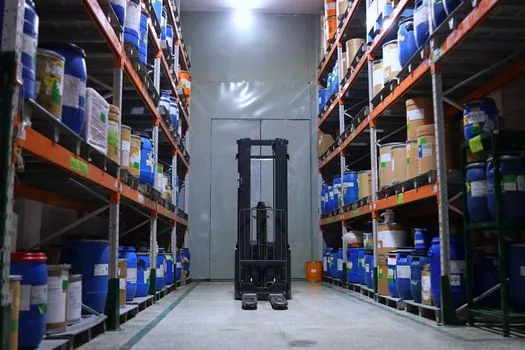
For a conveyor, lift, or hoist, planetary is the standard pick because the spec calls for smooth motion and high torque output, not sub-arc-minute repeatability, and maintenance is a straightforward periodic-lubrication schedule [S5]. For a six-axis articulated robot, an SCARA stocker, a wafer-handling stage, or a CNC rotary table, harmonic is the standard pick because the joint-level backlash budget is measured in arc-minutes and the joint envelope is measured in millimetres, which is exactly the trade-off the strain-wave geometry is built to solve [S3][S1]. For AGV and collaborative-robot joints, Harmonic Drive Systems explicitly markets the strain-wave topology as the geometry of choice, with the gear-head selection tool and CAD-data download paths published on the 2026 product page to support those exact applications [S3]. Material-handling specifiers who need to compare harmonic against a gear reducer family for a non-precision axis should be aware that the harmonic premium is paid for repeatability and mass, not for shock tolerance, and that cycloidal stages remain the better answer the moment indexing shock enters the duty cycle [S1].
Sourcing, Standards, and Procurement Signals for 2026
Distributor listings for the 14-frame and 17-frame CSF and SHG units are active on the 2026 aftermarket, with model codes CSF-14-30-2UH-LW-SP, CSF-14-50-2UH, CSF-14-100-2UH-SP, CSF-17-80-2A-R-SP, and SHG-17-50 all surfacing as catalog SKUs, and the SHG-17-50 explicitly showing a hollow-shaft input for cable pass-through [S1]. The Harmonic Drive Systems product page publishes 2D CAD downloads, a gear-head selection tool, and a product-discontinuation feed, which are the three artefacts a process engineer should pin to a sourcing plan before a 2026 build is released [S3]. Harmonic Drive Systems' own technology page frames the strain-wave gear as zero-backlash, high-torque, compact, with excellent positional accuracy and repeatability as the headline performance attributes, which matches the failure-mode caveats that the flexspline life is the limiting factor under cyclic torque spikes and misalignment-induced side-load [S6]. For an engineer writing a 2026 spec, the verifiable signals to track are distributor availability of the 14- and 17-frame SKUs, the published 545 Nm/kg power density ceiling on the CSG family, and the 1.5x to 2x peak-torque limit that defines whether the flexspline will survive the application's worst transient [S1].