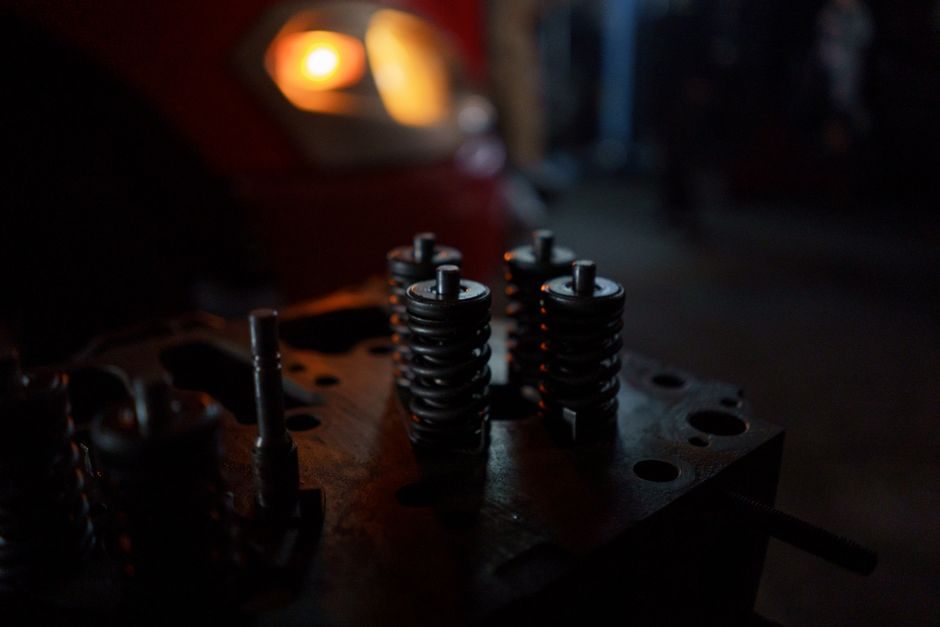
Spring selection in industrial machinery is decided by four interlocking parameters — load at working deflection, spring rate, available installation space, and the operating temperature/corrosion envelope — because the cheapest spring that deflects far enough almost always fails in fatigue or corrosion within weeks [S3].
The practical universe breaks into helical wire springs (compression, extension, torsion), flat/formed leaf springs, disc (Belleville) springs, gas/air springs, and elastomer-based dampers, each owning a different slice of the duty cycle map from static bias load to high-cycle vibration isolation [S2][S3].
Helical Compression, Extension and Torsion: The Default Mechanical Spring
Helical compression springs are specified by free length L0, wire diameter d, outer diameter OD, total coils Nt, and spring rate k = G·d⁴/(8·D³·Na) where G is the shear modulus of the wire material; the most common materials are music wire ASTM A228, chrome-vanadium A231, stainless 302/304 and Inconel X-750 for elevated temperatures [S3].
Industrial Spring Corporation's case data shows stainless-steel compression springs engineered for the plastic rotational-molding industry holding 500–600°F (260–316°C) continuous service, with a 3-day prototype and full production in 2 weeks on a 25,000-unit run — a representative lead-time and tolerance envelope for custom wire-form work [S3]. Compression springs are the right pick when the load is axial, the deflection is moderate, and the space envelope allows a coil; extension springs suit tension-only assemblies needing initial tension (the close-wound gap), and torsion springs deliver rotational restoring torque about a shaft axis [S3].
Air Springs and Elastomer Mounts: Vibration, Noise and Building Settlement
Continental ContiTech divides its industrial air-spring portfolio into four duty-specific product lines — Air Actuators (pneumatic work), Air Springs for Vibration Isolation (machine mounting), Expansion Joints (thermal growth and building settlement absorption), and SAM Springs for shock absorption on compressors, bin hoppers, blowers and motors subject to pulsating loads [S2].
The performance envelope of an elastomer air spring at 6 bar working pressure typically reaches 2–3× the deflection of a comparably sized steel coil at one-third the natural frequency, which is why they dominate machine-tool and HVAC-isolator installations where the goal is sub-10 Hz isolation, not stiffness [S2]. Steel coil springs are the wrong tool for sub-1 Hz isolation and for any duty that demands both energy storage and damping in a single compact element; for those, an air spring over oil damper or a wire-rope isolator is the cleaner answer [S2].
Disc (Belleville) and Flat Springs: High Load in Short Travel
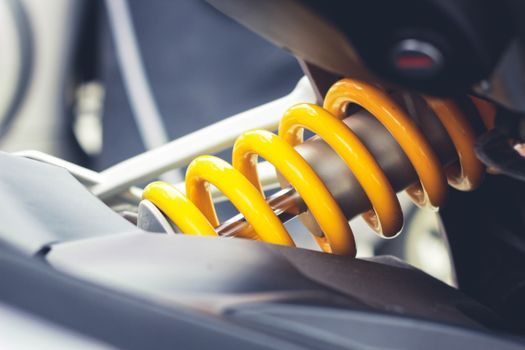
Belleville washers — a single-pitch variant — stack in series to multiply deflection or in parallel to multiply load, and they are the standard answer when the installation envelope is axial-shallow (a few millimetres) but the static load runs into tens of kN. They are common in bolted-flange pre-load, valve trim and safety-relief spring cans where a defined force over a tight deflection window is required. Readers cross-referencing linear guide preload strategies will see the same load/deflection trade-off play out in carriage pre-load selection. [S1]
Flat spring strips and constant-force negator springs enter the spec sheet when the duty is counterbalance — counterbalanced doors, cable retractors, tensioning idlers — and a near-constant force over a long stroke beats a rising-rate helical spring. Material choice follows the same temperature/corrosion rule as helical springs: 301/304 stainless for general industrial, 17-7 PH or Inconel for sustained temperatures above 200°C.
Material, Temperature and Corrosion Gates
The material decision tree is shorter than most engineers make it: cold-drawn music wire (ASTM A228) covers the bulk of indoor mechanical springs up to ~120°C; chrome-silicon (A401) and chrome-vanadium (A231) cover higher-stress and slightly higher-temperature service; 302/304/316 stainless covers corrosion and food/pharma washdown; and Inconel X-750 or Nimonic covers sustained 300–600°F service in turbines, exhausts and rotational-molding tooling [S3].
A useful cross-check: a spring washer for bolted joints follows the same A228/A231/stainless stack as helical compression springs, so a single material standardisation plan can cover both.
Selection Criteria Compared: Helical vs Air vs Disc
Three spring families, four decision criteria: helical wire springs win on cost per stored joule, footprint and simplicity for axial loads in the 10 N–50 kN range, but lose on damping and on low natural frequency; air springs win on tunability (stiffness varies with internal pressure) and low-frequency isolation, but lose on cost, footprint and the need for an air supply; disc/Belleville springs win on high load in a very short axial envelope, but lose on stored energy and on fatigue life unless stacked carefully. [S2]
For most general industrial buyers the default decision matrix is: (1) axial load, modest stroke, static or low-cycle → helical compression; (2) vibration/noise isolation of rotating equipment → air spring or elastomer mount [S2]; (3) high load, short stroke, tight envelope → Belleville stack; (4) counterbalance or constant-force tension → flat or negator spring. Wire diameter tolerance and surface finish (shot peening raises fatigue life by roughly 30–50% at the same stress level) are the two specs that move the most in custom procurement [S3].
Sourcing, Standards and Lead-Time Map
Custom industrial spring sourcing clusters around two patterns: US/Kansas City–style job shops like Industrial Spring Corporation with a 50+ year track record on short-run wire forms and compression springs (typical 2–4 week lead time on custom 5,000–25,000-unit lots) [S3], and India-based manufacturers such as Arpee Spring Industries (Hyderabad, founded 1995) and Jayvir Spring (Ahmedabad) covering standard helical and wire-form runs for OEM and replacement demand [S5][S6].
Standards covering industrial springs are split: ASTM A228, A231, A401 and A313 govern the most common wire materials; DIN 2096 covers helical compression spring calculation; and the application side falls under machinery-specific standards (e.g. EN 12927 for spring-loaded safety devices on lifts, ASME BPVC Section III for nuclear). For procurement, the minimum data sheet should carry wire material, d, OD/ID, L0, spring rate, max working deflection, max cycle count and operating temperature; without that, vendors cannot quote a real life figure [S3].
For engineers weighing spring procurement alongside other long-lead components, the industrial gear selection map is a useful parallel read — both rely on duty-cycle and material grade as the first two gating questions. Where spring selection crosses into tooling and fixturing — for example spring-loaded drilling fixtures — the core drilling machine selection guide covers the spindle-side constraints that set the spring's required stiffness window.
Trackable signals for 2026 spring procurement: vendors are publishing tighter tolerance bands (often ±2% on spring rate rather than the older ±10%) and adding 3-day prototype services for OEM development lots [S3]; buyers should request rate-tolerance and shot-peening data on RFQs, and verify material certification to the specific ASTM designation, not a generic "stainless" callout, before placing volume orders.
For component-level specifications, see crossed roller guide.