Shaft couplings transmit torque between a driver and a driven shaft while absorbing misalignment, shock and vibration, and the engineering decision in 2026 is dominated by seven mechanical families listed across the DirectIndustry catalogue: rigid, elastomer (jaw/spider), disc, gear, grid, bellows and chain/roller-chain [S2].
The selection is governed by four hard numbers — torque (Nm), rotational speed (rpm), bore diameter (mm) and misalignment type (parallel/angular/axial) — and the available envelope in production parts now stretches from sub-10 Nm instrument bellows to 358,000 Nm gear couplings, with disc and double-flex disc units filling the 20–1,164 Nm motion-control band [S1][S2][S3].
Rigid Couplings: Sleeve, Clamp and Flange Forms for Perfectly Aligned Shafts
Rigid couplings are specified where shafts are already coaxial, with no angular or parallel offset tolerated, and are machined as sleeve, clamp or flange bodies in steel or aluminium [S2].
JAKOB Antriebstechnik's RM-series rigid couplings cover 130–4,000 Nm at 2,000–4,000 rpm, while the 09.1013.81-series reaches 160–10,300 Nm at 1,700–5,000 rpm — both delivered as multi-part flange bodies that bolt the two shaft ends together [S2]. A rigid coupling is the cheapest and most compact option per Nm, but it transfers every bearing load directly, so a soft-start or shock-loaded drive upstream will destroy the connected bearings rather than the coupling itself. Specifiers also confirm a shaft collar can act as a locating stop on the shaft shoulder when rigid sleeves are clamp-fitted, preventing axial walk.
Elastomer and Jaw Couplings: Torsional Compliance for General-Duty Drives
Elastomer couplings use a polyurethane or nitrile "spider" between two metal jaws to absorb torsional shock and damp vibration, and the catalogue now lists jaw designs at up to 15,000 Nm and 19,000 rpm in spider-coupling form [S2].
JAKOB's EKHZ elastomer coupling covers 20–1,600 Nm at 300–3,500 rpm with a -30 °C to +90 °C temperature window and 10–100 mm shaft diameter — making it a stock choice for pump, fan and conveyor drives where misalignment is small and damping matters more than stiffness [S2]. The HRC-series elastomer coupling from APSOparts® is the established pattern in this category for general industrial use, and the trade-off is unambiguous: elastomer elements are wear parts with a finite fatigue life under reversing or pulsating torque, so they are almost never specified on servo axes where linear guide systems demand zero-backlash behaviour.
Disc and Composite-Disc Couplings: Zero-Backlash for Servo and High-Speed Motion Control

Disc couplings use thin stainless-steel disc packs bolted between two hubs and deliver zero backlash, high torsional stiffness and parallel/angular misalignment compensation in a single part [S1][S3].
ZERO-MAX's 6P18C flexible disc/gear model spans 20–1,164 Nm and 4,100–12,000 rpm, while the Double Flex 6P-C version runs 20–1,164 Nm at 2,100–14,000 rpm with a published -57 °C to +121 °C window and electrically insulating composite disc packs [S1][S3]. These double-cardanic composite disc couplings are the de-facto choice for servo motors feeding ball-screw and linear guide driven axes because their "very low reaction forces on the shaft bearings" let the system hold micron-class positioning accuracy [S3]. For buyers comparing the family directly, a Double Flex 6P-C explicitly accepts higher parallel and axial misalignment than the single-flex 6P18C at the cost of a longer overall length envelope [S1][S3].
Gear and Grid Couplings: Heavy-Duty Torque Density for Mill, Rolling and Marine Drives
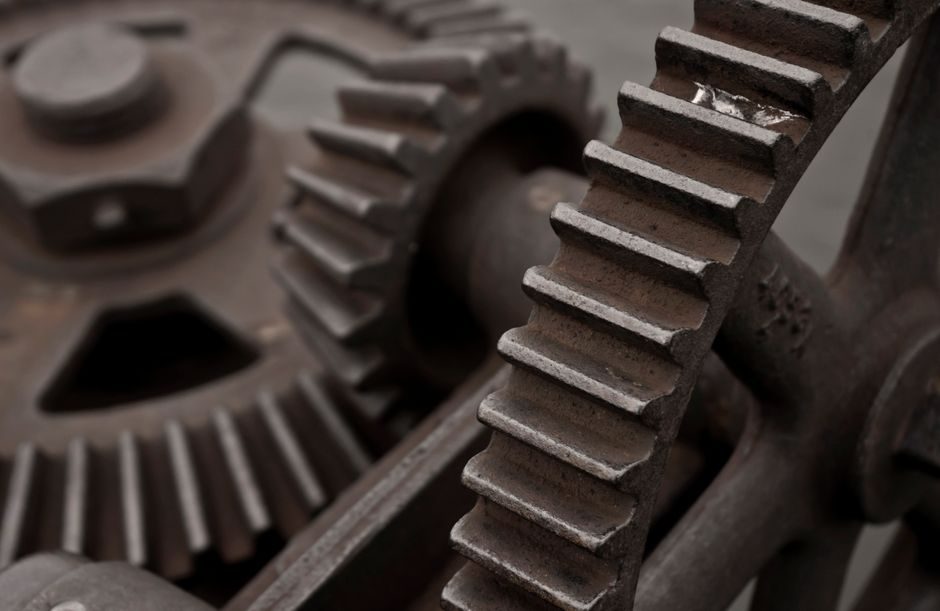
Gear couplings use crowned external teeth meshing with internal teeth on a sleeve to transmit the highest torque densities in the catalogue, and grid couplings use a flexible steel grid spring for the same heavy-duty envelope with built-in lubrication [S2].
The PN-series universal elastic gear coupling lists 46–358,000 Nm at 800–16,000 rpm and is documented as engineered to absorb torsional knocks, vibration and misalignment in rolling-mill, marine and large-pump service [S2]. Grid couplings (GDR/GDA/GH-series) cover 10–770 Nm at 3,500–7,000 rpm for parallel, angular and axial offset compensation where structure settling is expected [S2]. A grid coupling is grease-lubricated, so it is excluded from clean-room, food-grade and most chemical processes; gear couplings need a continuous oil or grease supply and a guard to contain lubricant spray at high speed. The two families share a use case — large-inertia drives started across the line — but a disc coupling is almost always substituted on a servo-fed mill auxiliary where backlash is non-negotiable.
Bellows, Chain and Pin-and-Bush Couplings: Specialised Solutions for Spindle, Encoder and Low-Speed Conveyor Lines
Metal bellows couplings use a formed stainless-steel bellows welded between two hubs to give zero backlash at low torque and high speed, while roller-chain and pin-and-bush couplings use a duplex chain or elastomer-lined pins to transmit torque on low-speed, high-misalignment lines [S2][S4].
Huco's 530.34-series stainless-steel bellows coupling is documented at 3.8–9.4 Nm and 15,000 rpm with a 3-convolution standard design, matching the encoder-to-spindle and small-servo niche where bore sizes are sub-25 mm and a separate shaft key is not used [S2]. KC-series roller-chain couplings on the China wholesale market list at US$17–200 per set with KC4014 and KC6018 chain-and-sprocket packages, and the published standard definition confirms double-row roller-chain couplings (双排滚子链联轴器) are the dominant variant for general industrial low-speed drives because they outperform single-row and nylon-chain variants on torque capacity [S4]. Pin-and-bush couplings, listed as the 6F22C family by ZERO-MAX, are the maintenance-friendly alternative to chain for shock-loaded, alignment-tolerant drives [S1].
Decision Matrix: Matching Coupling Family to Torque, Speed, Misalignment and Service
Selection reduces to four gates — torque, speed, misalignment, environment — and the following comparison reflects the published catalogue envelopes rather than market guesses [S1][S2][S3].
For torque under 20 Nm at 15,000 rpm on instrument/spindle shafts, specify metal bellows (Huco 530.34, 3.8–9.4 Nm). For 20–1,164 Nm at 2,100–14,000 rpm on servo and motion-control axes, specify composite disc (ZERO-MAX 6P18C or Double Flex 6P-C, -57 °C to +121 °C) [S1][S3]. For 20–1,600 Nm at 300–3,500 rpm on pumps, fans and conveyors, specify elastomer jaw (JAKOB EKHZ, 10–100 mm bore, -30 °C to +90 °C) [S2]. For 46–358,000 Nm at 800–16,000 rpm on rolling mills and marine drives, specify gear (PN-series) or grid (GDR 10–770 Nm at 3,500–7,000 rpm) [S2]. For low-speed conveyor lines with parallel misalignment up to several millimetres, specify double-row roller-chain (KC-series, 6.4 mm–25.4 mm pitch range typical) [S4]. A crossed-roller guide driven by a servo through a flexible disc coupling is the most common high-precision pairing in 2026 production machinery. Buyers also need to track that the catalogue of 95 manufacturers and 542 shaft-coupling SKUs on DirectIndustry is being updated weekly, with 94 of those companies offering a buying guide for shafts in the same feed window [S2].
Selection Failures, Sourcing Channels and Standards to Lock In
The most common selection failure is over-specifying a rigid sleeve on a pump drive and watching the upstream motor bearings fail within months; the second is under-specifying an elastomer spider on a reversing servo and watching the spider tear in under 1,000 hours [S2].
For sourcing, the DirectIndustry manufacturer directory lists 95 companies and 542 SKUs, while Made-in-China carries KC-series chain couplings at US$17–200 per set with KC4014 and KC6018 chain-and-sprocket package options, and Changzhou Tianniu runs a backstop-clutch-plus-coupling combined catalogue for one-way motion service [S2][S4][S6]. Specifiers locking down a new drive should verify three items: the coupling's published bore range matches the shaft diameter (with a shaft collar as the locating stop), the catalogue rotational-speed rating covers the maximum rpm with the agreed service factor, and the temperature window — for example -57 °C to +121 °C on the ZERO-MAX 6P-C — covers the worst-case ambient plus bearing heat-soak [S1][S2][S3].
Closing: track the next cataloguing refresh on DirectIndustry's 95-company shaft-coupling directory and watch for new Double-Flex composite-disc variants with extended -60 °C low-temperature ratings entering the motion-control band; the disc coupling family is the one to monitor through the second half of 2026.
For related coverage, see Explosion-Proof Motor Selection: Zone, Gas Group, Frame and Efficiency Gates.