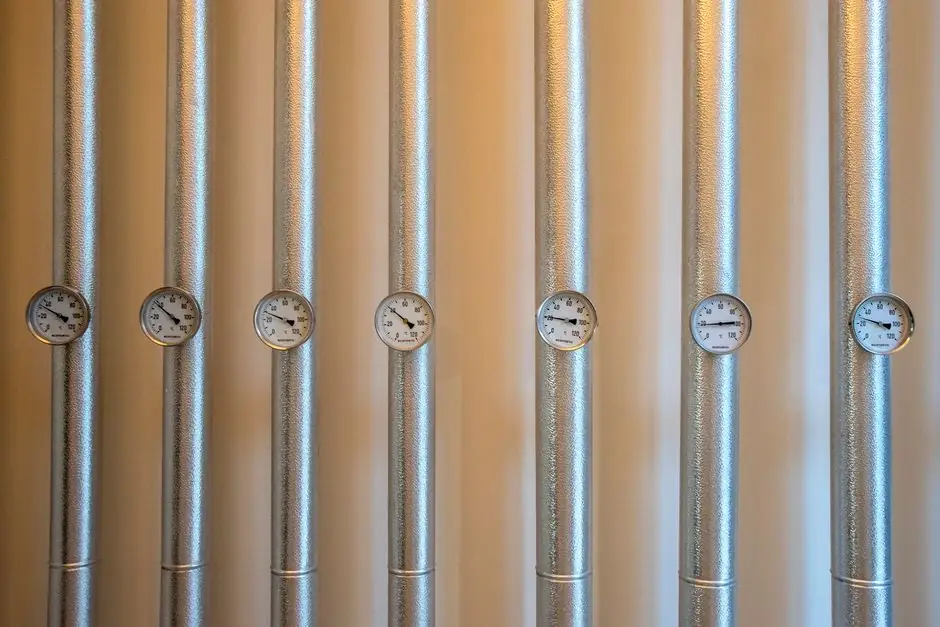
A heat-exchanger outlet calibration bath specification should be written as a standalone instrument line on the RFQ, not as an accessory buried in the exchanger data sheet, because the bath's working range, stability, and uniformity directly determine whether the outlet temperature reading the operator sees is trustworthy [S3].
This matters on every shell-and-tube RFQ, where the buyer typically hands over inlet and outlet temperatures for both streams as separate rows, and the manufacturer then back-calculates duty, LMTD, and area [S1]. If the bath that verifies the outlet sensor cannot cover that exact temperature with documented stability, the entire thermal balance rests on an unverified signal.
What a Calibration Bath Line on the RFQ Must Cover
Five parameters drive every quote: required calibration range, display/control stability over time, spatial uniformity across the working volume, bath fluid compatibility with the immersion probe, and minimum usable immersion depth. Add the probe type and diameter, the reference-standard traceability chain (NIST, NPL, NIM, or accredited lab), the as-found/as-left data format, and whether an accredited ISO/IEC 17025 calibration certificate is required. [S1]
Buyers who write only "calibration bath, -20 to 200 degrees C" force a requote cycle, because the supplier has to assume stability, uniformity, fluid, and tank size, and any wrong assumption pushes the price by 30-60 percent or swaps the fluid family entirely.
Matching the Bath Range to the Exchanger Outlet Temperature
The calibration range should bracket the actual outlet temperature with margin, not sit on top of it. For a hot oil exchanger outlet at 180-220 degrees C, specify 50-300 degrees C as the working range so the bath can verify drift at the lower alarm setpoint and at the upper operating limit, and confirm the heat-transfer fluid rating covers the upper end with a 20-30 degrees C safety margin against the fluid flash point. [S4]
For cryogenic LNG or refrigerant suction-line applications where outlet temperatures can drop to -40 degrees C or below, write the bath range as -80 to 50 degrees C and require a silicone or alcohol-based low-temperature fluid; water baths stop working near 0 degrees C and ethanol baths flash near 12 degrees C, so the fluid choice is a safety decision, not a preference. Reference working principles for temperature measurement confirm that immersion depth and stem-conduction error both grow as the bath working temperature moves away from ambient.
Stability and Uniformity: The Two Numbers Buyers Under-Spec
Stability is the bath's ability to hold a setpoint over time, typically expressed as plus/minus degrees C over 30 minutes. Uniformity is the maximum temperature difference between any two points inside the working volume at steady state. A quote-grade industrial bath commonly offers plus/minus 0.02-0.05 degrees C stability and plus/minus 0.05-0.1 degrees C uniformity at 100-200 degrees C; field/portable baths relax to plus/minus 0.1 degrees C stability and plus/minus 0.2 degrees C uniformity. [S3]
Write both numbers explicitly, with the temperature point they are quoted at, because a single spec like "stability 0.05 degrees C" without a reference temperature is unenforceable. The same discipline applies when you specify a temperature controller for the bath's own setpoint loop: control resolution below the calibration target is wasted spend.
Sensor Type, Immersion Depth, and Probe Geometry
State the reference probe and the device-under-test (DUT) probe on separate lines. Common practice is a 6.35 mm (1/4 inch) or 9.5 mm (3/8 inch) sheathed Pt100 or thermocouple as the reference, and the exchanger's outlet thermowell/RTD as the DUT, immersed to the manufacturer's rated depth (typically 150-200 mm for a standard industrial probe). [S1]
Short immersion is the single most common error in bath-based calibration. A 50 mm immersion in a 200 degrees C bath can introduce 1-3 degrees C stem-conduction error, which is larger than the bath's own stability, and it silently invalidates the certificate. Add a footnote: "reference and DUT probes immersed to the full active length stated by the probe manufacturer, with at least 50 mm of additional stem immersed beyond the sensing element."
Comparison of Common Bath Types for Heat-Exchanger-Outlet Verification

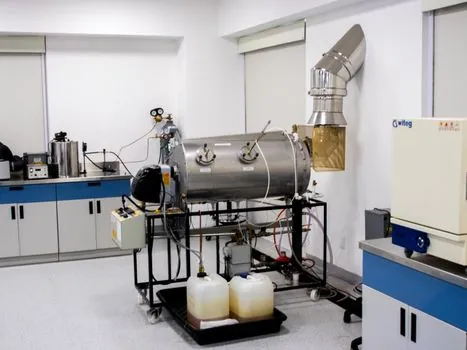
Three bath families dominate the market, and the right choice is set by the outlet temperature window plus the probe diameter. Liquid baths (water, silicone oil, mineral oil, salt) cover -90 to 550 degrees C and give the best uniformity, but they need fluid changes, fume management above 200 degrees C, and large bench footprints. Dry-block/MetWell baths (metal-block or stirred dry-well) cover -55 to 700 degrees C in a small portable package, but uniformity at the calibration zone is typically 3-10x worse than a liquid bath, and large or odd-shaped probes do not fit the block bores. Infrared/blackbody surface sources cover -20 to 1500 degrees C for non-contact pyrometers and thermal imagers, and are the only practical option above 550 degrees C, but they cannot calibrate an immersion thermowell at all. [S4]
For a shell-and-tube exchanger outlet in the -40 to 400 degrees C window, the correct comparison is liquid bath versus dry-well on four criteria: best achievable uniformity (liquid wins), probe size flexibility (liquid wins), portability to field skids (dry-well wins), and cost of ownership over a 5-year fluid-change cycle (dry-well wins). A buyer who tries to verify a 12 mm thermowell probe in a dry-well with 6 mm and 8 mm sleeves is buying a false certificate.
What to Write on the RFQ Line by Line
The line item should read in this order: required calibration range with units, display/control stability with reference temperature, working-volume uniformity, bath fluid family, working volume in litres or tank depth, minimum immersion depth, reference probe type and class, DUT probe type and acceptance tolerance, accredited ISO/IEC 17025 certificate required (yes/no), turnaround time in working days, and on-site or in-lab service. [S3]
Optional fields that inflate quote price when omitted: accredited certificate (versus traceable only), on-site service at the exchanger skid (versus ship-and-bench), multi-point calibration at 5 or more setpoints (versus single-point), and same-day or 24-hour turnaround. Conversely, the spec mistakes that force a requote cycle are: range written without a fluid, stability written without a temperature point, immersion depth omitted, and traceability written as "calibration certificate" without naming ISO/IEC 17025 or an equivalent national scheme. Anchoring the bath to the exchanger's process calibration loop, rather than treating it as a standalone accessory, removes most of those mistakes before the RFQ is sent.
Standards, Traceability, and the Heat-Detector Cross-Check
Calibration-bath traceability in the U.S. typically runs through NIST through an ISO/IEC 17025 accredited lab, with the certificate naming the standard used, the as-found/as-left data, and the expanded uncertainty (k=2) at each test point. In the EU, the equivalent chain runs through EURAMET national institutes; in the UK, UKAS-accredited labs; in China, NIM through CNAS-accredited providers. The same bath used to verify an exchanger outlet RTD can also serve as the reference for a heat detector or fire-detection thermal sensor test in a combined safety-instrumented / process-instrumented loop, provided the bath's upper limit covers the detector's rated alarm temperature. [S4]
One verifiable signal to watch: the spread of accredited labs offering on-site exchanger-outlet bath calibration is widening in 2026, with several Indian and Chinese providers advertising 5-7 working day turnaround at the skid, which was a 3-4 week lead time as recently as 2023 [S3]. Buyers who do not request a fixed-vessel heat treatment furnace on the same RFQ but do request a portable bath should expect a separate mobilization fee; clarifying that the bath is shipped to the exchanger outlet nozzle, not the maintenance shop, is the single line that prevents that surprise line item.
For related coverage, see Gearbox selection for textile mills: a 2026 spec map for spinning, weaving and finishing.