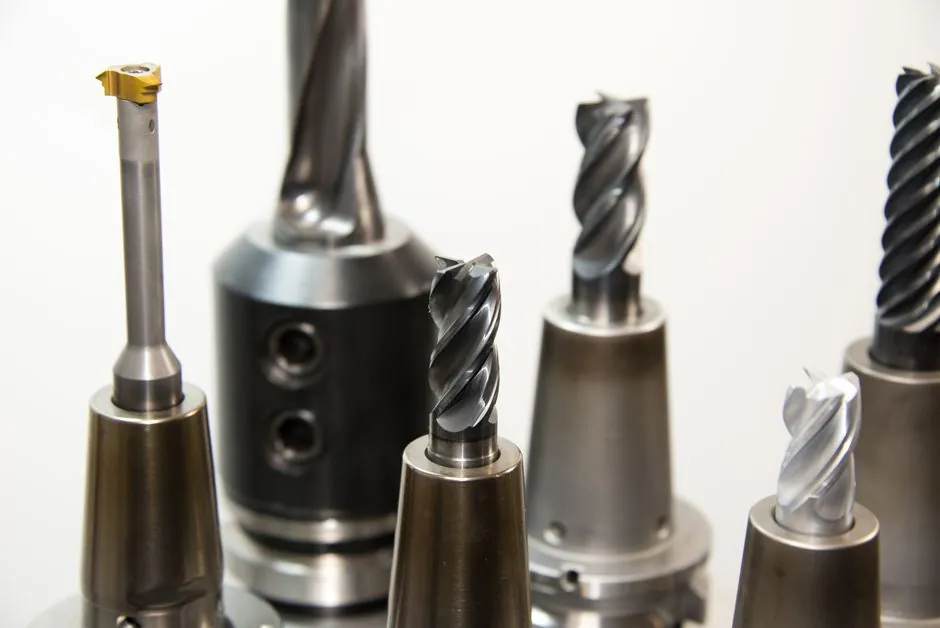
Textile-mill gearboxes in 2026 split into four practical families, helical, helical-bevel, worm, and planetary, covering 0.12 kW to 200 kW input power with reduction ratios from 5:1 to 100:1, ISO 6 gear-grinding precision, and efficiencies in the 60 to 96 percent band depending on stage count [S3][S8].
The job of the gearbox in a spinning frame, card, loom, winder, or stenter has not changed: convert motor high speed, low torque into process low speed, high torque, then distribute it to the working parts. What has changed is the seal, noise, and precision envelope demanded by modern high-speed lines, where lint ingress, acoustic limits, and zero-backlash drift now sit on the same datasheet as torque [S3][S6][S8].
Four gearbox families actually specified on textile lines
Helical and helical-bevel units dominate the spinning side because of their 94 to 96 percent stage efficiency and 60 to 68 dB noise ceiling; a representative RFKS helical gear reducer from Fangyuan lists input power 0.12 kW to 200 kW, gear material 20CrMnTi alloy steel with surface hardness HRC 37 to 62, HT200 grey cast iron housing, and precision-ground grade 6 gearing with backlash held to 20 arc-minutes or less [S3]. These units drive ring frames, roving frames, and draw frames where continuous duty and torsional stiffness matter more than right-angle packaging.
Worm and helical-worm units take over where a 90-degree right-angle output and self-locking torque are needed: yarn winders, small looms, knitting machines, and dyeing-finish auxiliaries. The FRV030 worm-gear reducer for textile machinery uses a hollow-shaft right-angle output, ground and lapped worm to Q7 (DIN 3974) finish, IP65 sealing with dust deflectors, and 60 dB acoustic emission at 1 m at full speed, versus 70 to 78 dB for generic industrial worm units, with self-locking torque of 15 to 95 Nm at 30:1 and above [S8]. The full gearbox family comparison in 2026 is less about which gear mesh is "best" and more about which combination of ratio range, sealing, acoustic limit, and efficiency fits the specific machine island.
Spec ranges that matter on a textile datasheet
A textile-qualified gearbox datasheet in 2026 typically carries six hard numbers: input power 0.12 kW to 200 kW, reduction ratio 5:1 to 100:1, gear surface hardness HRC 37 to 62, gear core hardness HRC 30 to 45, noise 60 to 78 dB at 1 m, and efficiency 94 to 96 percent for helical stages, lower for worm stages due to sliding contact [S3][S6][S8]. Vibration is held to 20 micrometres or less on helical units, backlash to 20 arc-minutes or less, and maximum oil-temperature rise to 50 degrees Celsius on a continuous duty cycle [S3].
For carding and high-speed spinning, the cotton-carding machine gearbox Tanhon JWF1218A-3600-1 is built as a precision-engineered transmission delivering high torque output and variable speed under continuous high-speed textile duty, with the same textile-specific sealing and noise envelope as the worm family [S2]. Selection on a card line is dominated by licker-in and doffer speed stability rather than raw ratio, so helical-bevel and parallel-shaft helical units (MP, MJ series) are usually preferred over worm units in this island.
Selection criteria by machine island
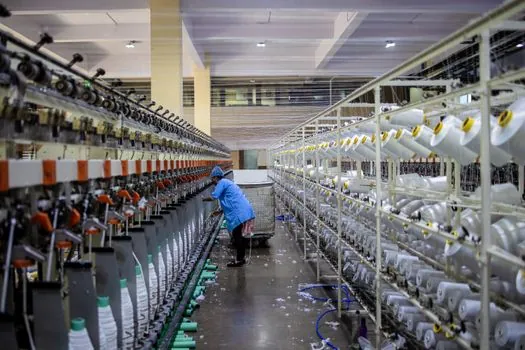
Spinning frames (ring, roving, draw) and carding machines favor helical or helical-bevel units for efficiency and torsional stiffness, with parallel-shaft helical as a third option when the drive is in-line; typical input power 1.5 to 200 kW depending on frame count, ratio 5:1 to 60:1, and HT200 cast iron housing with 20CrMnTi gears [S3]. The JWF series is explicitly designed for this duty, covering spinning, weaving, and dyeing-and-finishing equipment with high-load continuous operation as the design point [S1][S5].
Looms, winders, and knitting machines are where worm and helical-worm units earn their slot, because the 90-degree right-angle output drops straight onto a creel or take-up shaft without a coupling. The FRV030 textile-specific configuration uses a hollow-shaft output for direct mounting on a winder, with 5:1 to 100:1 ratio range and ground worm Q7 finish for stable yarn-tension torque at low speed [S6][S8]. For heavy weaving and wide-width looms, parallel-shaft helical units (MP series) are still preferred where efficiency matters more than the right-angle form factor.
Dyeing and finishing lines, stenter frames, and calenders run slow and hot, and the spec tilts back to helical-bevel or parallel-shaft helical with HT200 housing and L-CKC220 to L-CKC460 industrial-gear oil (Shell Omala 220 to 460), since worm units would derate badly under sustained 24-hour thermal load [S3]. For drive selection across the line, the PLC controlling the line sees the gearbox as a fixed ratio block; the real selection question is whether the gearbox's L10 bearing life and thermal rating match the duty cycle the PLC will demand.
Comparison of the four families on textile duty
On a textile line, the four gearbox families line up against four decision criteria. Helical units win on efficiency at 94 to 96 percent and on continuous-duty thermal capacity but need more axial space. Helical-bevel units add a 90-degree output without the worm sliding loss, at slightly lower efficiency, and dominate carding and ring-frame duty. Worm units win on self-locking torque (15 to 95 Nm at 30:1) and IP65 lint-tolerant sealing with dust deflectors, but pay for it with lower efficiency and a 60 dB at 1 m acoustic floor that is still acceptable, while generic industrial worm units sit at 70 to 78 dB [S6][S8]. Planetary units win on torque density and zero-backlash drift in precision winding and let-off, at higher unit cost.
Material choices are largely consistent across families in 2026: HT200 grey cast iron or ductile iron housing, 20CrMnTi alloy steel gears with case-carburized HRC 37 to 62 surface, 40Cr alloy steel input/output shafts at HRC 25 to 30, and either Chinese C&U bearings or specified premium brands (SKF, FAG, INA, NSK) on request [S3]. The textile-specific deltas, IP65 with dust deflectors, Q7 ground worm, and 60 dB at 1 m, are what separate a true textile-spec gearbox from a generic industrial reducer relabeled for the same duty [S8].
Where the generic-industrial gearbox fails on textile duty
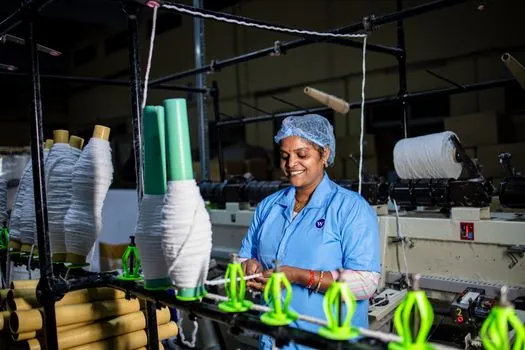
A standard industrial worm reducer rated IP54 without dust deflectors will pull airborne lint into the seal lip, leading to oil contamination and measurable backlash growth in dust-loaded textile environments, exactly the failure mode the FRV030 textile configuration is built to avoid [S6]. Sealing rating and acoustic emission are not negotiable on a modern high-speed line, because lint build-up at the seal is the primary root cause of premature bearing failure in textile gearboxes, and shop-floor noise limits in many mills are now hard-coded below 70 dB at 1 m.
Heat-rise limits are the second hard constraint: helical units on continuous duty are typically rated for a 40 degrees Celsius temperature rise and 50 degrees Celsius oil rise, and exceeding this on a 24-hour stenter or card line is the fastest path to seal hardening and oil leakage [S3]. Specifying a textile-qualified unit with the right lube grade (L-CKC220 to L-CKC460, Shell Omala 220 to 460) and confirmed oil-seal brand (NSK or KSK) is a one-line decision that prevents the most common field failure on textile gearboxes.
Standards, sourcing, and traceability signals
Textile gearboxes are not governed by a single dedicated ISO or API standard the way pressure transmitter or industrial valve specs are, so selection leans on the generic mechanical-drivetrain standards: DIN 3974 for worm-gear finish grade (Q7 in the textile case, Q9 for generic industrial), ISO 6 for gear-machining precision grade, and IEC 60034 for the driven motor interface. L10 bearing life is quoted on the better datasheets but is not always converted into hours at the textile duty cycle; engineers should request an L10h figure at the actual radial and axial load before signing off a card or ring-frame spec. [S8]
Procurement signals to track through the rest of 2026: stock availability of FRV030-class worm units with Q7 worm finish and IP65 dust deflectors from Chinese OEMs (Tanhon, Fangyuan, gearboxesworm), lead time on JWF-series helical units for new spinning lines, and the spread between textile-spec and generic-industrial pricing on identical ratio housings. A related selection map for packaging lines, which shares the lint-versus-washdown decision logic, is documented in gearbox selection for packaging lines; the same backlash and washdown trade-off shows up on textile dye-house auxiliaries running wet.
One trackable 2026 signal: whether more Chinese OEM datasheets publish a textile-specific L10h figure (not just L10 basic rating) at the actual radial load of a card cylinder, ring-frame spindle, or winder take-up. That single number, once it appears on the standard JWF and FRV030 datasheets, will let mills replace nameplate guesswork with a calculated bearing-life spec for the first time.