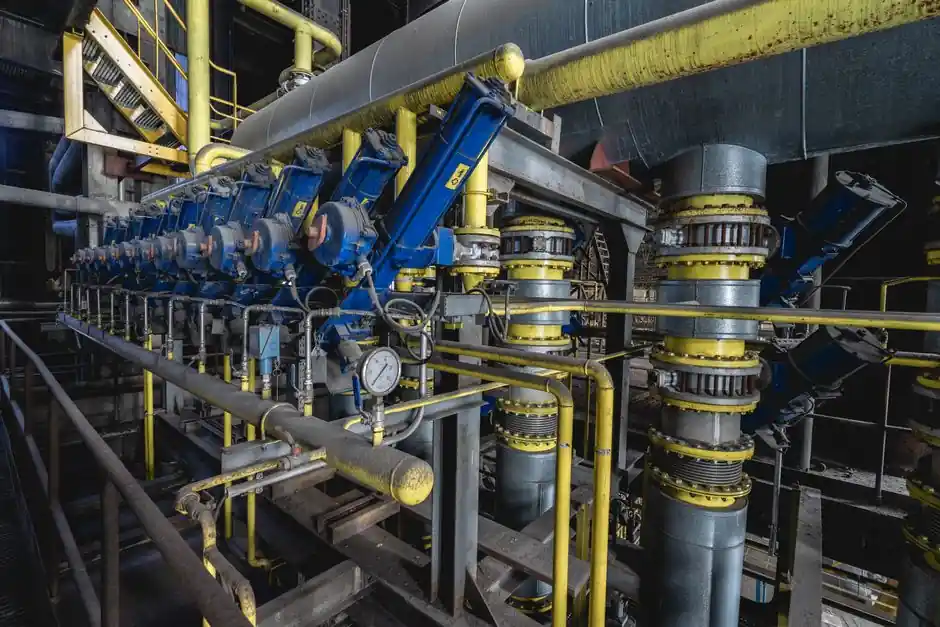
Heat exchangers transfer heat between two fluids across a solid separating surface without mixing them, and the construction choice (shell-and-tube, plate, finned-tube, or double-pipe) is governed by operating pressure, temperature, fouling tendency, and required thermal efficiency [S1][S4].
Industrial demand covers power generation, chemical processing, oil and gas, HVAC, refrigeration, food processing, marine, and sewage treatment, with sizing codes from TEMA and ASME governing shell-and-tube builds and TEMA classes A, B, and C still defining the dominant HVAC versus petrochemical split [S3][S4][S6].
Classification by Construction: Four Practical Families
By construction, the working set is double-pipe, shell-and-tube, plate/frame, and finned-tube, with each family branching into multiple sub-types [S1]. Shell-and-tube units are the workhorse of oil-and-gas and power duty, plate units dominate compact HVAC and clean-process duty, and finned-tube (extended surface) units handle air-side heat transfer where the gas film controls the U-value [S1][S2][S5]. A walk-through of the plate heat exchanger family shows why the gasketed plate style displaced many straight-tube liquid-to-liquid duties after the 1980s: larger effective area in a smaller envelope and easier mechanical cleaning [S5].
Double-pipe exchangers remain relevant for small-flow, high-temperature, or highly fouling service because the inner pipe can be replaced cheaply, and the annulus can be cleared with a rod [S1][S7]. Spiral and hairpin variants extend the same principle to viscous crudes and slurries where straight tubes would foul in days [S6][S7].
Flow Configuration: Why Counterflow Dominates
Counterflow exchangers, where hot and cold streams enter from opposite ends, reach 70–90% thermal effectiveness depending on flow rate and temperature differential, beating parallel-flow and cross-flow configurations on the same log-mean temperature difference (LMTD) [S4]. Cross-flow units typically sit in the 50–70% range on air-side duty, which is why finned-tube coils and air-cooled heat exchangers are sized with larger face area to compensate [S4].
Parallel-flow layouts are chosen only when outlet temperature matching matters more than heat recovery, for example in low-temperature crystallizer service where thermal stress on the tube sheet is a real failure mode [S4]. Multi-pass shells (1-2, 2-4, and 2-6) trade higher mean velocity and turbulence for added pressure drop, with 4-pass tube-side layouts being a common default in TEMA C shells for process fluids above 2 m/s tube velocity [S3].
Shell-and-Tube Sub-Types: U-Tube, Straight, Floating Head
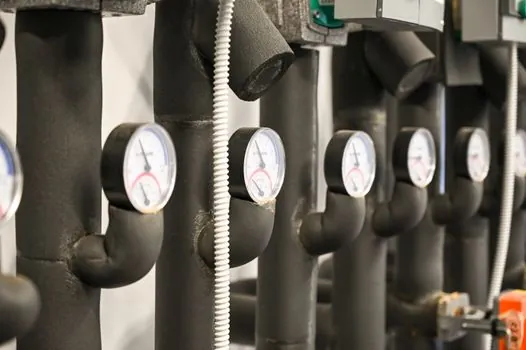
U-tube shells tolerate differential thermal expansion of copper or stainless tubes versus a carbon-steel shell, a critical point when one side is 250 °F (15 PSIG) steam and the other is a water/glycol mix; the steel shell may grow 1.5 in while copper tubes grow 2.3 in over the same 200 °F rise, and the U-bend absorbs the 0.8 in delta [S5]. Straight-tube shells are still specified for dirty water, slurries, and oils because each tube can be rodded straight through without disturbing the piping, especially when a removable channel head is fitted [S5].
Floating-head designs expose the entire tube bundle for cleaning and accommodate thermal growth, which is why they dominate TEMA C petrochemical service, refinery overhead condensing, and high-pressure feed/effluent exchangers above 70 bar [S3][S5]. Fixed tube-sheet shells remain the lowest-cost option for clean, equal-pressure services below about 30 bar differential, where bundle removal is not required for routine maintenance [S3].
Plate and Brazed Plate Exchangers: Compact Surface, Tight Tolerances
Gasketed plate heat exchangers (GPHE) stack corrugated stainless or titanium plates with elastomer gaskets, delivering 200–500 m² of effective area in a footprint a shell-and-tube unit would need three to five times the volume to match [S1][S5]. Plate materials span 304/316 stainless, titanium (seawater and chlorides), and SMO/254 for high-chloride brine, with EPDM, NBR, or FKM gaskets selected against the process fluid and temperature window [S5][S6].
Brazed plate exchangers (BPHE) vacuum-braze the plate pack with copper or nickel, eliminating gaskets and raising design pressure to roughly 30–45 bar with temperature ceilings near 200 °C on copper-brazed units, making them the default for evaporator and condenser circuits in chiller packages and heat pumps [S1][S5]. Welded plate blocks, where the plate pack is fully laser-welded for hazardous service, extend the same geometry into refinery and hydrocarbon duty where a gasket leak is unacceptable [S6].
Finned-Tube and Air-Cooled Exchangers: Where the Air Film Rules
Finned-tube coils multiply external surface area to break the air-side thermal resistance, with helical aluminum fins on copper or steel tubes being the common HVAC form and extruded fin tubes serving higher-temperature process gas coolers [S2][S6]. Air-cooled heat exchangers (ACHE) bundle finned tubes inside a plenum with forced-draft or induced-draft fans, and they are the default cooler in refineries, gas plants, and compressor stations where cooling water is scarce or expensive [S1][S6].
For cryogenic and LNG duty, aluminum plate-fin heat exchangers (PFHE) braze thousands of fins into compact cores, reaching area densities above 1000 m²/m³ and supporting multi-stream distribution in a single block [S6]. Selection pivots on the air-side U-value, fin density (typically 8–14 fins per inch for HVAC, lower for fouling gas streams), and material pairing that avoids galvanic corrosion between aluminum fins and copper tubes in humid service [S1][S2].
Selection Criteria: Matching Design to Duty
For clean liquid-to-liquid HVAC duty below 16 bar and 150 °C, GPHE or BPHE wins on footprint and approach temperature, typically 1 °C close to the cold outlet [S1][S5]. For high-pressure refinery, steam-generation, and chemical-reactor feed/effluent duty above 30 bar or 300 °C, shell-and-tube (TEMA C or B) is the default because of its pressure envelope, mechanical cleaning access, and code-stamped pedigree under ASME BPVC Section VIII [S3][S5].
For air-side cooling and condensing in remote or water-scarce sites, finned-tube ACHE is chosen; for viscous, fouling, or particulate-laden fluids, straight-tube removable bundle shells with larger tube diameters (typically 25–50 mm) are picked over plate units whose narrow channels plug in days [S5][S6]. For very high effectiveness on gas-gas or multi-stream cryogenic service, brazed aluminum PFHE cores are specified [S6].
Materials, Standards, and Failure Modes
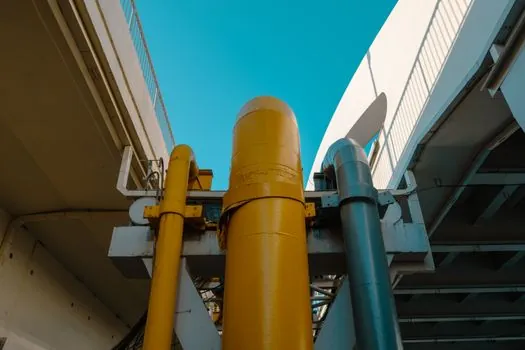
Common material pairings are carbon-steel shell with copper or 304/316 stainless tubes for HVAC, 316L or duplex stainless tubes for chloride-bearing service, titanium for seawater and wet chlorine, and nickel-copper (Alloy 400) or stainless for hydrofluoric acid alkylation duty [S3][S6]. Shell-and-tube design and manufacture are governed by TEMA standards (classes A, B, C for HVAC, general process, and refinery/chemical) and by ASME BPVC Section VIII for pressure-boundary code stamping [S3].
Dominant failure modes are fouling (loss of U-value and increased pressure drop), corrosion (galvanic, pitting under deposits, and stress-corrosion cracking on austenitic stainless in chloride service), and mechanical damage from thermal cycling or water hammer [S3][S5]. A four-pass tube bundle raises tube velocity above 2 m/s, which suppresses fouling but increases pumping cost, a trade-off usually resolved with the basket strainer upstream to protect the channel head from particulates. Inspection intervals follow TEMArecommended tube-sheet leakage testing, eddy-current or helium leak testing of tubes, and shell-side hydrotest after every bundle pull [S3].
Application Map: Where Each Type Sits
Power generation and steam surface condensers stay in TEMA C shell-and-tube territory with thousands of 25 mm tubes, often titanium in seawater-cooled units, while district heating and boiler feedwater preheats have moved heavily into BPHE for compact skid-mounting [S1][S3][S6]. Refrigeration and chiller packages are now dominated by BPHE for evaporator, condenser, and economizer circuits, with air-cooled finned coils on the condenser side [S5][S6].
Chemical and petrochemical reactors use shell-and-tube fixed or floating-head units as feed-effluent exchangers, often with bellows or expansion joints to absorb shell-to-tube differential growth, while plate-fin cores handle cryogenic ethylene, LNG, and air-separation cold boxes [S3][S6]. Marine and offshore platforms favor titanium plate or GPHE for seawater cooling and shell-and-tube for lube-oil and freshwater generators, all selected against DNV, ABS, or Lloyd's rules for pressure equipment [S6]. Food, dairy, and pharmaceutical duty typically specify 316L sanitary GPHE with EPDM gaskets and crevice-free plate geometry to meet 3-A and EHEDG cleanability rules [S6].
Trackable signals over the next reporting cycle: TEMA's ongoing review of high-pressure design margins for hydrogen service heat exchangers, the broader copper cathode demand picture shaping tube and fin supply, and the rising share of welded plate blocks displacing gasketed GPHE in midstream hydrocarbon duty [S1][S3][S6].
For component-level specifications, see heat detector, and heat treatment furnace.