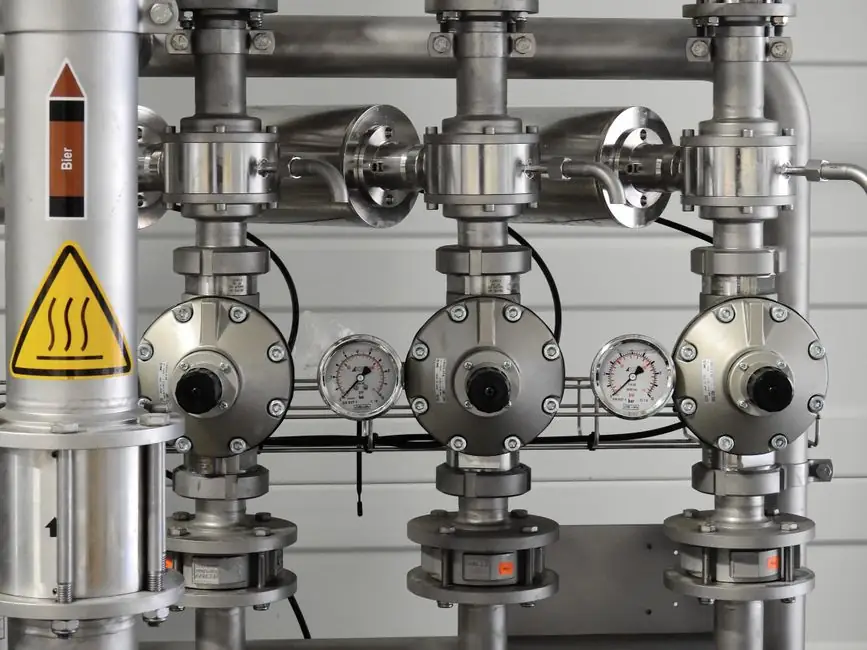
Refrigerant-side pressure transmitters for heat-pump compressor skids are commonly specified for 0-30 bar gauge with 4-20 mA plus HART output, paired with PT100 or PT1000 temperature probes on suction, discharge, and evaporator liquid lines.
The European Heat Pump Association confirmed registration opened on 22 July 2026 for the Heat Pump Forum & Awards 2026, scheduled for 01 December 2026 at SQUARE, Mont des Arts, 1000 Brussels, framing industrial heat-pump deployment as a stated EHPA policy priority [S1]. Across residential and light-commercial retrofits, contractors such as Red Rock Mechanical in Burlington, VT cite up to 60% energy savings when replacing an electric furnace with a heat pump, a figure that directly raises the value of accurate part-load monitoring [S2].
Control loop architecture and sensor selection
Heat-pump control loops run on the same vapor-compression skeleton as commercial refrigeration: compressor suction superheat, discharge superheat, subcooling at the condenser, and either a thermostatic or electronic expansion valve, with the loop protected by high- and low-pressure cut-outs. [S2]
Process-side pressure instrumentation typically uses stainless-diaphragm transmitters clamped or threaded into Schrader-accessible access ports on the liquid line, suction line, and discharge line; for ammonia (R-717) and CO2 (R-744) skids, wetted materials are upgraded to 316L stainless for ammonia and high-pressure-rated designs for CO2 transcritical operation. process-control foundations remain the same as on a chiller: transmitter output drives either a PLC PID block or a dedicated electronic expansion-valve controller, and process calibration of these loops is a documented commissioning step before any heat-rate guarantee is signed off.
Transducer and valve sizing envelope
Discharge pressure on an R-410A air-source heat pump at 45 °C condensing sits around 26-30 bar gauge; a transmitter ranged 0-40 bar with over-range to 60 bar keeps headroom without sacrificing resolution. Suction pressure on the same unit at 5 °C evaporator is roughly 9-10 bar gauge, so a 0-15 or 0-20 bar transmitter is the standard fit, and a 0-30 bar is usually the lowest cost-effective universal option for OEM skid builders carrying one SKU across R-32, R-410A, and R-454B. [S2]
Expansion-valve selection is driven by refrigerantspecific nominal capacity in kW, allowable pressure drop across the valve (typically 2-6 bar on the high side), and superheat setpoint, with electronic stepper-valve drivers adding a 0-10 V or 4-20 mA setpoint input from the controller. For industrial-heat applications the relevant heat treatment furnace disciplines overlap: heat-pump condenser duty curves, pinch-point ΔT, and part-load control behaviour are modelled with the same heat-exchanger math used in metallurgy, although at source temperatures from 60 °C up to 160 °C for industrial heat-pump deployment. Flow instrumentation on the source and sink water loops tends to be vortex or electromagnetic meters with HART, sized for 0.5-3.0 m/s and PN16 flanges; ultrasonic clamp-on meters are increasingly common on retrofit work where the pipework cannot be drained. V-process line analogies are not literal, but the commissioning discipline, calibrate transmitter, verify valve stroke, log steady state, mirrors any well-run process skid.
Communication protocols and controller integration
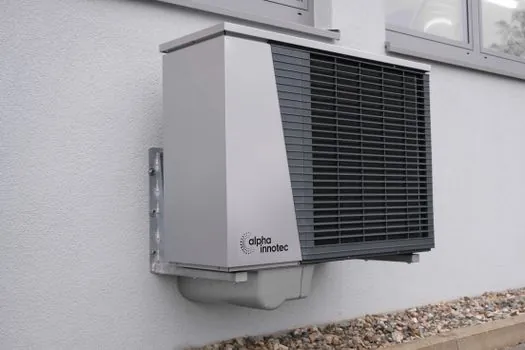
Field communication on a packaged heat-pump skid is overwhelmingly HART on a 4-20 mA loop, with Modbus RTU over RS-485 as the most common multi-drop layer feeding BMS or SCADA gateways. Foundation Fieldbus and PROFIBUS PA show up on heavy-industrial process-heat deployments where the heat pump is treated as one of several heat-recovery units feeding a plant steam header. [S3]
The European Heat Pump Association frames industrial heat pumps as a core technology in their "Electrification for energy sovereignty" policy line, with Heat Pump Forum 2026 on 01 December 2026 in Brussels positioned as the working-level venue for that agenda [S1]. Controller hardware in this class is dominated by PLCs with PID blocks rated for 10-50 ms loop time, expansion-valve driver boards with their own internal superheat-PID, and inverter-driven compressor controllers that expose a 0-10 V or PWM speed-reference input; the practical consequence is that multifunction process calibrator work in commissioning typically has to drive current, voltage, frequency, and resistance from one tool, since each loop family is referenced to a different physical variable.
Selection criteria and vendor landscape
Specifying instrumentation for a heat-pump skid reduces to four decision criteria: refrigerant compatibility of wetted materials, operating pressure envelope versus the worst-case compressor trip, output protocol matching the existing BMS, and ambient rating for outdoor cabinets (typically -20 °C to +55 °C, IP65 minimum). [S2]
U.S. wholesale distribution of residential mini-split heat pumps at price points starting from $438.00 is reported by Genie Air Conditioning and Heating, a distributor carrying LG, Midea, Cooper and Hunter, Frigidaire, Samsung, Soleus, Amana, and General Electric, which sets the low end of the volume curve against which any industrial-scale instrumentation BOM is benchmarked [S3]. The honest comparison is: (1) a packaged OEM skid with factory-integrated HART sensors, longer lead time but single-point warranty, versus (2) a system-integrator build using third-party transmitters and valves, shorter lead time and easier field replacement, at the cost of a less tidy documentation package. Neither choice is wrong; the deciding factor is whether the operator's maintenance crew is trained on the OEM service tool or on a generic HART handheld. For process plants with an existing instrument fleet, option 2 usually wins on stocking and heat detector service-cost continuity, even where option 1 wins on commissioning speed.
Limitations, failure modes, and what instrumentation cannot fix
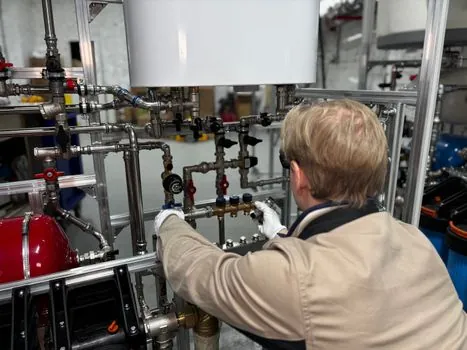
Instrumentation does not correct poor refrigerant charge, fouled condensers, or improperly sized expansion valves; it only reports state. A superheat probe installed in the wrong location (downstream of a distributor rather than at the evaporator outlet) will read 2-4 K low and drive the valve open until the compressor floods, with the high-pressure cut-out as the only remaining safeguard. [S2]
Outdoor transmitter placement is a recurring failure source: a discharge-line pressure transmitter mounted in direct sunlight on a black-painted compressor will drift on a summer afternoon, and a suction-line thermowell not sealed with conductive paste will read 1-2 K high. Both of these are documented process control rules in any chiller commissioning manual, and they apply unchanged to heat pumps. Industrial-heat-pump retrofits that try to reuse legacy 4-20 mA loops from a steam system are the most common mismatches: the steam loop was probably ranged 0-10 bar for saturated 180 °C service, while a heat-pump hot-water loop at 120 °C sits around 2 bar, leaving only the bottom 20% of the transmitter range usable. Cost discipline in this segment also matters: a structured light scanner spec map 2026 buyer doing a parallel capex review will recognise the same logic, do not pay for measurement range you cannot use, and do not accept a 0-50 bar transmitter on a 0-15 bar service. Standard mapping for industrial heat pumps cites EHPA's policy line on "Tap heat pumps' efficiency and flexibility" as the framework document for any European-spec build, with the next working-level checkpoint at the Heat Pump Forum on 01 December 2026 in Brussels [S1].
Trackable signal: the Heat Pump Forum & Awards 2026 on 01 December 2026 at SQUARE, Brussels is the next scheduled venue for EHPA policy and industrial-heat-pump instrumentation positions to be formalised [S1].