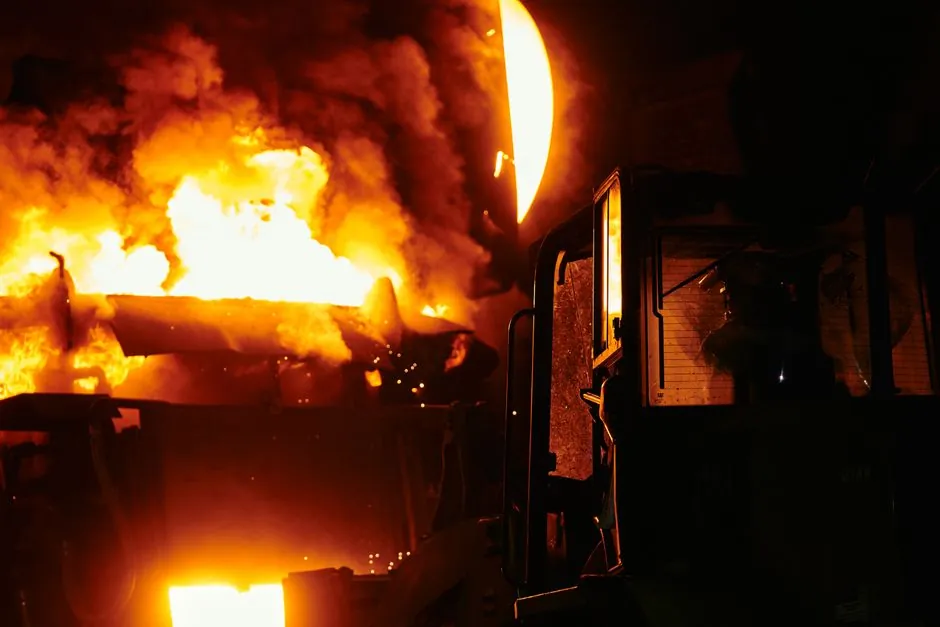
A 4,000 lb/hr mesh-belt furnace demonstrates why furnace price per ton per hour cannot be reduced to a catalogue number: throughput depends on belt loading, cycle time, atmosphere control, and the complete processing line [S5].
Batch box furnaces support an 8,000 lb maximum load, while Mesh Belt furnace lines support up to 4,000 lb/hr neutral-hardening capacity [S4][S5].
Price per ton per hour needs a defined calculation basis
One short ton equals 2,000 lb, so a furnace rated at 4,000 lb/hr has a nameplate material rate of 2 tons/hr before accounting for cycle time, loading, unloading, or rejected material [S5]. That rated rate is not the same as saleable output per operating hour.
The usable calculation is furnace acquisition cost divided by annual saleable tonnes processed, combined with energy, labour, maintenance, and lost-capacity costs. The U.S. Department of Energy process-heating sourcebook covers heat balances, heat-loss quantification, and energy-efficiency assessment, which are the relevant checks before assigning an operating cost to a furnace [S1].
Electric operating cost can be calculated directly from connected load and run time. A 3 kW oven operating for 3 hours consumes 9 kWh; multiplying 9 kWh by the electricity tariff gives the cycle energy charge [S2]. The same example illustrates why cycle duration, not furnace nameplate capacity alone, controls the cost of a batch.
Throughput options set different price and cost structures
Box furnaces are batch systems. One listed installation has a 95 x 63 x 36 in work zone, an 8,000 lb maximum weight, and a 2,200°F maximum temperature, with 2 units offered [S4]. Their acquisition price is easier to understand than continuous-line pricing, but cost per ton depends heavily on batch density and how close the load approaches 8,000 lb.
Mesh-belt furnaces serve continuous, high-volume processing. Can-Eng completed commissioning of a 4,000 lb/hr Mesh Belt Furnace System in 2020 and was awarded a contract to deliver a second line capable of up to 4,000 lb/hr neutral hardening [S5]. More equipment raises capital complexity, but automation and tracking can improve utilization and process control [S5].
Vacuum furnaces address controlled-atmosphere processing rather than high-tonnage steel treatment. A costing example allocates a $30,000 furnace-system expense across furnace operating hours to derive an hourly rate [S3]. This is an hourly equipment-cost method, not a published furnace purchase price, and should not be presented as a universal market price.
Temperature, load, and process scope narrow the comparable price

A high-temperature box furnace reaching 2,200°F is not comparable with a 1,000°F tempering furnace. The listed box furnace measures 95 in long by 63 in wide by 36 in high, accepts a maximum load of 8,000 lb, reaches a maximum temperature of 2,200°F, and is available in two units for hardening, annealing, stress relieving, and normalizing [S4].
Low-temperature treatment creates another category. The listed cryogenic freezers have a 70 x 46 x 46 in chamber, hold 1,500 lb, and reach -120°F, with 2 units available [S4]. A full process quotation may therefore combine a heating furnace with cryogenic stabilization, oil quenching, tempering, washing, cooling, and hardness inspection rather than treating the furnace as a standalone asset.
Mesh-belt pricing also depends on whether the scope is hardening only or the integrated sequence for carbonitriding and carburizing. The documented line includes a protective atmosphere-controlled mesh belt, oil quench, pre-wash, post-wash, tempering, and inline cooling [S5]. Omitting these units would understate both capital price and cost per processed ton.
Energy and maintenance dominate total operating cost
For an electric furnace, energy cost follows kWh multiplied by the applicable tariff, as shown by the 3 kW for 3 hours example [S2]. Heavier loads, longer soak times, higher temperatures, and loss of recoverable heat increase consumption. A smaller oven operating for more hours does not automatically cost less than a larger unit with a shorter cycle, which is why energy per ton must be measured from actual cycles [S2].
For gas-fired equipment, the comparable calculation uses fuel input, burner output, and delivered heat to the load. The DOE sourcebook frames this through system heat balances and quantified heat losses, allowing idle and standby losses to be separated from useful process heat [S1]. A vendor can quote an efficient furnace, but poor loading, excess combustion-air settings, or long idle periods still raise the cost per ton.
Maintenance cost must include refractory inspection and repair, heating-element or burner service, atmosphere-control upkeep, quench and conveyor maintenance, thermocouple calibration, and spare parts. Annualized maintenance and downtime therefore belong in the purchase-price comparison, not in a lower quoted furnace rate.
The main cost drivers rank differently by project
For a capital purchase, materials and furnace construction come first, followed by temperature capability, working volume, maximum load, atmosphere and quench requirements, controls, safety provisions, and installation scope. Certification, commissioning, and proving add cost, but the research provides no numeric price range for these elements, so a defensible quotation should separate them rather than hide them in an untraceable allowance. [S5]
For operating cost, the principal drivers are energy per saleable ton, annual throughput, utilization, labour, maintenance, and lost production during maintenance. Capacity has a nonlinear effect: a 20,000 lb car-bottom load can spread fixed furnace and handling costs across more mass than an 1,500 lb cryogenic batch, but the workpieces must actually fill that capacity [S4].
Lead time and scale further affect price because a continuous line integrates more equipment than a standalone batch furnace. The documented 4,000 lb/hr mesh-belt line demonstrates this scope difference, including automated handling and Level 2 automation for process data, diagnostics, cost analysis, and inventory management [S5]. For a fair comparison, continuous and batch systems must be priced per saleable ton over the same operating period.
Who benefits from each furnace configuration
High-capacity continuous equipment is suitable for automotive, aerospace, contract heat treatment, and other production requiring repeatable atmospheric hardening, carburizing, or carbonitriding. Its 4,000 lb/hr neutral-hardening rating and integrated automation fit continuous workloads, but the complete line requires disciplined loading and upstream and downstream process control [S5].
Batch box and car-bottom furnaces fit custom work, variable part sizes, large components, and moderate production volumes. The 8,000 lb box-furnace limit and 20,000 lb car-bottom limit allow substantial loads, while the latter is more appropriate for oversized aerospace, locomotive, and automotive parts [S4]. Vacuum equipment is better matched to controlled vacuum processing and smaller or high-value loads where the hourly-rate approach is more relevant than mass-ton economics [S3].
Build a comparison-ready supplier data sheet
A defensible heat treatment furnace price per ton per hour requires at least 6 operating fields: saleable throughput in lb/hr, cycle length in minutes, load weight per batch, furnace quantity, annual operating hours, and annual saleable tonnes. Add connected power in kW or burner input, process temperature, working dimensions, maximum load, atmosphere, quench method, and the installed scope. [S5]
Calculate capital cost per annual saleable ton by adding installed price, installation, commissioning, controls, and applicable certification, then dividing by annual saleable tonnes. Calculate energy cost from measured kWh or fuel consumption per cycle. Add maintenance, labour, and downtime on the same annual-tonnage basis. The 3 kW and 3 hour example and the $30,000 hourly allocation example provide simple formats for those calculations [S2][S3].
The first commercial comparison should normalize the mesh-belt case from 4,000 lb/hr to 2 tons/hr before applying actual cycle efficiency, while preserving the full line scope [S5]. The next control point is a measured production trial that records load mass, cycle time, energy, rework, and uptime, because those values determine whether the quoted furnace rate survives contact with production.