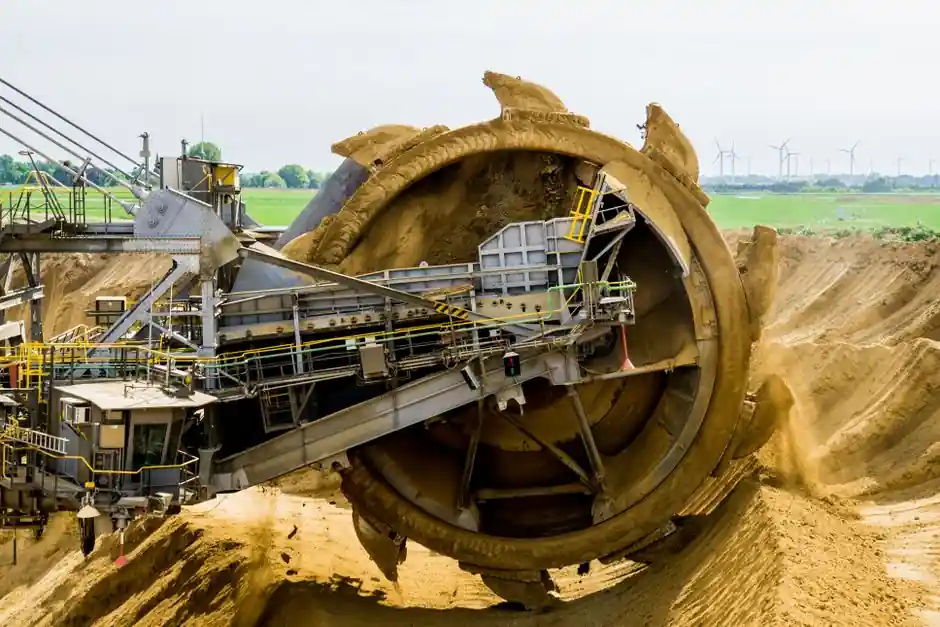
A heavy-duty shakeout grid can handle casting-and-sand loads up to 50 t, with a single grid providing up to 20 m² of working surface for large castings [S4].
The equipment is intended for vertical vibration, crane-loaded molds, and high-weight, low-volume foundry work where sand removal and casting protection must be balanced [S4].
Working Envelope for 20–50 Ton Castings
A shakeout machine for a 20–50 ton casting should be selected from the largest casting weight, flask or mold-block dimensions, sand load, and impact conditions, not from nominal production rate alone. Published shakeout-grid information identifies single-grid surfaces of up to 20 m², multi-grid surfaces that can be arranged to other sizes, and loads up to 50 t [S4].
The cited dimensional envelope is a screening point, not proof that every 50 t machine is suitable for every 50 t casting. A 20 m² grid must still be checked against the actual mold footprint, support arrangement, casting geometry, and total mass of the casting plus residual sand [S4]. Crane-fed molds are typical for this class of equipment because the mold and casting are loaded and removed separately [S4].
Carrier offers standard deck sizes ranging from 3 ft × 3 ft to 10 ft 6 in, and its shakeout and attrition combination units are engineered to handle loads up to 12.5 tons [S2]. That spread makes the casting mass, rather than deck area alone, the central selection criterion.
Vertical Knockout and Sand Separation
Large-casting grids normally apply vertical vibration to separate the metal casting from molding sand or bonded-sand clumps [S4]. This arrangement supports gravity-assisted discharge below the grid, where an under-floor conveyor can remove used sand and route it to reclamation and conditioning [S4].
Stationary grids address single-production or unusually heavy work. interVIB offers continuous shakeouts (SOC) and stationary shakeouts (SOS) for separating castings from molding sand [S5]. For a 20–50 ton part with low production frequency, a stationary grid is usually the more defensible starting point.
The separator also needs a controlled sand-retention strategy.
Grid, Deck, and Drive Configurations
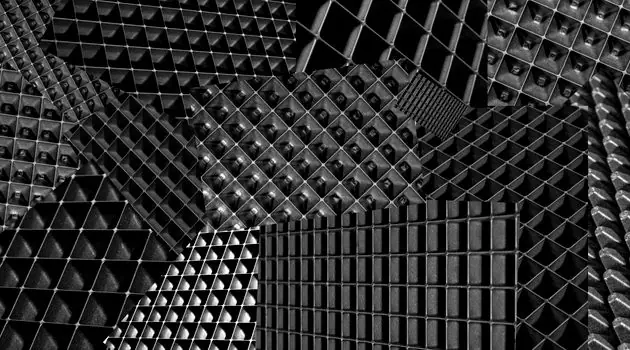
Three principal layouts suit heavy shakeout duties: a simple stationary grid, a deck-and-attrition combination, and a continuous trough. The stationary grid is compact and purpose-built for large, infrequent castings; the deck-and-attrition system adds lump reduction; the continuous trough combines movement with separation. [S2]
For a 20–50 ton casting, the key comparison is not simply purchase price. It is load capacity, working surface, sand-lump handling, casting protection, and plant integration.
Foundation, Access, and Reclamation
Foundation design is part of the machine specification. A counter-support construction integrates the hopper into the frame, reducing required pit depth and associated civil cost. The alternative cited for sand removal is a special angled-bucket elevator capable of transporting more than 30 t/h of sand [S4].
Heavy grids also require controlled crane handling and impact tolerance. interVIB states that its shakeouts resist impacts from heavy castings falling from a defined height, while Hewitt Robins International offers non-discharging shakeouts for foundry applications [S3]. The drop height, lifting points, and casting approach should therefore be engineered rather than left to operator practice.
Carrier states that its shakeout and attrition systems use heavy-duty components and a primary shakeout deck, secondary attrition screen, and discharge mesh screen to reduce sand lumps to grain size [S2]. These are meaningful options for a 20–50 ton grid because liner life and casting contact govern maintenance intervals.
Drive, Controls, and Operating Limits
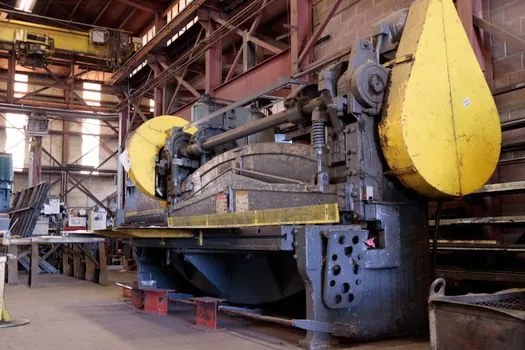
A heavy-duty grid needs drive torque and upset-condition capacity, not just sufficient nominal force. Carrier states that the drive system is designed to handle upset conditions [S2].
Cyrus Vibration Machines India's industrial shakeout machine handles up to 3–40 tons per hour [S1]. These figures come from a single manufacturer and should be treated as a vendor-defined configuration, not a universal performance guarantee.
That thermal figure should not be interpreted as a continuous operating-temperature rating without confirmation, particularly for sand, cores, and casting residue at the grid surface.
Heavy Casting Failure Modes and Controls
Excess vibration can damage fragile castings, while insufficient vibration leaves bonded sand, cores, and lumps around internal surfaces. Carrier differentiates low-vibration and high-vibration designs and notes that its deck system reduces no-bake sand to grain size through three stages: primary shakeout, secondary attrition, and discharge screening [S2].
Other common constraints include plugging of discharge openings, erosion of deck edges, overload during crane placement, and uneven sand removal beneath heavy sections. Opening geometry, boltable wear plates, moisture-resistant liners, and programmed vibration sequences address these risks [S2][S5].
Automating mold transfer can reduce crane exposure and cycle variation, but it does not replace load-cell confirmation, secure mold seating, and controlled vibration. The foundry must also decide where to place a casting that may still carry cores or hot sand. The grid separates material, while cooling and core-removal quality remain upstream operations.
Supplier and Acceptance Checklist
Ask each supplier to quote against the same maximum casting mass, total load, mold footprint, sand type, bond type, and casting sensitivity. Verify whether the stated capacity applies to the complete casting-plus-sand load or only to the metal casting [S2][S4].
Request evidence for grid dimensions, excitation arrangement, drive rating, liner material, opening size, impact tolerance, vibration sequence, and crane interface. For grid systems, published reference points include a 20 m² single-grid area, 50 t load capability, and more than 30 t/h sand transport through an angled-bucket elevator [S4].
The most important trackable signals after commissioning are retained-sand mass per casting, casting damage frequency, peak grid load, rejected sand lumps, vibration-motor current, and wear-liner consumption. These operating records provide a better basis for acceptance than an unqualified statement that a machine is rated for 50 t.
A 20–50 ton casting should move to a vertical-vibration stationary grid when production is intermittent and the mold can be crane-fed; a deck-and-attrition combination is preferable when bonded-sand lump reduction is part of the daily duty [S4][S5].