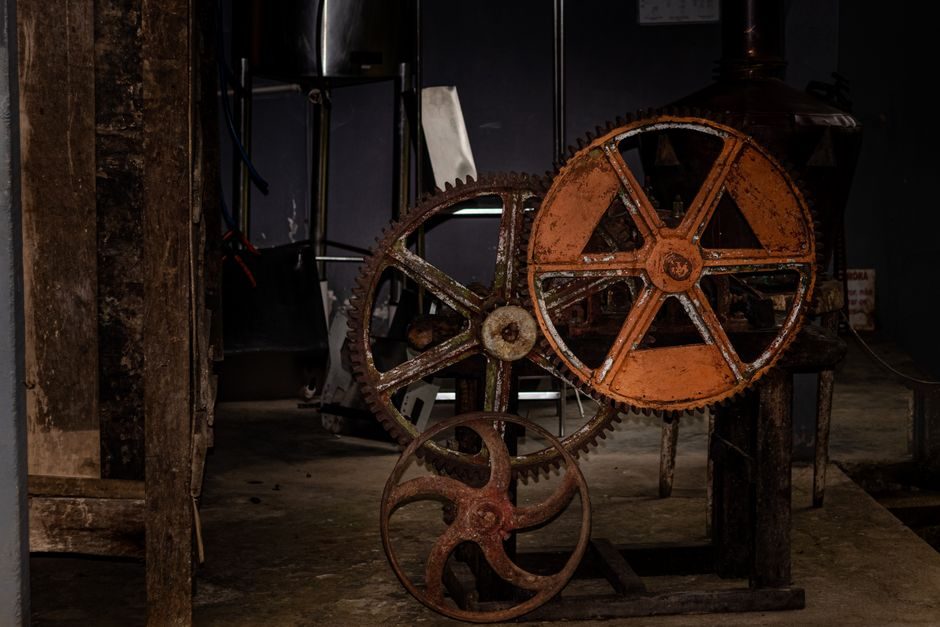
Helical gear reducers split into coaxial, parallel-shaft, and right-angle configurations, with published 2026 OEM lines covering torque from 10 Nm up to over 10 kNm and power from 0.06 kW to 220 kW across single-, double-, and triple-stage builds [S1][S2][S3][S4].
The taxonomy below is built from the shaft-orientation and torque-class data published on current OEM product sheets (Bonfiglioli KR, Transtecno CMG, I-MAK A/AE, Hansen HSM, Stm RXP 700, GEARKO TB, k-ngear XDJ) rather than from generic catalogues, and is aimed at process engineers writing a procurement spec [S1][S2][S3][S4][S5][S6][S7].
How the Three Shaft Orientations Define the Family
The first cut is shaft orientation, and it decides housing, footprint, and ratio envelope before any other parameter is set [S1][S2][S3][S4].
Coaxial helical units — input and output on the same centerline — are the compact default for conveyors, mixers, and general transmission duty; Transtecno's CMG line covers 500–1000 Nm at 0.06–7.5 kW with die-cast aluminium housings up to size 04 and cast iron at size 05, ground-hardened helical gears, and permanent synthetic oil long-life lubrication [S2]. Parallel-shaft units offset input and output on parallel axes, which trades coaxial compactness for a higher ratio per stage and easier through-shaft mounting; Stm's RXP 700 covers 200 Nm to 5 kNm at 0.31–43.1 kW and was launched as a natural complement to the RX 800 line, confirming parallel-shaft as the workhorse family for industrial drives in the 1–50 kW band [S6]. Right-angle units use bevel-helical or hypoid-helical combinations to fold the drive 90°, and Bonfiglioli's KR series delivers 10–200 Nm at 5,000 rpm max in a single-stage, flange-mount hollow-shaft package aimed at space-saving layouts [S1].
Stage Count, Ratio Envelope, and Where Each Architecture Wins
Helical gearing scales by adding stages, and each added stage roughly squares the available ratio band, which is the lever engineers use to hit a target output speed from a fixed motor [S1][S4][S7].
Single-stage coaxial helical units sit in the 1:1 to 5:1 band (Bonfiglioli KR lists gear ratios of 1, 2, and 5 in a single stage) and are used where a small reduction is needed but a right-angle or offset is unacceptable [S1]. Two- and three-stage helical inline units stretch the envelope to roughly 6:1 up to about 250:1, which is the band most parallel-shaft catalogues target for industrial agitators, extruders, and cranes. Shaft-mounted helical reducers like Hansen HSM use a 25-degree pressure-angle gear set with keyless taper-grip bushing mounting and integrated backstop, covering ratios from 5:1 to 220:1 at 0.2–220 kW, which is the practical upper limit for monolithic helical boxes [S4]. Beyond a single reduction around 250:1 in a single housing, designers step to helical-bevel or move into planetary helical units for higher ratios in the same envelope.
Torque Class Bands and the Heavy-Duty End of the Catalogue
Published OEM torque bands cluster into three practical tiers, and the boundaries are stable across vendors because they reflect bearing and gear pitch-line limits rather than marketing [S1][S2][S3][S4][S6].
Compact / instrument-class reducers span 10–200 Nm and are typically single-stage, right-angle, flange- or hollow-shaft mounted, exemplified by Bonfiglioli KR and the lower end of Transtecno CMG at 0.06 kW [S1][S2]. Mid-range industrial units span 200 Nm to 5 kNm and cover the bulk of conveyor, mixer, and extruder applications, with Stm RXP 700 (200 Nm – 5 kNm, 0.31–43.1 kW) and GEARKO TB planetary-helical (50 Nm – 5 kNm, 2,000–10,000 rpm) anchoring this band [S5][S6]. Heavy-duty industrial units start above 5 kNm and run beyond 10 kNm, with I-MAK A/AE covering greater than 10 kNm at 0.37–160 kW, 7–140 rpm output, and an ATEX option for hard environments like concrete mixers, pipes, and extruders [S3]. For very large reduction stages, a cycloidal reducer is a frequent cross-reference, but for steady high-torque parallel-shaft duty the I-MAK and Hansen HSM bracket defines the published ceiling in the 2026 set [S3][S4].
Mounting, Shaft Configuration, and Footprint Constraints
Mounting style is the second selector after orientation, and it is what determines whether the unit bolts to a motor face, a foot, a flange, or slides onto a driven shaft [S1][S2][S4][S5][S7].
Foot-mounted (IM B3-style) housings are the most common parallel-shaft pattern in the 1–50 kW range, with Transtecno CMG offering both flanges and feet across the same modular housing [S2]. Flange-mounted (IM B5 / B14-style) units bolt directly to a motor face or driven machine and are the standard fit for compact coaxial gear-motors. Shaft-mounted reducers (often called "shaft-mount" or "SM") clamp directly onto the driven shaft via a hollow bore and taper bushing — Hansen HSM uses a keyless Taper-Grip bushing and ships in ratios from 5:1 to 220:1, eliminating the need for a coupling and baseplate in conveyor and agitator layouts [S4]. Hollow-shaft output (Bonfiglioli KR, k-ngear XDJ) and solid-shaft output (I-MAK A/AE, GEARKO TB) are the two bore options, with hollow shafts preferred for shaft-mount and shrink-disc mounting and solid shafts preferred where a coupling, brake, or encoder must be added downstream [S1][S3][S5][S7].
Materials, Lubrication, and the Quiet Variables Behind the Spec Sheet
Published 2026 spec sheets differ most in housing material, gear finishing, and lubrication, and these three drive noise, life, and the ATEX / food-grade envelope more than the headline torque number [S2][S3][S7].
Housings run from die-cast aluminium at the compact end (Transtecno CMG sizes 00–04) to cast iron at the heavy end (Transtecno CMG size 05; I-MAK A/AE; Hansen HSM), with the crossover usually at 0.75–1.5 kW [S2][S3][S4]. Gear finishing is almost universally case-hardened and ground for helical units in this catalogue class — Transtecno explicitly lists "ground-hardened helical gears" for CMG — which is what makes helical the lower-noise default versus spur gearing at the same ratio [S2]. Lubrication is shifting from oil-fill to permanent synthetic oil long-life in the European lines, with CMG specifying it across the range, and I-MAK's A/AE highlighting long operating life plus an ATEX-rated variant for explosive atmospheres [S2][S3]. For precision motion duty, backlash and torsional stiffness start to matter as much as torque — Bonfiglioli markets KR as "precision, low-backlash" for applications that require space-saving and medium precision levels, and GEARKO TB specifies backlash-controlled planetary-helical builds in the 2,000–10,000 rpm range for that reason [S1][S5].
Application Map: Which Type Fits Which Duty
Matching the orientation to the application is more reliable than reading the headline kW figure, and the 2026 product set maps cleanly onto five recurring duty cases [S1][S3][S4][S5][S6].
Conveyors and belt drives are dominated by shaft-mounted parallel-shaft helical units (Hansen HSM, 0.2–220 kW, ratios 5–220) because they clamp directly onto the head pulley shaft and remove the need for a coupled alignment [S4]. Mixers, agitators, and extruders are dominated by heavy parallel-shaft helical units with high service factors (I-MAK A/AE, greater than 10 kNm, ATEX available), often supplied with a backstop to prevent reverse rotation on inclined screw conveyors [S3]. Right-angle helical units (Bonfiglioli KR, 10–200 Nm) fit where the motor must be folded out of the airstream or away from a hot zone, common in packaging, food machinery, and small conveyors [S1]. Coaxial modular helical units (Transtecno CMG, 0.06–7.5 kW) are the OEM default for pumps, fans, and small mixers, with foot or flange mounting both available from the same housing [S2]. Where torsional stiffness and ratio density are the bottleneck, helical planetary gear reducers (GEARKO TB coaxial or right-angle, 50 Nm – 5 kNm at 2,000–10,000 rpm) overlap the upper end of the helical-inline catalogue and are the right pick for servo-driven packaging and machine-tool axes [S5].
Selection Criteria and Comparison Table

A spec-driven comparison lines up the main options on torque class, ratio band, power, and typical mounting so the decision is auditable rather than vendor-driven [S1][S2][S3][S4][S5][S6].
Criteria for the comparison: torque class (Nm or kNm), ratio band, power range (kW), and preferred mounting. A helical gear coupling or industrial gear choice downstream should be checked against the reducer's output bore and keyway before finalising the spec, because most catalog rejections at commissioning are misalignment or coupling-bore mismatches, not torque errors. Use the table below to shortlist two or three lines before pulling full datasheets:
Coaxial helical inline (Transtecno CMG): 500–1000 Nm, 0.06–7.5 kW, ratio band defined by stage count, foot or flange, modular aluminium/iron housing — best for general pumps, fans, mixers [S2]. Parallel-shaft helical (Stm RXP 700, I-MAK A/AE): 200 Nm – 10+ kNm, 0.31–160 kW, high single-stage ratio plus multi-stage options, foot/flange/shaft-mount — best for conveyors, extruders, mixers [S3][S6]. Right-angle helical-bevel (Bonfiglioli KR): 10–200 Nm, up to 5,000 rpm input, single-stage, flange or hollow-shaft — best for compact, space-saving, medium-precision packaging lines [S1]. Shaft-mounted parallel helical (Hansen HSM): ratios 5–220, 0.2–220 kW, hollow-shaft taper-bush mount with integrated backstop — best for direct conveyor and agitator drives [S4]. Helical planetary (GEARKO TB): 50 Nm – 5 kNm, 2,000–10,000 rpm, coaxial or right-angle, low-backlash — best for servo-driven precision axes where a harmonic reducer or gear pump drive is not appropriate [S5].
Failure Modes, Limits, and Sourcing Reality in 2026
Three failure modes dominate field returns on helical reducers and are worth pricing into the spec rather than discovering at commissioning [S1][S3][S4][S5].
First, thermal limit: helical gear efficiency is high, but sustained output below 7 rpm at 10+ kNm (I-MAK A/AE's published minimum) with no auxiliary cooling will trip the housing oil-temperature limit long before the gear's mechanical rating — a common oversight in heavy-mixer tenders. Second, backlash creep in single-stage right-angle units used in positioning service — Bonfiglioli's "medium precision" KR is not a substitute for a backlash-controlled planetary on a servo axis, and the catalogue makes that distinction [S1]. Third, mounting and coupling alignment: shaft-mounted units (Hansen HSM) save a baseplate but transfer any driven-shaft deflection directly into the gear mesh, so driven-shaft runout and overhung load are part of the helical reducer spec, not the driven machine's. Sourcing reality in 2026: the Zhejiang cluster in China — represented by suppliers such as Zhejiang Shuanglian Machinery, member of the Chinese Speed Reducer Association — continues to publish generic R/RF/RX/RXF series lines at 0.18–160 kW, 6–1,154 rpm output, 20–18,000 Nm torque, and ratios 1.3–249.16, providing a low-cost baseline against which the European OEM lines (Bonfiglioli, Transtecno, I-MAK, Hansen, Stm) compete on lead time, documentation, and ATEX/IECEx coverage [S8][S9][S10].
Two trackable signals to watch over the next procurement cycle: Bonfiglioli's confirmation of KR series continuation in the 228-page TQ/TQF/TQK/TR/MP/LC/LCK/SL/KR precision planetary catalogue, and the follow-on Stm RX 800 launch that positioned RXP 700 as its natural complement — both indicate the helical-inline and right-angle families are still being actively extended, not consolidated [S1][S6].
Related analysis: Strapping Band TCO: Cost Drivers, Material Comparison, and 3-5 Year Ownership Math.