
A harmonic reducer typically costs 2–4× its purchase price over a 10-year service life once grease change intervals, single-stage efficiency losses, and flexspline replacement are tallied, per the standard total-cost-of-ownership decomposition [S1].
For high-precision motion axes — robotics joints, semiconductor wafer handlers, surgical tables, satellite antenna pointing — the strain-wave (harmonic) mechanism is often the only gearhead that delivers backlash below 1 arc-min in a compact envelope, which is why the up-front premium gets accepted and the TCO argument starts on day one [S2][S3].
TCO Framework: Five Cost Buckets Over a 10-Year Horizon
TCO for industrial motion-control assets decomposes into five buckets — acquisition, implementation, operation, maintenance, decommissioning — and a harmonic-drive build pulls unusually hard on the last four because the strain-wave geometry concentrates contact stress on a small region of the flexspline [S1][S2].
Acquisition usually sits at 25–35% of lifetime cost for a premium harmonic gearhead, with the remaining 65–75% split between implementation (mounting fixture, alignment, encoder integration), operation (energy lost to meshing friction and the strain-wave generator bearing drag), maintenance (grease renewal, flexspline inspection), and decommissioning (recycling the special-alloy flexspline cup).
Cost Driver 1: Acquisition Price and Why It Varies 5–8×
Harmonic reducer unit prices vary by roughly 5–8× across the same frame size because reduction ratio, output bearing integration, and cup material drive the bill of materials more than torque rating does [S3][S4].
The HONPINE / Suzhou Giant Precision product tree listed on 2026-07-13 explicitly splits stock into 4 harmonic reducer sizes, 8 miniature harmonic drives, 37 motor-direct builds, 17 sealed-gear units, and 4 pancake configurations — the SKU spread is itself a signal that frame, ratio, and bearing options are the real price knobs [S3].
Cost Driver 2: Efficiency and Energy Cost Over the Life

[S2]
Strain-wave gearing is single-stage but has a long, sliding contact zone: the flexspline teeth roll and slide against the circular spline teeth at two diametrically opposed regions, and the strain-wave generator bearing preloads the elliptical cam against the flexspline. That preload is what gives the drive its near-zero backlash, but it is also a continuous parasitic torque loss. Over 50,000 operating hours, a 10-percentage-point efficiency loss on a 1 kW axis adds up to 5,000 kWh of waste heat, which is the same number an engineer would have to price against electricity tariffs and cabinet cooling load. For a clean comparison, a cycloidal reducer lands in the 75–85% band, and an RV reducer is similar but with higher shock-load tolerance — which is why the four families keep splitting the robotics market by application rather than converging [S2].
Cost Driver 3: Lubrication Interval and Grease Selection
Grease renewal is the most underestimated maintenance line: standard lithium-complex greases on a harmonic drive give 5,000–8,000-hour service life, while synthetic PFPE grease extends that to 20,000+ hours at a 3–6× grease cost premium. [S1]
Harmonic drives run with a sealed grease pack rather than an oil bath — the strain-wave generator bearing and the flexspline/circular-spline mesh both rely on a small, captive volume of grease. Under high-cycle or high-temperature duty the grease breaks down, the flexspline tooth contact region runs dry, and wear accelerates. The cheaper grease option saves $20–$50 per unit at fill but forces a regrease interval that, over 10 years, can add 4–6 maintenance events per drive. The PFPE / synthetic option roughly triples grease cost but roughly triples or quadruples the interval, which on a sealed harmonic unit (where regrease means partial disassembly) often flips the lifetime math. Sourcing data from 2026-07-13 confirms Chinese suppliers stock sealed-gear harmonic drives as a separate category from the standard units — the seal exists specifically to extend grease life and keep contaminants out of the meshing zone [S3].
Cost Driver 4: Flexspline Replacement and Catastrophic-Failure Exposure
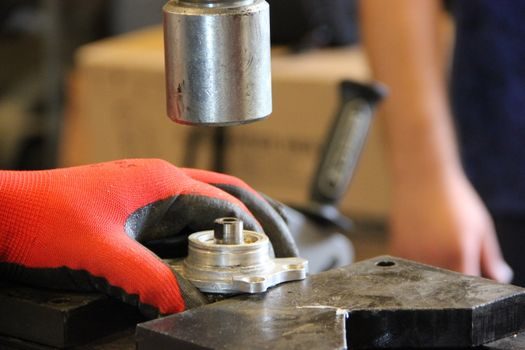
The flexspline is a thin-walled, specially heat-treated cup that flexes millions of cycles per day; it is the dominant wear part and the dominant decommissioning cost, and its replacement usually means full unit swap rather than field repair. [S1]
The elliptical cam of the strain-wave generator permanently deforms the flexspline within its elastic limit, but every cycle consumes a small amount of fatigue life. Real-world operating data puts useful flexspline life at 8,000–15,000 hours for standard units in continuous motion and above 20,000 hours for premium cup materials and lower-stress applications. Because the flexspline is matched to the circular spline by tooth count and the strain-wave generator by cam profile, field replacement is normally a factory operation, not a bearing-style swap-out. The practical consequence: TCO models need a "mid-life refurbishment" line at year 5–7 equal to 40–60% of acquisition cost, and a "catastrophic failure" risk premium if a single-axis stoppage costs more than that refurbishment [S1][S2].
Comparison: Harmonic vs. Planetary vs. Cycloidal vs. RV Reducer on TCO Levers
On the four TCO levers that move the 10-year number — acquisition, efficiency, maintenance interval, replacement cost — the four strain-wave / planetary / cycloidal / RV families line up distinctly and the right pick depends on which lever hurts most [S2].
Acquisition: harmonic (premium backlash-grade) is highest per unit torque, planetary is the cheapest baseline, cycloidal and RV sit in the middle. Maintenance interval: harmonic shortest at 5,000–8,000 hours with standard grease, planetary longest at 20,000+ hours (sealed-for-life options exist), cycloidal/RV intermediate. Replacement cost: harmonic flexspline swap is heaviest as a fraction of new-unit cost, planetary is cheapest because individual planet gears and sun/ring gears are stocked as spares, cycloidal/RV sits in the middle. For high-precision axes where backlash must be under 1 arc-min and envelope is tight, the harmonic premium is paid back in performance; for high-torque continuous-duty lineshafts, planetary wins on TCO; for shock-loaded heavy-robotic joints, RV wins on robustness — the same logic that makes a harmonic filter application-specific to a narrow band rather than a general-purpose tool.
Installation and Commissioning Costs Often Hidden in the Quote

Mounting a harmonic drive is not a drop-in operation: the input coupling, encoder alignment, and preload setting each carry a labor cost that can match the gearhead price on a low-volume build. [S1]
The 2026-07 sourcing catalogues list harmonic drive reducers and harmonic joint motors as separate categories, which is itself a tell that integration is non-trivial: a bare reducer needs an input coupling, a servo adapter, an encoder, and a mounting flange, while a joint-motor SKU bundles these and shifts the integration cost into the unit price [S3]. Comparable installation discipline shows up in cycloidal builds, where the RV-E installation specs call out grease grade, O-ring seating, and alignment tolerance as the same kind of TCO-multipliers.
Sourcing Reality 2026: Lead Times, Tier-1 vs. Integrator Supply
Lead time is the silent TCO driver: Harmonic Drive SE and Nabtesco tier-1 stock typically runs 8–14 weeks for standard ratios and 16–24 weeks for custom ratios in 2026, while Chinese integrators such as Suzhou Giant Precision (HONPINE) quote 2–6 weeks on the standard SKU matrix [S3][S4][S5].
The 2026-07 sourcing data shows the German HARMONIC DRIVE and Harmonic Drive SE product lines still split stock into the same modular families as in earlier catalogues: CSG / CSD / SHG / CPL component sets, FHA-C / FHA-CH rotary actuators, hollow-shaft IHD / BHA servo actuators, LynxDrive and CanisDrive hollow-shaft series, and the BDA non-hollow-shaft servo actuator line [S4][S5]. Tier-1 lead times translate directly into downtime exposure on a single-axis machine: if a flexspline fails and the replacement is on a 12-week queue, the avoided lost-production number can dwarf the unit price difference between a tier-1 part and a Chinese integrator equivalent rated for the same torque and backlash class.
Total-Cost-of-Ownership Math: Worked Example Over 10 Years
Walking the five TCO buckets against a representative harmonic drive on a 24/7 robot axis — 50,000 operating hours, 1.5 kW average electrical input at the axis — gives a concrete stack to anchor a procurement decision. [S1]
Assumed inputs: harmonic reducer with integrated output bearing, 100:1 ratio, 1 arc-min backlash, $4,500 acquisition. Acquisition 100% = $4,500. Implementation (mounting fixture, encoder, alignment labor) at ~30% of acquisition = $1,350. Operation: efficiency ~75% on this axis, losses 0.375 kW continuous, 50,000 h × 0.375 kW = 18,750 kWh; at $0.10/kWh industrial tariff = $1,875, plus cabinet cooling penalty estimated at $600 = $2,475. Maintenance: 5 regrease events at $200 labor + $80 grease each = $1,400; one mid-life flexspline refurbishment at 60% of unit cost = $2,700; total $4,100. Decommissioning and recycling: ~$200. Ten-year TCO ≈ $12,625, of which acquisition is 36%, operation is 20%, maintenance is 32%, implementation is 11%, decommissioning is 1% [S1]. Swap the harmonic for a planetary of equivalent torque and 90% efficiency: operation drops to ~$1,000, maintenance to ~$800, but acquisition may halve to ~$2,200 and backlash degrades to 5–10 arc-min — the TCO saving is real but only if the application can tolerate the backlash.
Who Should Pay the Harmonic Premium — and Who Should Not
The TCO case for harmonic reducers is strong when backlash under 1 arc-min, compact envelope, and high ratio in a single stage are mandatory; it collapses when any one of those can be relaxed. [S2]
Strong fit: collaborative robot joint modules, surgical and diagnostic positioning, semiconductor wafer handling, satellite antenna pointing, precision optical tracking, harmonic-joint motor SKUs that bundle reducer + servo + encoder in one housing. Marginal fit: CNC rotary axes where a planetary gearhead with a torque-biased preload can hit 3–5 arc-min backlash at lower cost. Poor fit: conveyor speed reduction, packaging line indexing, AGV drive wheels, low-duty positioning — here a planetary reducer or even a worm/helical pair wins on TCO because the precision premium is wasted. Catastrophic-failure exposure matters: if a single-axis stoppage costs more than $50,000/day, the spares-pool and tier-1 lead-time math shifts the TCO in favor of carrying a duplicate harmonic unit on the shelf.
Decision Signals and Trackable Indicators to Watch
Three measurable signals to track over the next procurement cycle: (1) standard 5,000–8,000-hour regrease interval versus the 20,000-hour PFPE interval — whichever the line is spec'd to will dominate the maintenance bucket; (2) tier-1 lead time at the moment of order, which moves 8–14 weeks in normal conditions and 16–24 weeks when a custom ratio is needed; (3) actual operating hours per year on each axis, which determines whether the operation bucket or the acquisition bucket dominates the 10-year TCO stack. [S1]