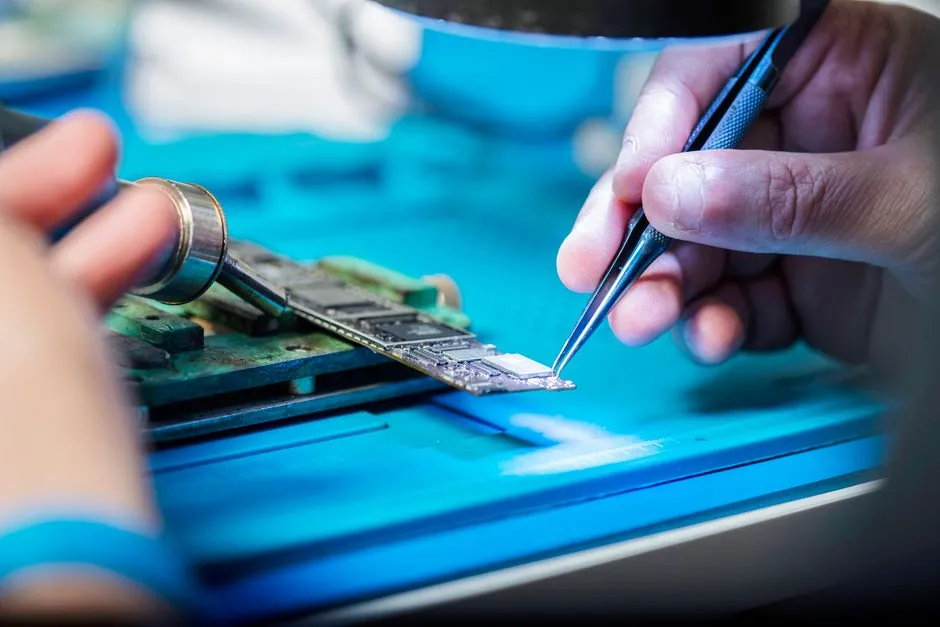
Aluminum holding furnaces feeding high-pressure die casting (HPDC) cells for consumer electronics housings typically operate in the 660-720°C range with bath temperature held to ±5°C, and the dominant Chinese-sourced models in the 800-3000 kg class quote in the US$6,600-15,000 export band as of 2026 [S5].
Selection for thin-wall housings (laptop lids, phone frames, LED heat-sink bodies) is driven less by nameplate capacity than by thermal uniformity, metal cleanliness, and refractory compatibility with magnesium-bearing alloys such as A380 and ADC12.
What a holding furnace actually does in an electronics-housing casthouse
The holding furnace receives tapped metal from a melting furnace or dosing furnace, then conditions the bath to a target casting temperature and chemistry before it is ladled or bottom-tapped into the HPDC shot sleeve [S2]. Unlike the melter, it does not add significant sensible heat; it controls losses and homogenizes the melt, which is why finite-element work on aluminum holding furnaces has historically focused on detailed temperature distributions and the time to bring delivered metal back to setpoint [S2]. For electronics housings, where wall sections are commonly 1.0-2.5 mm and surface finish is cosmetic, the holding furnace is the last opportunity to settle inclusions and degas before the shot, and it directly governs scrap rate on porosity and cold-shut defects.
Core design types and where each fits
Three configurations dominate the electronics-housing supply chain, and a side-by-side comparison is the cleanest way to pick: a stationary electric resistance holding furnace is the smallest capex, a gas-fired radiant roof furnace is the lowest operating cost at high throughput, and an induction-stirred bath gives the most aggressive inclusion settling but stirs the melt. Detailed comparison on the four decision criteria that actually matter: [S4]
Stationary electric resistance holding furnace, common in Chinese export catalogues at 800-3000 kg capacity and US$6,600-15,000 [S5]: temperature uniformity ±5-10°C with bottom-zone heater banks; metal cleanliness medium (no active settling aid); capex low; energy efficiency 60-70% at 700°C; best fit for job shops and small housing runs under 200 t/yr.
Gas-fired radiant roof holding furnace (reverberatory style, often paired with a shaft melter as in the continuous copper-rod line architecture [S3]): temperature uniformity ±8-15°C across bath; metal cleanliness medium-high with a deep bath; capex medium; energy efficiency 35-45% but fuel cost is roughly 30-40% of electric at industrial gas tariffs; best fit for single-alloy high-volume runs of one housing SKU.
Induction-stirred holding furnace (channel or coreless): temperature uniformity ±3-5°C due to forced convection; metal cleanliness poor for settling because electromagnetic stirring re-suspends inclusions, contradicting the Stokes-law assumption that casthouses traditionally apply [S1]; capex high; energy efficiency 75-85%; best fit where the priority is shot-to-shot thermal stability, not inclusion removal, and where upstream filtration is doing the cleaning work.
Metal cleanliness is a settling problem, not a heating problem
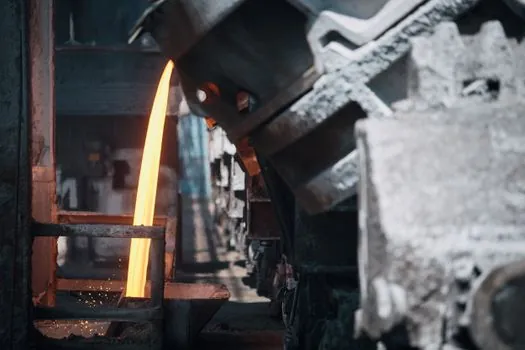
Inclusion behaviour in a holding furnace does not follow Stokes' law because thermal convection from temperature heterogeneity continuously re-entrains settled particles, and any assumption of a quiescent bath is wrong [S1]. Sztur et al. built a turbulent-fluid-flow trajectory model that matched PoDFA and LiMCA inclusion counts on both lab and industrial furnaces, and showed that furnace geometry (deep vs shallow bath, bottom-tapped vs tilting) changes settling efficiency more than holding time does [S1]. The practical conclusion for electronics-housing work is that the holding furnace should be sized to maximise quiescent zones (low height-to-diameter ratio, baffles, side-well dosing), and that the holding step is a complement to, not a replacement for, in-furnace fluxing and ceramic-foam filtration upstream.
Refractory, alloy, and atmosphere compatibility
For A380, ADC12, and the magnesium-bearing AlSi9Cu3(Fe) variants used in 5G router and smartphone frames, the working lining is typically a 70-75% Al2O3 low-cement castable in the bath zone, with a higher-alumina or SiC backup layer; the choice is driven by Fe pickup limits (housing foundries usually cap Fe at 0.8-1.0% to preserve die soldering resistance) rather than peak temperature. Stationary electric resistance holding furnaces are the dominant Chinese export product in the electronics-housing tier, with 800-3000 kg class units quoting at US$6,600-15,000 per piece in 2026 [S5]. Bath depth should be kept shallow enough that hydrostatic pressure does not exceed 30-40 kPa at the tap hole, both to limit refractory wear and to reduce Mg burn-off; in practice this means choosing a larger-diameter, lower-height vessel when scaling up rather than a deeper bath of the same footprint.
Where induction holding is the wrong tool
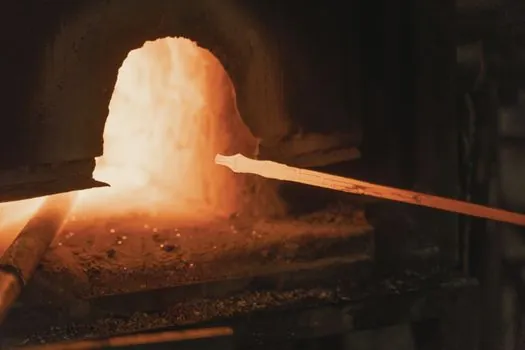
For thin-wall electronics housings with cosmetic Class-A surfaces, electromagnetic stirring from an induction furnace configured as a holder tends to keep oxides and spinel particles in suspension rather than letting them settle, which raises inclusion-related scrap on pressure-tightness and surface-defect criteria [S1]. Induction is the right melter for the upstream cell, but downstream of fluxing and filtration, a stationary resistance or gas-fired holder outperforms it on metal cleanliness even though the nameplate efficiency is lower. Buyers specifying induction as the holder stage on the strength of its temperature uniformity are usually compensating for an under-sized upstream treatment ladle.
Selection gates in order of priority
For a 1500-3000 t/yr electronics-housing line the spec gate should run in this order: (1) alloy and Fe/Mg control compatibility of the refractory lining, (2) temperature uniformity at setpoint with documented ±°C band rather than nameplate kW, (3) inclusion settling geometry including bottom-tap vs spout and bath aspect ratio, (4) capex and energy source match to local utility tariffs, (5) throughput per shift with realistic dwell time, not just peak tap rate. Stationary electric resistance units at 800-3000 kg are the default low-capex choice at US$6,600-15,000 [S5]; gas-fired reverberatory holders are preferred once a single SKU exceeds 60% of annual volume; induction holders are reserved for thermal-stability-critical niche alloys. A useful adjacent reference for furnace-class comparison in heavy casting is the gas-fired aluminum melting selection map for rail components, which applies a similar capacity-versus-uniformity gate. The geometry-driven inclusion model behind the cleanliness gate is the same one that governs metal quality in a crucible furnace used for smaller batch work, so the same PoDFA/LiMCA validation logic applies when scaling down.
Trackable signals for the next buying cycle: inclusion count drift on PoDFA coupons after a refractory reline (target less than 0.05 mm²/kg of oxides above 20 µm), Mg burn-off rate per shift (target less than 0.05% absolute loss on A380/ADC12), and shot-weight consistency on the HPDC cell (Cpk above 1.33 on a 200-shot sample). Cross-check on the broader agriculture-machinery specification map if you are also sizing holders for non-electronics casthouse work, since the same furnace type is often shared across product lines.
This topic is covered further in Rebar Threading Machine Selection for Concrete Work: 2026 Spec Map.