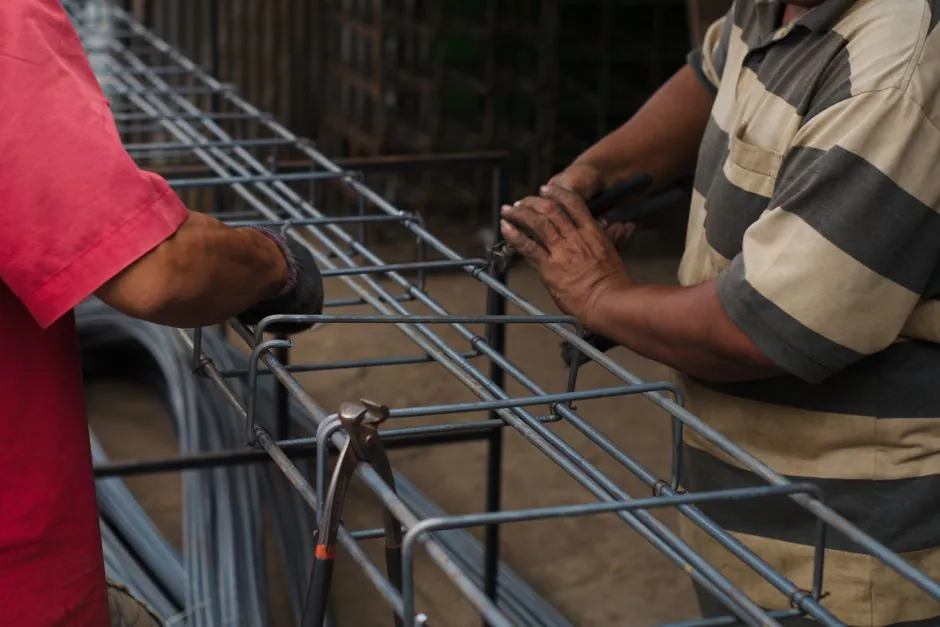
Rebar threading machines for concrete reinforcement in 2026 are typically specified at 380 V, 3-6 kW, weighing 100-1000 kg, and CE certified, with thread lengths spanning 100-300 mm across rolling, cutting, and upsetting-threading variants [S1][S2].
Three process families dominate procurement: rebar thread rolling, rebar thread cutting, and rebar end upsetting followed by parallel threading, each matched to a specific splice and bar-size profile. The choice is driven less by brand and more by bar diameter range, daily output, and the rebar coupler system already on site.
Process Families: Rolling, Cutting, Upsetting-Threading
Rolling forms the thread by plastic deformation between dies and preserves the rebar parent-metal grain flow, which is the preferred method for high-grade HRB400/HRB500 splices on diameters from 16 mm up to 40 mm [S2].
Cutting uses tangential chasers or single-point cutters to remove material and produce a parallel thread; it is faster per piece but reduces the bar's effective cross-section at the engagement zone, so it is normally paired with an upset end on larger diameters [S1][S2].
Upsetting-threading first hot- or cold-upsets the bar end to recover the section lost to thread cutting, then rolls or cuts a parallel thread into the thickened zone. Strong-type upsetting parallel thread couplers are explicitly marketed for "high grade rebars" where the as-rolled section would otherwise be undersized for the splice [S2].
Electrical and Mechanical Envelope
The dominant 2026 OEM envelope is 380 V three-phase at 3-6 kW, with machine mass between 100-1000 kg depending on frame size, and CE certification on the automatic tier [S1].
Mid-volume site shops typically land in the 3-4 kW, 200-400 kg band, while production shops running full rebar prefabrication lines sit at 5-6 kW with heavier cast frames to absorb continuous-duty vibration. A rebar threading machine at the lower end of that power range will still process 16-32 mm bar at usable cycle times; pushing past 32 mm generally requires moving to the upsetting-threading workflow.
Matching Machine to Bar Diameter and Coupler
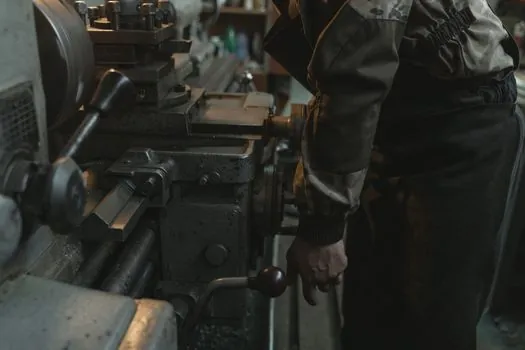
For 12-25 mm HRB400 bar with standard parallel-thread couplers, a thread rolling machine in the 3-4 kW class with 100-200 mm thread length is the lowest-risk pick [S2].
For 28-40 mm bar, or for splices rated for 100% bar ultimate (Grade 500 / HRB600), specify the upsetting-threading route: auto upsetting machine plus a rolling or cutting head, with thread length 200-300 mm to develop full engagement length in the rebar coupler [S2].
For diameters above 40 mm, or for projects that mix bar sizes daily, the pragmatic move is a 5-6 kW heavy frame with quick-change die heads, accepting the 100-1000 kg mass band as the cost of flexibility [S1].
Throughput and Daily Output Sizing
Single-head automatic rebar thread rolling machines from tier-1 Chinese OEMs are commonly quoted at production capacities around 500 sets per month at single-shift utilization, which maps to roughly 15-20 spliced ends per shift hour on 16-32 mm bar [S4].
Export-traded entry-tier units such as the GHB22 are listed at a supply capability of 20 units per month from Tianjin, indicating a small-batch OEM model where the bottleneck is the threading head, not the motor [S3]. For a contractor doing under 200 splices per day, one 3-4 kW rolling head is enough; beyond that, add a second head before adding a second operator.
Comparison: Rolling vs Cutting vs Upsetting-Threading
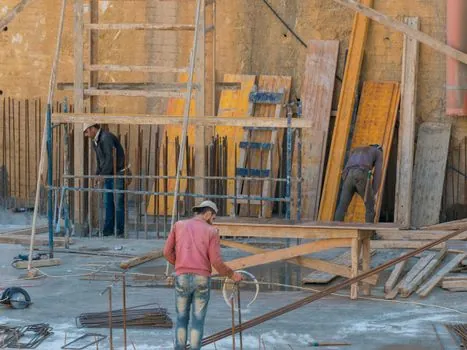
Across the three workflows, rolling wins on splice strength retention and die life but loses on flexibility for mixed diameters; cutting wins on simplicity and per-piece cycle time but reduces the net tensile section; upsetting-threading wins on heavy-grade and large-diameter splices but adds a second machine and a heating or cold-upset stage to the line [S1][S2].
For cost-driven housing work on HRB400 12-22 mm bar, rolling alone is the baseline. For infrastructure (bridges, metro, high-rise cores) on HRB500/HRB600 28-40 mm bar, upsetting-threading is the default and cutting-only is generally rejected by the project's QA reviewer.
What a Rebar Threading Machine is NOT For
It is not a substitute for a rebar bender or shear: bending moments on the threaded zone will fracture the engagement, so any bar that is bent after threading must have the bend formed before the thread is cut, and the thread zone must be kept clear of the bending pin. [S1]
It is also not a universal pipe-threading tool: a "hydraulic pipe threading machine" and a "rebar threading machine" from the same vendor can share a 380 V, 3-6 kW rating and 100-1000 kg frame, but the chasers, dies, and feed geometry are different, and cross-use will produce out-of-tolerance threads on at least one of the two workpieces [S1].
Failure Modes and Field Constraints
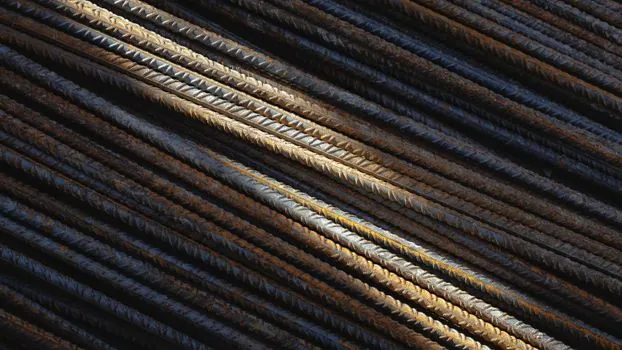
The three failure modes seen in practice are: (1) thread profile drift after die wear, which presents as coupler engagement torque outside the QA window; (2) bar-end ovality from a worn upsetting die, which produces intermittent couplers that pass torque but fail pull-out; (3) overheated cutting tools on HRB500/HRB600 bar, which work-hardens the cut surface and cracks the first engaged threads under load. None of these are visible at the machine HMI; they show up only at the coupler torque test or the rebar pull-out test. [S1]
For QA, the practical gate is to keep a calibrated thread ring gauge and a torque wrench at the machine, log the first three pieces of every shift, and re-gauge after every die change. This is consistent with the way strong-type upsetting parallel thread couplers are marketed: the "easy installation and high efficiency" claim only holds when the upstream thread is in tolerance [S2].
Sourcing and Standards
CE marking is the most common regulatory anchor on the 2026 OEM data sheet, with 380 V / 3-6 kW / 100-1000 kg as the typical published envelope [S1].
Chinese OEM capacity is concentrated in Cangzhou (Hebei) for couplers and threading machines, with parallel-thread and upset-end coupler grades in 40CR and 45# carbon steel as the standard material pair [S2]. Indian OEM offerings overlap on the same voltage and weight band, indicating a converged global spec envelope for entry- and mid-tier machines [S1]. Tier-1 export lines out of Shanghai list single-head automatics at roughly US$1,800 FOB for 1-set MOQ with 500 sets per month capacity, useful as a 2026 price anchor for budget planning [S4]. For related concrete-side spec work, see the 2026 prestressing strand selection for data center concrete structures map.