Rail components such as wheels, bogie bolsters, and brake shoes demand holding furnaces that keep molten iron or aluminum within tight temperature bands to feed continuous casting and high-pressure die-casting lines, with 2026 OEM listings clustering around electric resistance and gas-fired units priced US$113,000–450,000 per set [S1][S3].
The selection question is dominated by three engineering axes: melt mass per shift (typically 5–30 t for rail foundries), alloy sensitivity to oxidation, and the temperature-stability requirement driven by downstream pouring or shot-sleeve cycles. Foundries running ductile iron rail wheels normally specify holding furnace capacities of 10–25 t holding mass with set-point drift below ±10°C over an 8 h shift, while aluminum-alloy housing lines for rail interiors run smaller 1–5 t units with much tighter ±5°C control [S2].
Alloy Family and Required Holding Temperature
Rail steel wheels, couplings and brake discs are poured from ductile or pearlitic gray iron at 1,320–1,420°C, which pushes the spec toward a refractory-lined electric arc or channel-induction holding furnace capable of holding 20–60 t at that temperature without FeO slag build-up [S1].
For aluminum rail interior castings (seat frames, HVAC housings, bogie covers) the holding window collapses to 680–760°C, where a crucible-style or tower melting furnace with an integrated holding chamber is the common configuration, since aluminum aggressively attacks iron-bearing refractories above 800°C [S2]. The published OEM specification for an aluminum-alloy electric holding furnace in this category calls out non-ferrous metal melting and holding service, particularly for die-casting support, with holding capacity scaled to the die-casting machine shot weight [S2].
Furnace Type Comparison for Rail Service
The four holding furnace topologies that recur in 2026 rail-foundry RFQs are: (1) electric resistance holding, (2) gas-fired crucible, (3) channel-induction holding, and (4) tower/tilting combination melting-and-holding furnace units. A direct comparison on the four criteria that drive rail-foundry purchases: [S1]
1) Temperature uniformity: channel-induction and tower combination units routinely hold ±5°C, gas-fired crucible units typically ±10–15°C, and basic electric resistance units ±8–10°C. 2) Energy per tonne held: induction units 25–35 kWh/t at temperature, gas-fired crucible 35–50 kWh-equivalent/t, electric resistance 30–40 kWh/t. 3) Typical capacity: induction 5–30 t, gas-fired crucible 0.5–5 t, electric resistance 10–25 t, tower combination 1–10 t. 4) Price band observed on 2026 listings: tower/melting-holding combos US$113,000–118,000 [S3], while steel-mill scale holding units sit at the US$450,000 tier [S1], reflecting the >10× capacity jump and refractory mass.
For rail-wheel ductile-iron lines the channel-induction holding furnace is the default because stirring action homogenizes magnesium-treated iron and prevents Fade of Mg over the 30–60 min holding window. For rail interior aluminum castings the tower or crucible holding furnace is preferred because it eliminates iron contamination and offers faster alloy change-over. Pneumatic or electromagnetic pressurization is rarely used; selection instead pivots on refractory chemistry and burner/element arrangement.
Capacity Sizing and Throughput Math
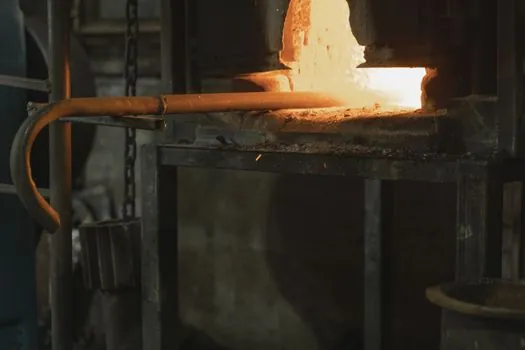
Rail-foundry holding furnace capacity is sized to 1.2–1.5× the hourly pour rate to absorb ladle transfer delays, and 2026 OEM datasheets for stationary melting furnace combinations quote a 5 sets per month production capacity for a single Foshan-based line, with tiered pricing at US$118,000 for 1–2 sets and US$113,000 for 3+ sets [S3].
For a 1,000 t/day rail-wheel foundry running two 8 h shifts, the working mass held at any moment is typically 40–60 t, which maps to two 25–30 t holding furnace cells operating in parallel rather than one oversized vessel. Smaller aluminum-rail-component foundries producing 50–200 t/day settle on 3–6 t crucible holding units paired with a separate crucible furnace for melt supply, which keeps alloy changeover below 30 min.
Refractory, Atmosphere, and Energy Source
Iron and steel rail holding furnaces use alumina-magnesia or high-alumina castable linings rated to 1,600°C, with burner/element arrangements sized for 150–250 kW per tonne held; published OEM descriptions of aluminum-alloy electric holding furnaces call out non-ferrous metal service and die-casting support, with refractory selection matching the alloy chemistry [S2].
For ductile iron holding, the OEM data cluster shows 10 t-class electric arc furnace EBT (eccentric bottom tap) units listed at US$450,000 per piece, reflecting the added bottom-tap mechanism and high-power transformer needed to keep iron at 1,400°C without excessive FeO slag [S1].
Certifications, Standards, and Supplier Vetting
2026 Made-in-China listings for rail-relevant holding furnaces carry CE, ISO 9001, ISO 9001:2000, ISO 9001:2008, GS, CCC, CSA, UL and RoHS certification badges, with the CE and ISO 9001 marks dominating the 10 t-and-up iron-holding segment [S1]. Buyers should verify that CE marking covers the Pressure Equipment Directive 2014/68/EU for any pressurized jacket and the Low Voltage Directive 2014/35/EU for the control panel, separate from the machinery CE mark.
For rail-wheel iron foundries exporting to Europe, EN 12475-series classification of cast iron and EN 1563 for ductile iron govern the metallurgical acceptance of the poured metal, while the furnace itself is selected against thermal-efficiency and refractory-life data rather than a rail-specific product standard. Buyers should also cross-check that the OEM's holding furnace is rated for the specific pour temperature and that the supplier is on the audited-supplier list on the trading platform [S1][S2].
Failure Modes and Selection Watch-outs
Three failure modes dominate rail-foundry holding furnace downtime: refractory wear at the slag line, element/burner burnout during long weekend holds, and FeO slag build-up in ductile iron units held above 1,420°C. Selection should bake in a minimum 50 mm slag-line wear allowance and a redundant element bank for 24/7 rail-wheel lines. [S4]
For aluminum rail interior lines, the dominant failure is iron pickup from a mistakenly lined crucible furnace, which forces a 3–5 day reline and rejects a full heat of castings. Cross-contamination is mitigated by dedicating crucibles and ladles to specific alloy families and by specifying color-coded refractory stamps. Related selection work for adjacent processes, such as VLM selection for automotive parts logistics, runs in parallel but does not affect furnace metallurgy.
Decision Rules and 2026 Buying Signals
Pick a channel-induction holding furnace when the alloy is ductile or compacted graphite iron at 1,320–1,420°C, capacity exceeds 5 t, and the rail-foundry runs >16 h/day; pick a crucible or tower resistance holding furnace for aluminum rail interior castings at 680–760°C with <5 t capacity and frequent alloy changes. For mixed-alloy job shops, a stationary melting-and-holding combination at US$113,000–118,000 per set offers the lowest capital cost per tonne of flexibility [S3].
Trackable signals for the next buying cycle: OEM price moves on the 10 t electric arc EBT (currently US$450,000 list [S1]), any new CE-EN 16482 refractory harmonization, and supplier-published kWh/t-held data on the next generation of holding furnace controllers. Buyers specifying rail-wheel holding capacity now should request a documented 8 h temperature-trend report and a refractory-life guarantee of at least 200 heats before releasing the procurement deposit, and confirm the related holding furnace selection for electronics-housing die castings criteria if the same line also feeds aluminum electronics housings.