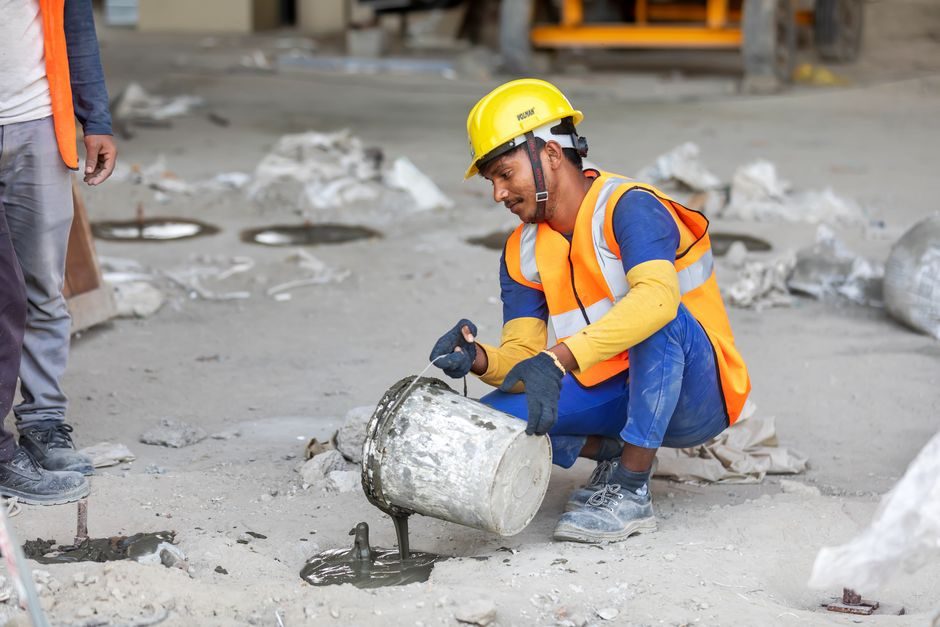
Hospital-grade dry-mix mortar is a factory-pre-blended system of cement, graded aggregate (<4 mm), and polymer or additive packages that must meet EN 998-1 (rendering/plastering) or EN 998-2 (masonry) classification plus project-specific hygienic requirements [S3].
Standard plant throughput for the upstream production equipment feeding these mortars ranges from 3 TPH BHR2000 small lines up to 20-100 TPH automated systems, with single-line outputs scaled for individual site silos rather than continuous commodity supply [S1].
EN 998-1 vs EN 998-2: which governs which wall zone
EN 998-1 covers factory-made rendering/plastering mortars and is the controlling standard for any cementitious skim, base coat, or topcoat applied to hospital interior walls and ceilings; EN 998-2 covers factory-made masonry mortars used in autoclaved aerated concrete (AAC) and clay-block bed-joint work [S3]. Compressive-strength class is declared as CS I–CS IV per EN 998-1 (1.0–6.0 N/mm² typical), while EN 998-2 classes M1–M20 are matched to the masonry unit's declared compressive strength rather than chosen for wall-zone function. The first decision on any hospital wall assembly is therefore category, not brand: tile-bed, plaster, screed, and bed-joint mortars cannot be interchanged without re-designing the substrate-to-finish compatibility.
Wall-zone function drives additive package, not just binder
Operating-theatre and clean-room walls require polymer-modified mortars carrying redispersible polymer powders such as VINNAPAS grades to meet low-VOC and crack-bridging demands, with WACKER Academy's two-day training program formally covering formulation behaviour for these hygienic environments [S3]. Wards, corridors, and back-of-house zones accept general-purpose CS II–CS III plasters, while wet zones (shower rooms, scrub areas) require water-resistant polymer-rich renders plus compatible tile adhesives. Bed-joint AAC and clay-block work follows a separate M-class table keyed to block density, with M5 the most common mid-range designation for non-loadbearing partitions.
Production equipment that controls blend consistency
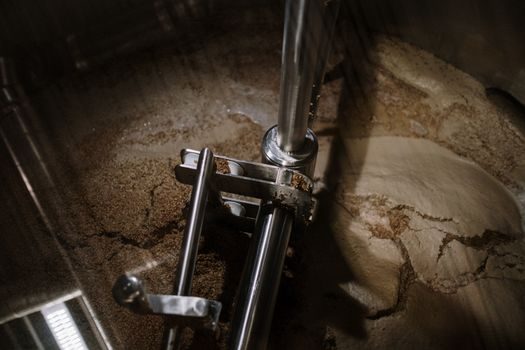
Pre-mixed dry mortar stirrers and continuous-mix twin-shaft paddle mixers in the JHW1000 cylinder class are the workhorses specified for on-site silos and mobile dry-mortar storage tanks feeding hospital fit-out [S1][S2]. Factory-batched silo systems up to 20-100 TPH annual output are specified when a project demands 30,000+ tonnes/year, while 3-15 TPH semi-automatic lines are common for hospital build-outs running 50-200 tonnes/day peak demand [S1]. A consistent 3-cylinder sand dryer upstream is the variable that most often differentiates a CE-marked silo mortar from a bagged site-mixed product, because moisture control in the 0.2-0.5% range is what enables polymer re-dispersion on site.
Selection criteria: 4 dimensions to score before sign-off
Hospital mortar specifiers should score candidate products on four criteria before sign-off: (1) declared EN 998 compressive class and test certificate; (2) VOC/emission documentation aligned with the project's indoor-air-quality target; (3) polymer-modification level matched to the wall zone (low for dry zones, high for wet/clean zones); and (4) documented compatibility with the chosen finish system (paint, epoxy, vinyl, tile). The matrix below maps the three dominant product families against these criteria: [S1]
General-purpose CS II/III plaster — compressive class 1.5-3.5 N/mm², low-modification, low cost, suitable for wards and corridors only; not rated for wet zones. Polymer-modified CS IV render — class 6.0 N/mm², 5-15% redispersible powder, hygienic-cleanable, suitable for operating-theatre and clean-room walls [S3]. Masonry M5 bed-joint mortar — 5.0 N/mm², low-modification, used in AAC/clay-block partitions; not a finish coat. Hospital specifiers should treat the choice as a system decision, not a single-line item.
Limits, failure modes, and what hospitals must avoid

Three failure modes recur in hospital mortar audits. First, substituting masonry M-mortar into a plaster wall zone breaks the EN 998 boundary and invalidates the finish-system warranty. Second, using a general-purpose CS II plaster in a wet zone causes water ingress at the skim coat within 12-24 months in scrub-room service. Third, sourcing bagged site-mixed mortar instead of factory-batched silo mortar sacrifices the moisture control and additive dispersion that the polymer system was designed around. Related engineering guidance on factory-batched systems and silo selection is mapped in this dry-mix mortar spec map for industrial facilities. [S1]
For sub-zero or cold-chain storage zones adjoining hospital pharmacy or morgue areas, a different binder and additive combination is required; the spec map at Cold-Storage Dry-Mix Mortar Selection covers frost-cycle exposure that the standard hospital spec does not. Where floor substrates under the same fit-out need their own class and hardener selection, the warehouse-floor treatment at Special Cement Spec Map for Warehouse Floors applies the same class-vs-hardener logic the specifier should use on wall plasters.
Reference baseline: dry mortar properties compiled from manufacturer datasheets updated 2026-07-14 [S3] and plant-equipment catalogues dated 2026-08-01 [S1].
Component reference pages worth checking: ready mix concrete, and dry type transformer.