
Hot box core shooters form resin-bonded sand cores at 250–350°C, making thermal control, shot compaction, and tool alignment decisive for automotive casting dimensions [S4].
Automotive foundries use vertically and horizontally parted machines for internal cavities and passages, with production equipment spanning HS-16 to HS-26 designs and automated core handling [S1].
How Hot Box Cores Control Automotive Casting Dimensions
A hot box core shooter blows resin-bonded sand into a heated, clamped core box, where heat cures the binder and forms a rigid core [S1][S2]. The process is used for automotive castings requiring internal cavities, passages, and other features defined by cores [S1].
Published operating data place hot core-box temperatures between 250 and 350°C [S4]. Core-box dimensions and allowable core weight must match the machine specification, with manufacturers defining maximum mould dimensions and related operating limits [S5].
Rather than treating the shooting machine as a standalone accuracy device, engineers should qualify the complete process: sand and resin preparation, mixer output, shot pressure, box closure, heat distribution, curing time, ejection, and post-cure measurement. A hot box core machine controls several of these variables, but core geometry also depends on the tooling and material formulation.
The Tolerance Chain That Drives Core Accuracy
Core accuracy is a chain, not a single machine specification.
These values define equipment compatibility, not casting tolerance. The automotive drawing still needs core features, datums, material condition, thermal-growth expectations, inspection limits, and casting allowance. A 40-pound capacity machine does not guarantee a repeatable 40-pound core, and a heated tool does not establish a permissible dimensional band by itself.
Hot Box Versus Cold Box and Shell Core Processes
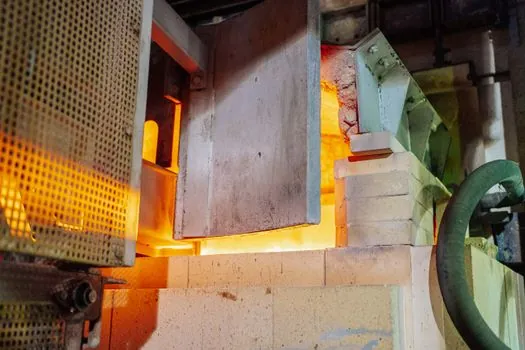
Hot box shooting combines pressure deposition with thermal curing, while cold box shooting cures chemically at room temperature and shell shooting creates a resin-coated shell against a heated tool [S3]. These methods differ in temperature control, curing mechanism, core structure, and handling, so they are not interchangeable dimensional-control strategies.
Cold box machines avoid heated tooling and use a two-part resin system that cures at room temperature after the sand is blown into a vented box [S3]. Hot box machines shoot resin sand into a preheated box and use box heat for rapid curing, which supports detailed core forms and adjustable curing conditions [S3]. Shell machines use resin-coated sand, and one published comparison gives a preheated-tool range of 200–250°C [S6].
For automotive work, cold box is suitable where room-temperature curing and lower tooling complexity dominate. Hot box is suited to resin-bonded cores requiring heated curing and production automation. Shell shooting fits cores requiring a controlled shell around a heated tool, with the shell thickness governed by curing time. The choice should follow part geometry, volume, material behavior, and required dimensional stability rather than a generic preference for one process.
Tooling and Machine Configuration for High-Volume Cores
Vertical and horizontal parting determines how the tool opens, how the core is ejected, and how automation accesses the station. ATD offers vertical-parted and horizontal-parted hot box core-machine configurations, including the dual-purpose HS Series, which can produce either hot box or shell cores on the same machine.
ATD hot box core machines can be configured with automated core handling, tooling, and temperature-control options.
This matters because the tool must resist 250–350°C service while maintaining cavity geometry, parting alignment, venting, and repeatable closure. For gray cast iron versus steel hot box core boxes, tooling selection for 250–350°C service provides a focused comparison of material considerations.
Thermal, Process, and Dimensional Failure Modes

Uncontrolled core-box temperature changes binder curing, surface quality, and hardness, so temperature variation must be mapped across the working cavity rather than judged from one heater setpoint [S1][S4].
Core shooting compacts the mold material through the sudden expansion of a limited volume of compressed air [S4]. Shot pressure, sand flowability, resin distribution, venting, and fill pattern can therefore change local density and dimensional repeatability.
Other common qualification failures are misaligned parting faces, worn or damaged cavities, leakage at vents or seals, unstable closure, inadequate curing, and damage during ejection. The machine must clamp the core box during shooting and gassing, and the gassing plate must be sealed properly [S4].
Automotive Core Qualification and Inspection
An automotive core qualification plan should connect machine settings to the controlled casting feature. Define the core's critical dimensions, datums, and tolerances, then verify those characteristics on the finished core and in the first-off casting rather than accepting process settings as proof of conformance [S1][S3].
For example, one HS-22 configuration is listed with a standard 50-pound core capacity, an optional 75-pound capacity, and a 23.25 by 27 by 18 inch mounting area [S1]. These figures set the equipment envelope. The automotive acceptance plan still needs specimen frequency, temperature limits, shot settings, curing-time control, measurement instruments, and defined action limits, none of which can be inferred from those envelope values alone.
The casting mold and its core supports are production interfaces, so dimensional traceability should extend from core-box cavity and parting surfaces to the completed core and molded casting. For lower-volume or prototype geometry, a sand 3D printer may offer a practical alternative, as discussed in core shooter versus sand 3D printer selection.
Specifying a Hot Box Line for Automotive Work
A hot box line is suitable for high-production automotive cores when the process can maintain a 250–350°C heated-tool window and control shot compaction [S1][S4]. The technical specification should list model, parting arrangement, maximum core weight, cavity dimensions, required opening, air pressure, heating method, curing time, and automation scope rather than requesting a machine under the generic label of core shooter [S1][S5].
ATD specifies 80–120 PSI for listed hot box machines and gives model-specific mounting areas and tool-weight limits that must be reconciled with the actual core box [S1]. Used-equipment examples demonstrate the need for matching capacity, including a 25-litre cold-box machine with a 400 by 790 mm vertical partition, 800–1000 mm horizontal partition, and 600 mm maximum core-box height [S5].
The next engineering action is a dimensional capability study on the intended automotive core: record cavity and core temperatures, shot and curing parameters, core mass, and critical dimensions across repeated cycles, then verify the resulting casting features against the drawing tolerance. This produces a process-specific control plan instead of borrowing an unsupported tolerance from a generic hot box machine.