
Hot box core shooters require significant heating energy, whereas cold box core shooters cure resin-bonded sand at room temperature without heated tooling [S1][S3].
The comparison covers hot box, cold box and shell processes, and cold box cures sand at room temperature without requiring heated tooling.
What Determines Core-Level Energy Cost
Hot box machines blow resin-bonded sand into a heated core box, where thermal curing forms a rigid core; proportional electric heating or controlled gas supply can be added to maintain the specified box temperature [S5].
Cold box machines use an unheated box. Resin-coated sand is blown into the cavity, concentrated amine fog is introduced, and the core hardens in seconds at room temperature before the chamber is purged and opened [S2][S3].
The essential cost difference is therefore process heat: hot box must heat the core box and cure the binder thermally, while cold box replaces that heat requirement with catalyst delivery, gassing and scrubbing [S1][S2][S3].
Comparison by Energy, Cycle and Production
Cold box cures sand at room temperature without heated tooling, while the shell process has potential for high-volume production, excellent core surface and good dimensional accuracy. Hot box trades higher heat use for controlled thermal curing, rigid cores, accurate dimensions and intricate core geometry [S1][S4].
Shell core shooting also uses a preheated metal box, but resin-coated sand forms a shell from the wall inward and uncured interior sand can be drained, allowing hollow cores and reducing the sand burden per core [S1][S2].
For a decision based on four criteria, cold box is the practical choice when low energy per core, rapid cycles and volume output dominate; hot box is preferable when thermal curing and detailed shapes justify the heating load; shell is suited to accurate, hollow cores with a fine surface finish; and inorganic processing serves applications using hot air up to 180°C without amine [S2].
Why the Heat Penalty Appears
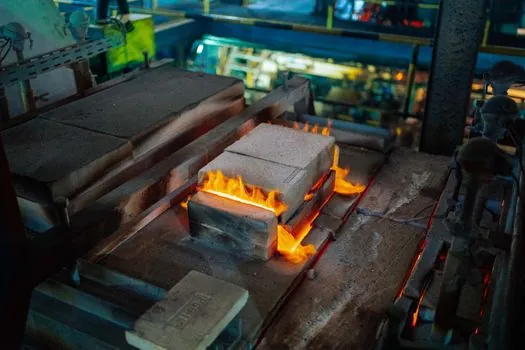
Published shell-process data identifies a heated metal tool operating at 450–650°F, with natural gas or bottled gas supplying the heat, as a direct contributor to reduced productivity and higher cost [S4].
Hot box equipment can use electric heaters with solid-state relay control or regulate gas flow to hold core-box temperature [S5]. Electricity, gas and compressed air therefore remain separate cost drivers: an electric hot box shifts the energy burden to electrical demand, while gas heating adds a direct fuel cost.
Cold box does not make energy disappear. Its mechanical and environmental burdens shift toward compressed air, catalyst generation, purging, scrubbing, and binder handling, but the process itself requires no heated core box [S2][S3][S4].
Core Quality and Process Limits
Hot box offers controlled thermal curing and rigid, dimensionally accurate cores, making it suitable for detailed or intricate geometries and applications where proportional temperature control is preferred [S1][S5]. Its main constraint is the continuous energy demand for heating and temperature control.
Cold box produces fast, very strong cores, and its working sand temperature should not exceed 30°C, with a stated processing-time limit of two hours. The cold box process uses amine gas, and unreacted amine is captured by a scrubber.
Inorganic core making eliminates amine and reduces casting smoke, but hot-air curing at up to 180°C gives it a slightly longer cycle than cold box [S2]. This middle path reduces chemical-catalyst handling while retaining a heat-related energy load.
Cost Drivers and Total Ownership
The purchase price of a core shooter is only one component. For hot box, total cost also includes electric or gas heat, compressed air, heated-tool maintenance, temperature-control equipment, tooling and faster curing support; for cold box, it includes amine consumption, gas-generation and scrubbing systems, compressed air, binder management and process control [S3][S4][S5].
Volume changes the result. High core output spreads fixed equipment and tooling costs across more pieces, while cold box benefits from short cycles and reduced unit cost in high-production operation [S4]. Low-volume foundries should compare the installed cost of heated tooling and control systems against the added catalyst, scrubbing and environmental-control requirements of cold box.
Maintenance follows the same logic. Hot box equipment uses a heated core box and offers temperature-control options, while cold box cures at room temperature and adds gas-handling and amine-scrubbing duties. A full cost-per-core calculation should therefore include purchase price, installation, energy, maintenance, consumables, cycle time, rejected castings and labor.
Which Process Fits the Foundry
Cold box is not the automatic choice for every foundry. It suits production that can run at room temperature, maintain sand below 30°C, distribute amine uniformly, control the 2-hour processing window and manage scrubbing and emissions [S2][S3].
Hot box fits foundries that value controlled thermal curing, rigidity and accurate detailed cores enough to accept higher process energy use [S1][S5]. Shell process equipment can produce accurate, fine-surface, hollow sand cores.
The most defensible operating comparison is therefore measured, not assumed. Record heater or gas consumption, compressed-air demand, cycle time, core weight, reject rate and labor for the same core geometry. The cold box core machine and hot box core machine must be evaluated as complete production systems, including their respective curing, control and support equipment.
Track kWh or gas volume per accepted core, cycle seconds per core, amine and scrubber media consumption, and maintenance hours per production shift. If hot box energy remains above cold box after normalizing output and quality, the lower thermal energy cost is confirmed only if defect and rework performance remain equivalent.