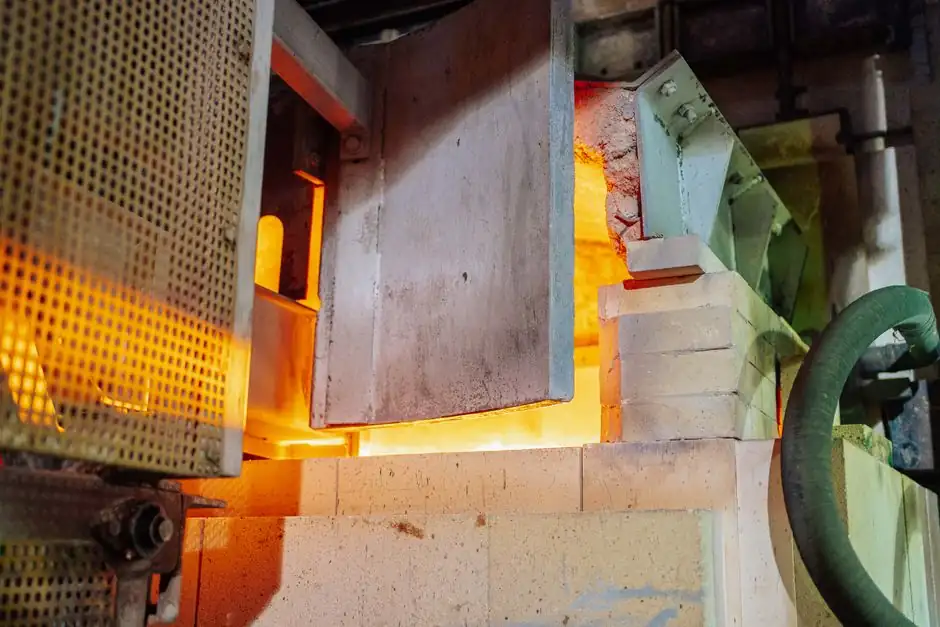
Hot-box core shooting uses heated tooling, with published core-box temperatures of 250–350°C [S4].
The core box must transfer heat into resin-bonded sand, limit warping, resist repeated thermal cycling, and release cured cores without damaging thin features [S1][S4].
Heat Conductivity Sets the Curing Response
Core-box temperature is only one part of the thermal design because the tooling must also conduct heat from the heater into the cavity wall [S1][S3]. Higher effective conductivity can reduce the cold-start penalty when the box receives a fresh shot of cooler sand, while the wall must still retain enough mass to control temperature gradients and dimensional movement.
Hot-core equipment operates at core-box temperatures of 250–350°C [S4]. A material with high thermal conductivity does not remove the need for uniform heat distribution, controlled resin addition, and an adequate curing dwell.
For process design, the hot box core machine must deliver resin-coated sand to a consistently heated cavity, cure the binder thermally, and then eject the rigid core [S1][S3]. The selected box material therefore affects both cycle time and the repeatability of core hardness and dimensional accuracy.
Compare Candidate Core-Box Materials
Cast iron, steel, graphite, and thermally conductive insert materials must be compared against four criteria: service temperature, heat-transfer response, thermal mass or dimensional stability, and resistance to resin adhesion and sand abrasion [S1][S4].
Cast iron and fabricated steel provide rigid tooling and are established choices where a heavy, heat-storing cavity is acceptable.
Graphite provides high thermal conductivity and lower thermal mass than a comparably thick metal box, but it is porous, has lower mechanical strength, and is more vulnerable to impact and abrasion. It is more suitable for selected core geometry, expendable tooling, or localized heat-transfer duties than for every production cavity.
Aluminum conducts heat well and is lighter than steel or cast iron, but its melting point is far below the 250–350°C operating range. It is therefore inappropriate as the exposed hot cavity in this service. Copper and copper alloys provide strong conductivity, but cost, oxidation, and thermal expansion can restrict broad use. Tooling selection must therefore treat conductivity as one property, not as a standalone ranking.
Thermal Mass Controls Cycle-to-Cycle Variation
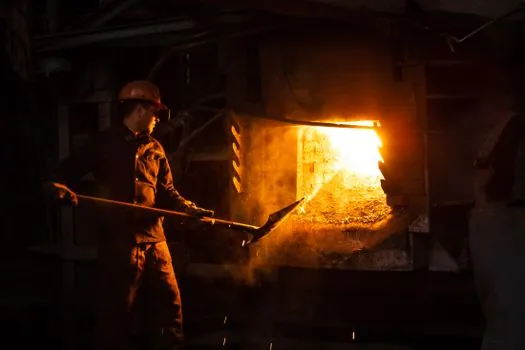
A core box that stores heat can absorb the initial cooling effect of each sand charge, supporting a stable curing cycle [S1][S6]. This thermal inertia is useful for repeatability, but it does not correct poor heater control or uneven temperature distribution.
Published machine configurations include proportional electric heating with solid-state relay control, proportional gas control, automatic core-box scraping, and automated core unloading [S1]. These systems show that stable temperature depends on both the box construction and the controls applied to it.
For a hot box core shooter, flowable mold material can be filled into the heated core box at temperatures between 250 and 350°C [S4]. The equipment can use vertical-parted or horizontal-parted configurations, and ATD's HS Series machines are dual-purpose, producing either hot-box or shell cores on the same machine [S1].
The process is suited to small and medium automotive, valve, and machine-tool cores, including complex internal casting cavities [S3]. It is less attractive for very large parts that exceed the practical thermal mass and ejection capacity of the box.
Tool Geometry and Dimensional Control Matter
Core-box material must maintain alignment and cavity dimensions while the casting surface heats and cools through repeated cycles.
Published mounting dimensions illustrate why box construction cannot be reduced to a conductivity figure.
Thin walls, deep pockets, draft changes, and abrupt section transitions amplify thermal gradients. Uniform wall construction and controlled extraction improve release, but a rigid box can still distort if unsupported. Tool design should combine a stable structural frame with a heat-transfer layer selected for the production rate and curing temperature.
Resin, Sand, and Surface Condition Interact with the Box

Patent CN102000777A is titled "Core sand mixing process, heated core box core-making process and sand core prepared therefrom," and its keywords include sand core, resin, ceramic, and calcined [S2].
These proportions determine the thermal load placed on the core box. Resin formulation, sand grain condition, sand temperature, and cavity fill mass all affect how quickly the tool receives heat and how uniformly the binder cures. A highly conductive surface can improve heat transfer, but it does not guarantee uniform curing if sand distribution or residence time varies.
Resin-coated sand is used for high-strength cores with a good finish [S3]. Sand release also depends on cavity condition, draft, ejection force, and the binder's adhesion to the tooling. Automated core-box scrapers can remove adhering material between cycles, while automated core wash can apply the release layer during the production sequence [S1].
Specify for the Actual Production Envelope
A usable core-box specification should state the operating cavity temperature, permitted heating method, surface material, wall construction, maximum box weight, parting direction, cycle rate, ejection method, and tolerance plan. For electrically heated boxes, embedded heaters and proportional control through solid-state relays are available configurations [S1]. Steam or gas heating also appears in hot-box equipment, so the material and seal design must match the selected heat source [S3].
For copper-alloy tooling, the expected thermal conductivity is lower than that of copper, but copper alloys are generally easier to fabricate, stronger, and more resistant to oxidation than pure copper. For graphite tooling, compare conductivity, porosity, compressive strength, abrasion resistance, machining capability, and repairability against the full production duty. For cast iron or steel, compare heat-transfer performance with thermal mass, casting soundness, machinability, weld repair, and dimensional stability.
Do not accept a bare statement that a material has "high heat conductivity." The procurement specification needs an operating-temperature limit, a minimum or typical conductivity requirement where justified by thermal calculation, a surface finish criterion, a dimensional tolerance, and a defined number of heating cycles. Published hot-box equipment already spans core-box temperatures of 250–350°C, so material selection must be validated at the intended upper operating condition rather than at ambient temperature [S4].
The nearest related comparison is Shell Core Machine vs Shooter: Which Produces Stronger Cores?, which helps separate shell tooling from hot-box core production. For the hot box itself, the decisive next step is to build a production-based comparison using one resin formulation, one core mass, and identical cure cycles, then record cavity temperature uniformity, cure time, dimensional variation, and tool surface condition.