
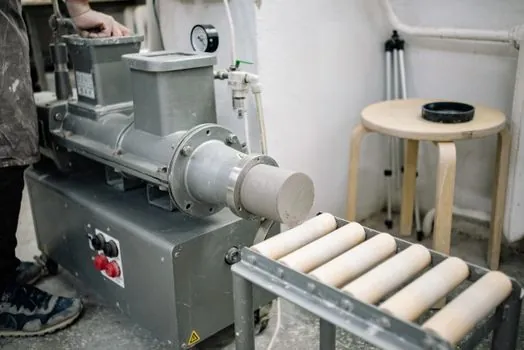
Hot box core machines shoot resin-bonded sand into a heated core box, cure the binder, then remove the rigid core by tilting and ejecting it from the box [S1].
Hot core-box temperatures are generally between 250 and 350°C [S2].
Hot Box Ejection Cycle and Thermal Window
Hot box cores are formed inside a preheated metal box: compressed air drives resin-bonded sand into the cavity, heat cures the binder, and the finished core is released after the mold separates [S1][S2]. The documented operating range for hot core-box temperatures is 250–350°C [S2].
A practical cycle therefore contains at least four controllable stages: core-box preheating, sand filling and compaction, binder curing, and box opening followed by core ejection. The source material describes automated tilt and ejection onto a conveyor, as well as automated unloading and box scraping, as separate functions available on production machines [S1].
Shell mold materials and hot box mold materials harden at higher temperatures [S2]. It is the thermally defined hardening period in the source, and its effect depends on sand composition, binder system, sand temperature, core geometry, wall thickness, and the heat-transfer path through the core box.
Ejection Temperature: Box Temperature Is Not Core Temperature
The 250–350°C figure describes the heated core box, not the acceptable ejection temperature of the sand core [S2]. A cured core can remain hotter than the surrounding air because the sand body has low thermal conductivity and retains heat after the box opens.
Heat curing relies on controlled electrical or gas heating. Electric core-box heaters can be controlled through solid-state relays, while proportional gas control regulates gas flow to maintain box temperature [S1]. This distinction matters because a machine-side setpoint of 300°C does not prove that every part of the core reached 300°C at the same instant.
For process planning, three temperatures must be handled separately: the heated tool temperature, the sand-mass temperature at ejection, and the handling or transport temperature. The research establishes the first value as a 250–350°C tool range, but it does not provide a universal permissible ejection temperature for every resin, sand grade, or core size.
Cooling Time: Distinguish Holding, Cooling, and Cycle Time
Cooling time is not interchangeable with curing time. Shell cores are produced by curing resin-coated sand in a heated core box [S5]. Cooling after ejection is a separate heat-removal problem.
Three timing definitions should appear on a production worksheet: box preheat time before the first shot, in-box cure or hardening time, and post-ejection cooling time before a core reaches its handling or downstream temperature. A hot box core shooter should therefore be evaluated by its thermal-control hardware, cure-cycle repeatability, ejector arrangement, and downstream handling capacity rather than by a single cycle-time number.
Post-ejection cooling cannot be assigned a universal duration from the available data. Core mass, binder loading, sand thermal conductivity, ambient temperature, airflow, and whether the core remains on a conveyor all affect the cooling curve. A practical test must record temperature at the core center and near its surface, rather than infer cooling from a timer or from the box-temperature setpoint.
Hot Box, Cold Box, and Shell Process Comparison
Hot box and shell processes use heat, while cold box cures a resin-bonded mix with amine gas at room temperature [S2][S3]. The main selection criteria are cure mechanism, thermal demand, geometry, surface quality, emissions handling, and cycle control.
Cold box is the practical comparator when a heated box is unnecessary, while shell equipment is better suited to controlled wall thickness and hollow internal passages [S5]. Neither temperature nor cycle time can be compared fairly without including the binder and the mass of sand heated in each cycle.
What the Hot Box Machine Must Control

A controlled core box temperature is necessary for consistent resin curing, but ejection performance also depends on mechanical handling. The documented production sequence moves from a heated box to core release, automatic unloader operation, box scraping, optional core-wash application, and tilt-and-eject delivery to a conveyor [S1].
Electric systems use built-in heaters and proportional control through solid-state relays; gas-heated systems regulate the gas supply. The cited HS machines use 120 V, 60 Hz, 10 A electrical service and 80–120 psi compressed air, while the listed gas connection is 3/4-inch NPT with a 10-inch water-column requirement on the HP-43 specification [S1]. These utility values belong to the cited equipment, not every hot box machine.
Machine size also affects thermal and ejection planning. The cited HS-16 handles cores up to 40 lb, has a 200 lb sand hopper, and accepts a maximum core-box weight of 400 lb; HS-22 is listed at 50 lb standard capacity with a 75 lb option, and HC-16, HC-22, and HC-26 cover horizontally parted configurations [S1]. Larger boxes can hold more heat and more sand, so cure and cooling behavior must be qualified for the actual tooling and load.
Ejection Failures and Temperature-Control Risks
Core ejection defects usually begin with a mismatch between thermal cure and mechanical release. Shell (hot-box) cores cure from resin-coated sand in a heated core box, while inorganic cores use a water-glass binder cured by hot air up to 180°C [S5]. These are two different thermal failures with different remedies.
Undercure becomes visible as poor strength, surface friability, erosion during metal pouring, or dimensional distortion. Overcure can damage resin properties or create difficult release conditions. Uneven temperature across the box adds another variable because one timer cannot represent local heat flux through different core thicknesses.
Cooling errors produce a different set of defects. Ejecting a core before its internal temperature has stabilized can cause dimensional change after the core enters the mold. Leaving cores to cool without controlled airflow can lengthen handling time and consume floor space. By contrast, aggressive cooling applied too early may create thermal gradients within the core, particularly where sand conducts heat poorly.
The cure interval should be validated using the specific resin, sand grading, binder dosage, box temperature, and core mass. At acceptance, measure cycle time from shot to ejection, inspect core hardness and surface condition, and record core temperature at ejection and at the point of transfer to the next process.
Commissioning and Cycle Qualification
Start hot box qualification with a controlled core-box ramp and a verified working temperature inside the 250–350°C process band [S2]. Confirm that the thermocouple location and control system represent the working zone closely enough for the intended core geometry.
Run trial cores at the intended sand mass and binder formulation, recording shot pressure, cure time, box temperature at opening, core temperature at ejection, and the time required to reach the agreed handling temperature. The available machinery references list 80–120 psi air for the cited HS equipment and show both vertical and horizontal core-box formats, so utility and access requirements should be checked against the selected model [S1].
For production tracking, use two separate records: the in-box cure time, normally beginning from completion of filling, and the downstream cooling time, beginning with mechanical ejection. This distinction prevents a stable 40–120 second shell-hardening interval from being misapplied as a universal post-ejection cooling allowance [S2].
Operators can then qualify automated handling by confirming that the core releases cleanly, the scraper removes residual sand without damaging the heated surface, and the conveyor receives cores without uncontrolled cooling variation. These checks connect thermal cure to the actual ejection step, the point where core ejection and handling determine whether a controlled core box produces repeatable castings.