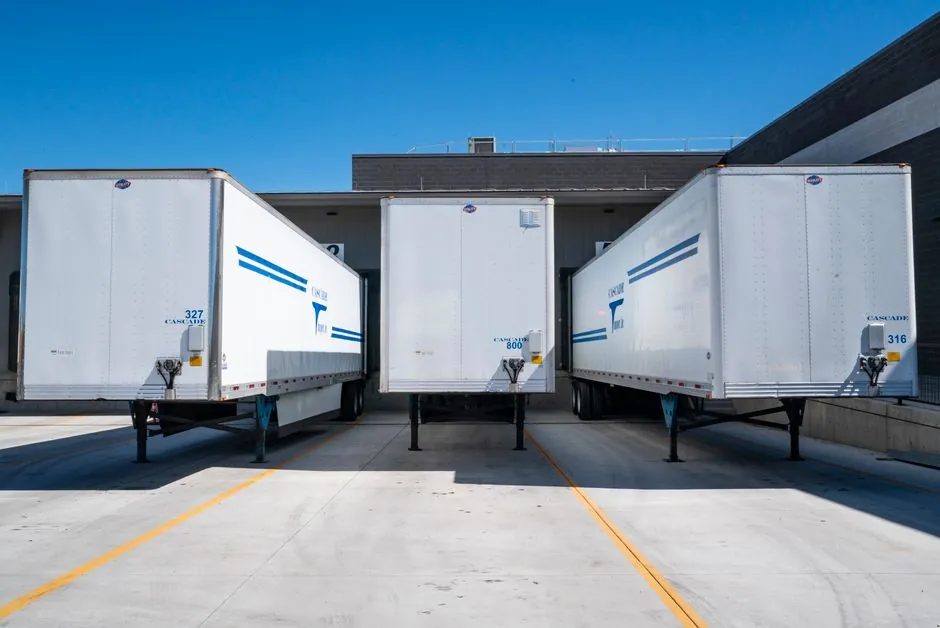
A dock leveler closes the standard 8-10 inch horizontal gap and a working vertical range of roughly 12 inches above to 12 inches below the dock surface, carrying forklift and pallet-jack loads across a hinged lip that rests on the trailer bed [S4][S1].
With no leveler, the 36-60 inch variation in trailer bed height against a fixed 48 inch dock opening forces workers to drive off an unprotected curb edge, which is why pit and edge-of-dock levelers are treated as core loading dock equipment rather than accessories [S3].
The Geometry the Leveler Has to Absorb
Trailer bed heights on US highways cluster between 40 and 50+ inches off the ground, while dock heights sit in a 38-55 inch band, leaving a 12 inch above / 12 inch below working envelope that a properly sized leveler must cover without binding [S4]. The horizontal gap to the rear of the trailer is set by rubber or steel dock bumpers and lands at a typical 8-10 inches that forklifts cannot safely jump under power [S4].
Trailer suspension also breathes: as forklifts roll in and out, the rear of the truck settles or rebounds, so the leveler cannot be a rigid ramp. It has to "float," staying in contact with the truck bed as the trailer moves up and down during loading [S1][S6]. For facilities that need deeper material handling context, the dock leveler reference page documents the same floating-deck principle against the broader loading-dock product family.
Operating Sequence: From Backing-In to Floated Ramp
When a truck reverses against the bumpers, the operator activates the leveler: the deck rises above the pit floor, the hinged lip plate extends outward, and the assembly lowers so the lip lands flat on the trailer bed, producing a continuous ramp from concrete to truck [S1]. On powered units this is a single push-button cycle; on mechanical units the operator pulls a release chain, the spring lifts the deck, the lip pivots open, and the operator's own weight walks the deck back down into the trailer [S4].
During the load, the leveler stays in "float" mode, with the deck following trailer movement of several inches up or down so the forklift never sees a sudden step. Once the truck pulls out, the lip retracts, the deck returns to the stored flush position, and the pit cover closes the recess [S1][S3]. For an adjacent piece of equipment that shares the same pit-or-flush decision logic, see the overhead bridge crane entry, which is specified on similar loading-bay cycle-rate grounds.
Three Drive Types on the Same Deck

Hydraulic, air-powered, and mechanical levelers all perform the same lift-extend-lower sequence, but they differ sharply on operator effort, maintenance load, and capital cost. The table below lines them up against the criteria a spec engineer actually weighs [S1][S3][S4].
Hydraulic units use a hydraulic cylinder under push-button electric control and dominate high-volume docks because they deliver the lowest operator effort, automatic lip extension, and the lowest routine maintenance, albeit at the highest first cost [S1][S3]. Air-powered units use a pneumatic bladder driven from a standard 110 V supply, offering push-button operation with fewer moving parts than hydraulics, but the bladder is puncture-sensitive and is generally specified for medium-duty service [S1][S3]. Mechanical units use a spring-and-chain mechanism, cost least up front, suit light to moderate traffic, but demand more operator effort and accumulate higher lifetime maintenance as springs fatigue [S1][S3][S4].
Mounting Style: Pit, Edge-of-Dock, or Vertical
How the leveler mounts to the building is a separate decision from the drive type, and it changes both the installation cost and the available lift range. A pit-style leveler sits in a concrete recess flush with the floor, delivers the highest capacities and the widest trailer-height range, and is the default in busy distribution centers [S1][S2].
Edge-of-dock (EOD) levelers anchor to the dock face rather than the floor, so they avoid the cost of saw-cutting and re-pouring a pit, but they have a more limited vertical operating range, making them appropriate only when trailer beds sit at or very near dock floor height [S1][S2][S4]. Vertical-storing hydraulic levelers fold up inside the building when idle, eliminating the perimeter gap that lets cold air infiltrate, which is why they dominate refrigerated and cold-storage facilities [S2][S3]. A rail dock leveler is a vertical-style variant mounted on a sliding rail to service rail cars rather than over-the-road trailers [S2].
Selection Criteria: Traffic, Load, Height, Environment
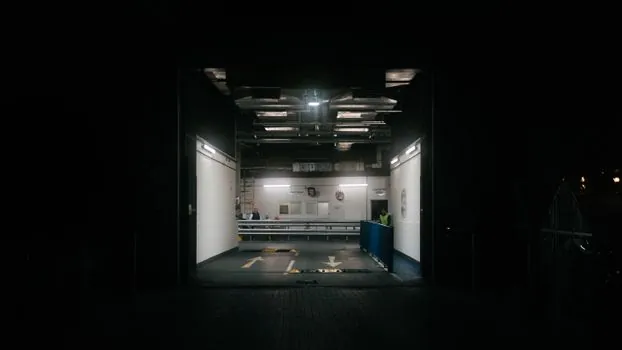
Sizing a leveler comes down to four numbers and one environmental flag, per the consensus across OEM guidance pages [S1][S2][S3]. First, traffic volume dictates drive type: high-volume docks go hydraulic or air, low-to-moderate docks can accept mechanical [S1][S2]. Second, total moving load must include both the lift truck and the cargo, since that gross number sets the platform's rated capacity [S2].
Third, the deck-height range of the trailers being served (typically the 36-60 inch band, with a 40-50+ inch core) defines the working envelope the leveler must cover [S3][S4]. Fourth, the dock's fixed height (often 48 inches) plus the chosen pit dimensions determine whether a standard 6-8 ft leveler is enough or a longer ramp is required [S3]. The environment flag is insulation: refrigerated facilities usually push the spec toward vertical-storing units to cut energy loss through the pit perimeter [S2][S3].
Safety Devices and Failure-Mode Considerations
Modern levelers carry full-range toe guards, automatic lip extension and projection sensors, vehicle-restraint interlocks, and re-locking mechanisms that prevent free-fall if a hydraulic hose ruptures [S1]. Powered units also pair with dock lights and truck-locking devices as a complete interlocked safety package, a combination mechanical levelers cannot offer because they lack the electrical control path [S4].
Common failure modes worth pre-empting in the spec: spring fatigue on mechanical units (drives the lifetime maintenance penalty), bladder puncture on air units (favors hydraulic for heavy cycles), and the energy-loss penalty on pit-style units in cold storage (favors vertical-storing) [S1][S3][S4]. For a parallel view of how latched interlocks and safe-stop logic are specified on neighboring material-handling equipment, the aerial work platform and aerial work truck references document similar interlock patterns on fall-arrest equipment.
Verification Points Before Spec Sign-Off
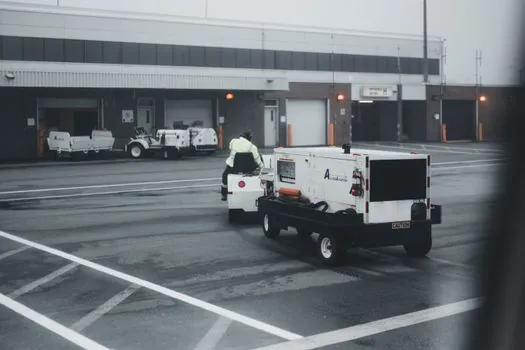
Before locking a model, confirm the rated dynamic capacity against the heaviest lift-truck-plus-load combination actually running on the dock, and verify the operating range (commonly 12 in above to 12 in below dock) covers the tallest and shortest trailers that will reverse in [S2][S4]. Match drive type to daily cycle count, match mounting style to whether a pit already exists, and confirm the safety interlock package integrates with the vehicle restraint and door controls already on the bay [S1][S2][S4].
Two signals worth tracking: a tightening of energy-loss rules for refrigerated docks, which keeps pushing volume toward vertical-storing hydraulic designs [S2][S3], and incremental standardization of 110 V controls across air-powered units, which continues to make them a credible middle-ground spec for medium-duty retrofits where cutting a pit is not an option [S3][S4].
Related analysis: Fire Hydrant Nozzle Height Above Finished Grade: Jurisdictional Specs Compared.