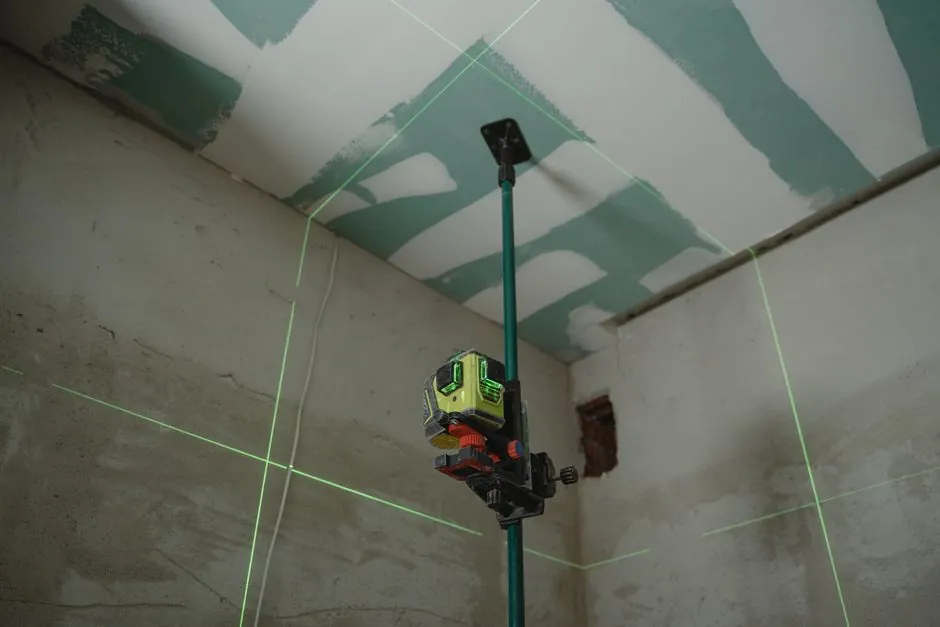
A laser distance meter derives range by measuring how long a laser pulse takes to travel to a target and back, then multiplying half that round-trip time by the speed of light (~3×10^8 m/s) [S1][S6]. Because light moves at a constant velocity in the atmosphere, even a sub-nanosecond timing error corresponds to only a few centimetres of range error, which is why consumer meters commonly quote ±1.5 mm to ±3.0 mm accuracy at distances up to 30 m [S3].
Most hand-held units (often called laser tape measures) operate over roughly 50 cm to 100 m, with theoretical range claims of 200–300 m under ideal reflective conditions [S3]. Beyond simple ranging, the same optics and timebase are used to compute area, volume, and indirect heights via Pythagorean functions, since the timing electronics are already fast enough to deliver millimetre-scale resolution in a single shot [S1][S5].
Time-of-Flight Pulse Measurement
Pulsed time-of-flight is the dominant method in surveying, military, and golf/sports rangefinders: the meter emits a short, high-peak-power laser pulse, the pulse scatters off the target, and a photodiode times the return [S2][S6]. The most common form of laser rangefinder operates on the time-of-flight principle by sending a laser pulse in a narrow beam towards the object and measuring the time taken for the pulse to return [S6].
For a 30 m round-trip, the flight time is about 200 ns, so the timing circuit must resolve nanoseconds to achieve millimetre accuracy, which is why these units use avalanche photodiodes and high-speed TDCs (time-to-digital converters) [S4]. At long range (several kilometres), pulsed time-of-flight outperforms phase methods because the high peak energy returns a usable signal even from diffuse surfaces like rock, foliage, or low-reflectivity building cladding [S2][S4].
Phase-Shift (Modulated Beam) Method
Phase-shift meters do not time a single pulse; instead they modulate the laser's intensity at a known radio frequency and measure the phase difference between emitted and returned light [S1][S4]. The phase shift technique uses an intensity-modulated laser beam, and the phase shift of the modulation is proportional to the time of flight; compared with interferometry, accuracy is lower but unambiguous range is much larger and the method handles diffuse targets well [S4].
EngineerSupply notes this is how more traditional survey equipment works, contrasting it with the simple pulse method used in most consumer laser tape measures [S1]. In practice, phase-shift devices deliver sub-millimetre accuracy over 1 m to 200 m and are the technology behind most professional construction laser distance meters, because modulating power keeps the average laser output low (helping with eye-safety classification) while still resolving millimetres [S1][S4].
Triangulation for Short Range, High Accuracy

Triangulation is a geometric method in which the laser emitter, the target spot, and a position-sensitive detector (a CMOS linear array) form a triangle; the spot's position on the detector shifts predictably with distance [S2][S4]. Triangulation displacement sensors typically work over millimetres to a few hundred millimetres, with one compact model covering 10–500 mm in a single housing, and CMOS integration time is increased when the return signal is weak to preserve accuracy [S2].
Accuracy falls off rapidly with range, and depth of field is limited because the device cannot measure the distance corresponding to its own emitter-to-detector baseline, so triangulation stays in the short-range, high-precision niche (e.g. thickness gauging, vibration, displacement of small parts) rather than room-scale measuring [S2]. When you want a quick cross-reference on consumer range and optics, this comparison of laser distance meters against golf rangefinders lays out how the same time-of-flight hardware is retuned for different use cases.
Interferometry and Frequency Modulation
Interferometers measure distance with accuracy far better than the wavelength of the light used, by counting interference fringes between a reference arm and a measurement arm [S4]. This is the workhorse of machine-tool calibration and laboratory metrology, but it requires a cooperative retroreflective target and a continuous path, so it is not what a jobsite "laser tape measure" uses.
Frequency modulation (FMCW) is a separate approach: a laser is linearly chirped in frequency, and the beat note between the sent and returned beams translates into distance [S4]. FMCW handles low-cooperation targets and is common in industrial 1D laser distance sensors for factory automation, where 10 m to 300 m ranges and millimetre resolution are needed on conveyor and crane-positioning tasks.
Comparison of the Four Main Principles
Triangulation wins on short range and sub-micron accuracy but loses depth of field; pulsed time-of-flight scales to many kilometres but at the cost of millimetre-plus resolution; phase-shift gives the best accuracy-vs-range trade for hand-held construction meters (typically ±1–2 mm at 50–100 m); interferometry delivers the highest absolute accuracy but needs a cooperative retroreflector and a stationary bench setup [S2][S4]. For diffuse, low-reflectivity targets like dark fabric or asphalt, phase-shift and pulse methods both degrade, while triangulation, working off the specular spot on a CMOS array, can remain accurate on shiny, near-perpendicular surfaces [S2][S4].
As a rule of thumb, choose triangulation below 500 mm when micrometres matter, phase-shift between 1 m and 200 m when you need millimetres off a wall, and pulse time-of-flight above 200 m or when the target is non-cooperative [S2][S4]. If you want the same selection logic applied to the visually similar laser level category, the trade-off there is plane accuracy and self-levelling range, not pulse timing.
Reflectivity, Beam Geometry, and Atmospheric Limits
Any solid object will reflect a small percentage of the emitted energy, and even a few percent of the return is enough for the detector to lock, which is why laser meters work on wood, plaster, brick, and concrete without a special target [S1]. Lasers are highly focused, near-monochromatic beams that resist atmospheric dispersion far better than white light, so the spot stays tight over long distances before divergence weakens the return [S1].
For very short or very long distances, accuracy degrades: at a few centimetres the timing resolution and the receiver's dead-time dominate, and at multi-kilometre range beam divergence, scintillation, and weak returns on low-reflectivity surfaces set the error floor, which is why the same method that is millimetre-precise at 30 m becomes decimetre-precise at 5 km [S1][S4]. The same physics shows up in laser profiler line-scan sensors, where the triangulation-vs-time-of-flight choice depends almost entirely on the standoff distance and surface.
Standards, Eye Safety, and Practical Specs
Most consumer and construction meters fall into laser Class 2 (≤1 mW visible output) or Class 3R (≤5 mW), and the stated range is valid only with the OEM-supplied reflective target plate on long-range models. Acuity's most common triangulation displacement sensor (the AR100) covers 10–500 mm at up to 9,400 samples/s in a single housing, illustrating the typical short-range envelope for that principle [S2].
For a hand-held time-of-flight unit, a published accuracy of ±1.5 mm at 30 m and a working range up to ~100 m are representative, and the same 0.05–100 m envelope shows up in the engineering guides that frame the laser distance meter category [S3]. Track these as verification nodes going forward: vendor datasheets listing both "accuracy at reference distance" and "accuracy at maximum range" separately, and any move by Class 2 phase-shift meters into the >200 m range with sub-millimetre spec. For processes where the beam is doing more than ranging, such as engraving or marking, the same time-of-flight optics underpin a laser marker head, and the same triangulation geometry shows up in surface-scanning laser screed control loops.