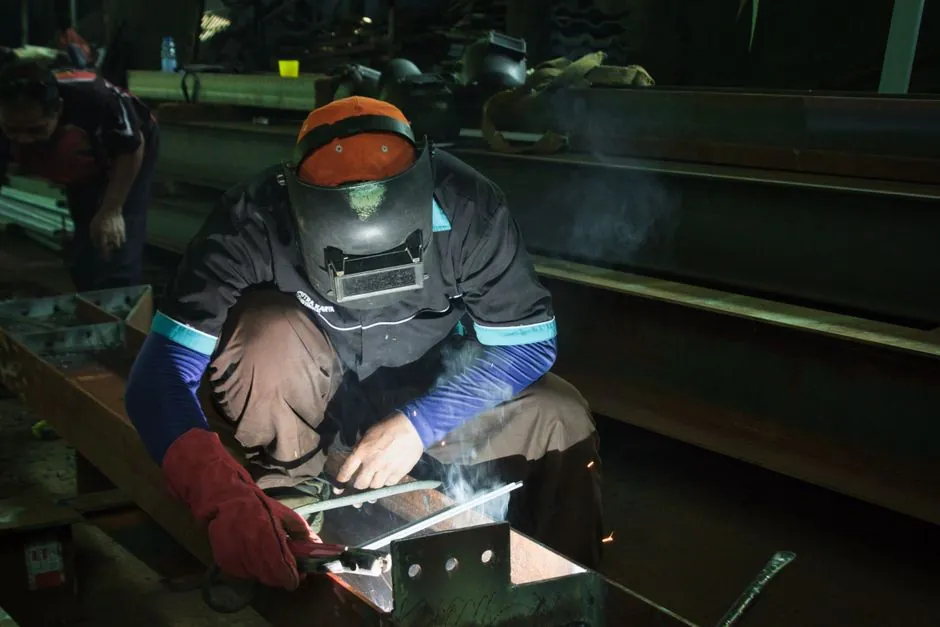
CD stud welding is a capacitor-discharge process that completes the weld in roughly 1–3 milliseconds using stored electrical energy from a bank charged off standard 110–115V AC wall power [S3][S4]. Drawn arc stud welding is a DC arc process with a typical weld time of 100 to 1,500 milliseconds, using a DC rectifier or generator powered from 110V single-phase or 480V three-phase supply [S2][S3][S4].
That single time difference drives almost every other distinction between the two: power source, stud size range, base-metal thickness, ferrule use, shielding gas need, and the kind of joint you can confidently specify in production. The choice is not CD vs arc on a spec sheet, it is a fit question tied to the stud diameter, the base-metal gauge, and whether the rear face of the workpiece has to stay unmarked [S1][S3][S4].
How Each Process Builds an Arc and a Joint
CD stud welding starts with a specially formed ignition tip on the end of the stud; the stud sits in contact with the workpiece, the gun is triggered, the rapidly rising current vaporises the tip, an arc is struck, and the stud plunges into the molten pool as the arc collapses when metal-to-metal contact returns [S2][S3][S5]. Total weld time is about 3 ms in contact mode and roughly 1 ms in gap mode, which is what lets CD weld onto sheet as thin as 0.5 mm without burn-through [S2].
Drawn arc stud welding works in the opposite mechanical sequence. The stud and a ceramic ferrule are placed on the base metal, a weld gun lifts the stud a preset distance to draw a low-current pilot arc, the arc melts both stud and base metal into a molten pool, the solenoid plunges the stud into the pool, and the ceramic ferrule contains the molten material and shields it from atmosphere while it solidifies [S2][S4][S5]. A short-cycle variant runs the same drawn-arc sequence in 20–30 ms, used for semi-structural thin-sheet work below ½" stud diameter [S5].
Power Source, Stud Range, and Base-Metal Limits
CD welders draw from a capacitor bank charged at 110–115V AC, so the process is single-phase and shop-outlet friendly [S3]. Drawn arc welders are DC machines, rectifiers or engine-driven generators, and ship in both 110V and 480V three-phase variants depending on the stud size and duty cycle [S3][S4].
CD is the small-fastener process. Practical stud diameter is M3 to M10, roughly 14 gauge to ⅜" [S2][S3]. Recommended base-metal thickness is about 1/10 of the stud diameter, with 0.5 mm as a hard floor for mild steel, stainless, aluminium, and brass [S2]. One Midwest Fasteners reference even calls out welding onto material as thin as 0.015" (about 0.38 mm), provided the stud and sheet are properly matched [S3]. Drawn arc covers M3 to roughly M24 (3–25 mm), with the ferrule variant recommended above 12 mm and a base-metal floor around 1.2 mm (0.048") for one-sided welds [S2][S4].
Ferrule, Shielding Gas, and Flux: What Each Process Needs
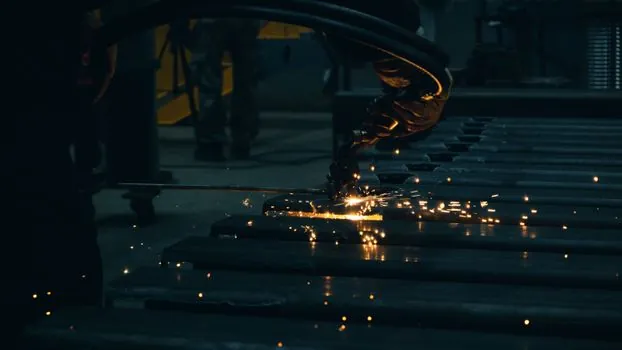
CD stud welding does not use a ceramic ferrule, does not require shielding gas, and does not use a flux pill; the arc is short enough that atmospheric contamination is not a practical problem, and the joint forms from a clean tip-initiated fusion zone [S2][S3][S4]. This is a meaningful simplification on a production line: no ferrule loading, no spent-ferrule extraction, no gas bottles, no flux inventory.
Drawn arc stud welding uses a ceramic ferrule (also called an arc shield) for the standard variant, which contains the molten pool, holds it against the stud, and excludes oxygen from the weld zone [S2][S4][S5]. The ferrule is broken off after the weld. For larger studs or where weld-pool protection from atmosphere is critical, drawn arc can also be run with shielding gas, often argon-based, and an aluminium flux is used in the stud for structural duty [S2][S5].
Material Compatibility and Dissimilar-Metal Joints
CD stud welding handles mild steel, stainless steel, aluminium, brass, and zinc-coated steels, and the HBS documentation specifically calls out that the gap variant (1 ms weld time) makes aluminium and brass weldable without shielding gas [S2][S3]. CD also welds dissimilar metal combinations, which is one of its recognised advantages over drawn arc when small parts are involved [S1].
Drawn arc is most commonly run on mild steel and stainless steel, with aluminium as an option when shielding gas is added [S2][S4]. Drawn arc is a structural process, so most published approvals and codes (AWS, ASTM, U.S. Navy, ABS, MIL-S-24149, ISO 13918) sit on the arc-stud side rather than the CD side, which matters when the welded stud carries a rated load in a ship, bridge, or offshore module [S4].
Weld Appearance, Heat Input, and Reverse-Side Marking
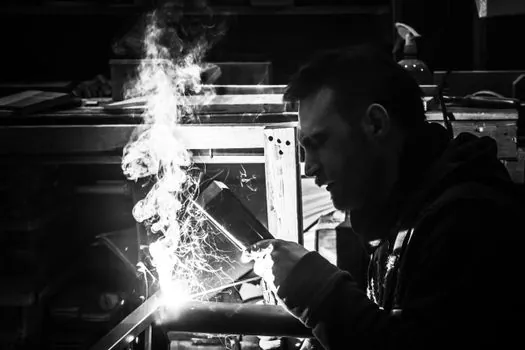
CD's signature property is a clean, unmarked reverse side. The arc and plunge happen in roughly 1–3 ms, the heat-affected zone is small, and there is no marking, discoloration, or burn-through on the back of the sheet [S2][S3][S5]. That is why CD is the default for consumer electronics, signage, decorative trim, control panels, appliance enclosures, and HVAC parts where the back face is a visible surface [S3][S7].
Drawn arc delivers a structural full cross-sectional weld, the entire face of the fastener is fused, but it is also a much longer, hotter cycle. Weld time of 100–1,500 ms means visible heat tint on the front, a ferrule residue ring that has to be knocked off, and a meaningful HAZ on the base metal, which is why drawn arc is paired with thicker base metal (≥1.2 mm typical) and not used where an unmarked reverse side matters [S2][S4].
Selection: CD vs Drawn Arc by Criteria
Match the process to the constraints, not the marketing. Use this four-criterion comparison as a quick selector: [S3]
Stud diameter. CD covers M3–M10 (14 ga to ⅜"). Drawn arc covers 3–25 mm with the ferrule variant recommended above 12 mm. If the fastener is above ⅜", arc is the only realistic option [S2][S3].
Base-metal thickness. CD goes down to 0.5 mm and is documented as low as 0.015" for matched small studs. Drawn arc floor is around 1.2 mm (0.048") for one-sided structural welds [S2][S3][S4].
Structural vs non-structural. CD is for non-structural and light-duty fastening where the reverse side must stay clean. Drawn arc (including the 20–30 ms short-cycle variant) is the structural and semi-structural choice and is what the offshore, shipbuilding, and bridge codes reference [S3][S4][S5].
Power and consumables. CD is 110–115V AC single-phase, no ferrule, no gas, no flux. Drawn arc is DC from 110V or 480V three-phase, ceramic ferrule required for the standard variant, shielding gas for some materials, and aluminium flux for structural stud grades [S2][S3][S4][S5].
Where Each Process Is Actually Used
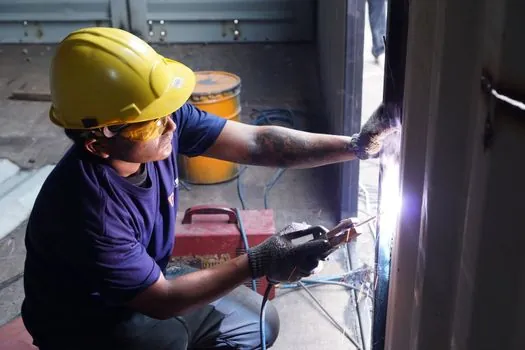
CD shows up in sheet-metalwork, electronics and switchgear cabinets, laboratory and medical equipment, food-industry stainless fit-out, household appliances, signage, and any application where the back of the panel is a cosmetic surface [S2][S3][S7]. HBS and other OEM references list M3–M10 fasteners on steel, stainless, aluminium, and brass sheet as the canonical CD workload [S2].
Drawn arc shows up in shear connectors on composite steel beams, anchor plates on tanks, cable management and power-distribution hardware, shipbuilding and offshore platforms, military vehicles, food-service equipment, and moving-vehicle fabrication [S4]. It is the process behind the large studs you see welded to bridge girders and ship hulls, and it is the process most of the published stud-welding standards (AWS D1.1 references, ISO 13918, MIL-S-24149) are written around [S4].
Related Trade Context
Stud welding is one of several fastening and joining methods that fall under the broader stud welder category, which also covers drawn-arc equipment, short-cycle equipment, and capacitor-discharge equipment as distinct machine classes. Where the joint is a stud, the same production environment often uses related cutting and preparation tooling catalogued under welding cutting tool for ferrule trimming, tip dressing, and base-metal cleaning. For plants that run both processes, the welding power source itself is documented under arc welder, which covers the DC rectifier side of drawn-arc stud welding, and broader machine-shop equipment such as construction machinery and equipment often sits one bay over from the stud-welding cell. [S3]
For comparison with related arc-welding control topics, the trade press treatment of inverter-MMA arc-force behaviour is a useful parallel: Arc force control on inverter MMA welders covers the same arc-energy envelope, just applied to stick electrodes rather than studs.
For a structural steel context where studs are placed by hand or by rebar fixers, the adjacent trade boundary between bar bending and rebar fixing is laid out in Bar bender vs steel fixer: distinct tasks, one trade, and the assembly-side economics of where studs ultimately get welded sit alongside the analysis in Moving final assembly of industrial equipment and the tariff bill.
Limits, Failure Modes, and Common Mis-Specs
CD's failure mode is almost always a base-metal or stud that is too thick for the stored energy, which shows up as a weak, cold joint that pops off under load, or, in gap mode, as misfiring if the spring lift is out of adjustment [S2][S8]. CD does not produce a structural rated weld, so specifying CD on a load-bearing shear-connector application is a mis-spec and a code-compliance problem [S3][S4].
Drawn arc's failure modes are ferrule-related (wrong ferrule for the stud size, ferrule not seated, spatter bridging the arc) and energy-related (under-current at long cable lengths, wrong lift height, missing flux on aluminium studs) [S2][S4][S5]. On a job site, the most common drawn-arc defect is incomplete fusion caused by a stud held too long off the base, which the operator compensates for by shortening the lift and checking the ferrule seating against the stud manufacturer's chart [S4].
Two signals worth tracking: AWS and ISO working-group output on ISO 13918 amendment revisions, and any updates to MIL-S-24149 covering stud grades for shipboard and offshore use. Both documents sit on the arc-stud side and are the de facto acceptance criteria for the structural stud-weld work that drawn arc dominates.