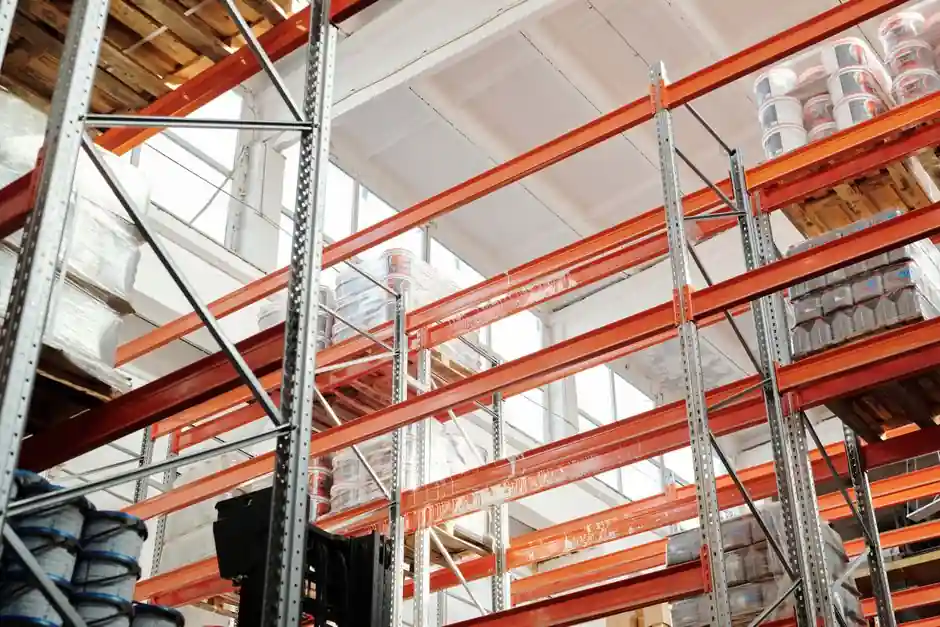
A flow rack uses gravity to move cartons or pallets down inclined roller tracks, with operators loading at the back and picking at the front to enforce first-in, first-out (FIFO) rotation [S1]. Roller pitch, brake tension, and lane incline are the three physical variables that set throughput; misalignment on any one stalls the lane.
Beyond flow lanes, the broader category of industrial rack divides by load mechanism: selective beams for random access, drive-in/drive-thru rails for high-density LIFO or FIFO, cantilever arms for long loads, and shuttle or ASRS carriers for automated retrieval. The common engineering element is the same: a steel frame that transfers vertical pallet load through beams into uprights, then into the floor slab via base plates and anchors [S2][S4].
Gravity flow mechanics in carton and pallet flow lanes
Carton flow racks work on a 0%-8% inclined track of steel or polymer rollers, where a braking roller or strip controls the descent speed to roughly 0.3 m/s so an operator can stop a carton with one hand [S1].
Flow rack frames are built from steel tubes and modular joints rather than welded plate, which lets the structure be reconfigured as SKU profiles change [S1]. For a wider rack system, the pallet rack family extends this idea by using roll-formed or structural uprights and bolted beams, where each beam pair carries the pallet load directly across the front face.
Selective, drive-in, and cantilever frames: the structural variants
Selective racking is the most common warehouse configuration, with pallets resting on horizontal beams between two vertical frames so any pallet can be reached without moving another [S3]. Drive-in racking lets a forklift drive into the rack on rails to load or unload from a single side, enforcing last-in, first-out (LIFO) stock rotation, while drive-thru racking adds a second aisle for FIFO access at the cost of one extra access corridor [S3].
Cantilever racking replaces the front beam with a single open arm column, which is the standard solution for long, awkward loads such as lumber, pipe, and structural steel. The same upright, beam, and base-plate load path applies, but with the base plate and anchor sizing driven by the moment arm rather than by pure vertical load.
Load, utilization, and seismic design numbers
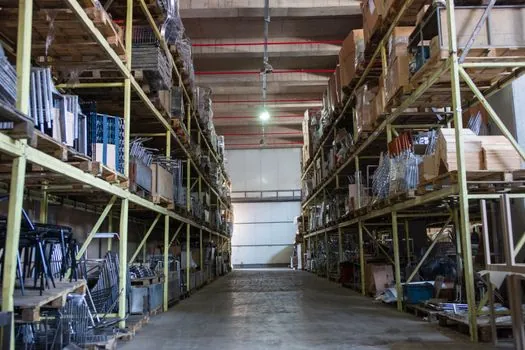
Engineers size racks using a "utilization ratio" expressed as a percentage of allowable stress: at 30% the rack is underused and can be lightened, while anything above 100% is overstressed and unsafe [S4]. Beam load ratings depend on beam length, profile depth, and steel gauge; upright frame capacity is the system-level limit that the engineer checks against the combined weight of stored items plus pallets [S4].
Seismic zone drives a counter-intuitive trade-off, because over-designing capacity in a high-seismic area adds mass that the earthquake must accelerate, forcing heavier base plates, more anchors, and thicker slab reinforcement [S4]. The structural decision therefore starts from expected load, not from a "heavier is safer" assumption, and the two baseline steel choices are structural (heavier, higher capacity) and roll-formed (lighter, more versatile, typically lower cost) [S4].
Comparison of rack families against throughput, density, and rotation
On four decision criteria, the rack families diverge sharply. Selective racking gives the highest random-access selectivity at the lowest storage density, while push-back racking stores 2-5 pallets deep on nested carts on inclined rails and is good for high-volume same-SKU stock [S3]. Double deep racking doubles per-aisle density by stacking one SKU behind another, but the rear pallet needs a double-reach truck and slows pick rate [S3]. Pallet flow racking and drive-thru racking are the two main FIFO options, with pallet flow using gravity on rollers and drive-thru using forklift lanes through the rack [S3]. For cartons rather than pallets, the storage handling chain normally pairs flow racks with order pickers or a shuttle system upstream, since shuttle systems are built for high-density tote storage rather than full-pallet flow.
Selection criteria: which system fits which operation

Use selective racking when SKU count is high and every pallet must be reachable on any shift; the trade-off is aisle count, since each aisle only stores two rack rows back-to-back. Use drive-in, drive-thru, or push-back when SKU count is low and the operation can accept LIFO or limited selectivity in exchange for 60%-80% more pallet positions in the same footprint [S3]. Use pallet flow when the SKU is perishable or has a hard expiry date, because FIFO rotation is enforced by gravity, not by operator discipline [S3].
Use cantilever when the load is long, flat, or awkward and beams would block the face, and use a storage cage for valuables or restricted items that need a lockable enclosure rather than open beams. For facilities with no room to add aisles, an ASRS system trades capex for a small footprint, and the upstream rack design still has to match the crane or shuttle envelope.
Failure modes and limits engineers watch on a working rack
Beam deflection, anchorage pull-out, and upright buckling are the three failure modes that show up first in service, and all three are driven by the same root cause: capacity was specified against a single heaviest pallet rather than against the system's worst-case combination of beam length, frame capacity, and seismic load [S4]. Forklift impact is the leading cause of in-service rack damage in selective and drive-in aisles, which is why most safety codes now require end-of-aisle guards and visible column protectors in addition to the rack structure itself [S3].
On flow lanes, the typical in-service failures are roller seizure, brake slip, and frame racking from uneven loading, all of which are caught by routine visual inspection of the lane rather than by load-cell instrumentation. Engineering analysis from a licensed professional is the standard gate for any design that exceeds standard manufacturer load tables, especially in higher seismic zones [S4].
Standards, sourcing, and what to verify before purchase

Two material choices dominate the spec: structural steel for high-capacity, heavy-duty applications and roll-formed steel for general warehouse duty, with the decision driven by capacity, seismic zone, and budget rather than by brand [S4]. For higher-density or automated sites, rack design must integrate with the upstream ASRS system envelope and the downstream order-picking path, and designers should map material flow before locking beam and upright sizes.
Track the following signals on the next design review: utilization ratio for the heaviest-loaded beam (target well below 100% with a documented safety factor), anchorage pull-test results for the slab, and forklift impact frequency per aisle per quarter, because that number is the leading indicator of when to add column protection. Buyers sourcing steel-heavy rack components can also reference the stainless steel procurement brief for supplier-side signals on lead time and pricing that affect rack frame delivery dates.