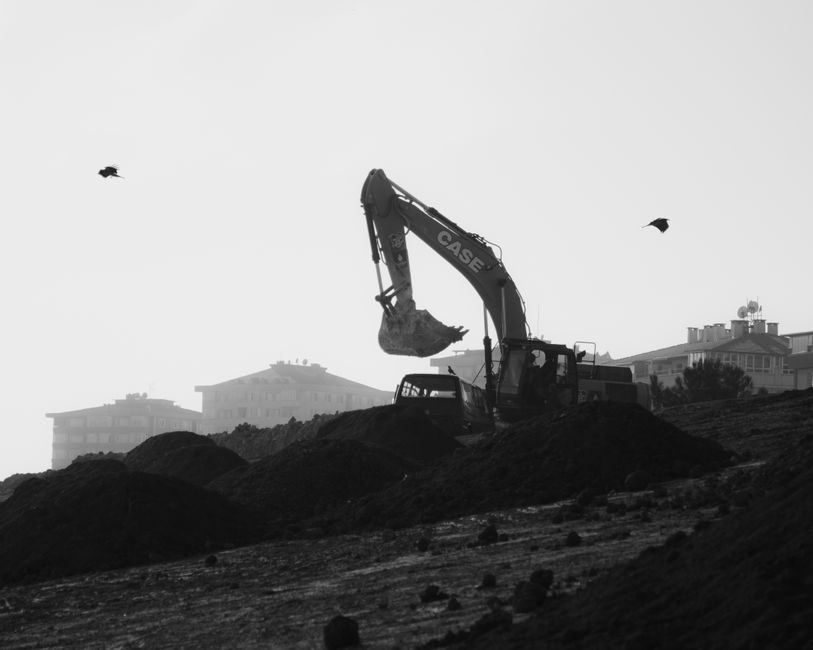
A crawler excavator is the right pick when the work stays in one footprint and the ground is soft, uneven, or slope-prone — tracked undercarriages spread load over a far larger contact patch than tyres and give the machine the mass it needs to swing a full bucket without walking [S1].
The 2026 market on DirectIndustry lists 54 manufacturers and 539 crawler-excavator models, segmented by size into mini (186), midi (20), medium (232), large (115), and micro (10), with 528 diesel, 11 electric, and 1 hybrid variant, so the shortlist is built by filtering on operating weight, engine kW, and tail-swing class first [S1].
Step 1 — Lock the Operating-Weight Class to Soil and Haul Constraints
Operating weight sets ground bearing pressure, transport legality, and counterweight budget in one move; for a 20-tonne class machine expect roughly 50–55 kPa on a standard 600 mm track shoe, while a 40-tonne class climbs toward 70–80 kPa on the same shoe width [S1].
Pick mini/micro (under 6 t) for finished-landscape work and indoor demolition where a 1.5–2.0 m tail swing and a 1.5–3 t trailer tow weight matter; pick medium (10–25 t) for utility trench, pipe-lay, and general earthwork where you still need to road the machine on a low-bed under standard 40 t GVM limits [S1]. For a side-by-side look at the small end of the range, Mini Excavator Types and Applications: A 2026 Spec and Selection Map breaks the under-6-tonne classes by boom configuration.
Step 2 — Match Engine kW, Pump Flow, and Hydraulic Architecture to Attachment Duty
Engine power has to cover both roading and peak hydraulic draw; on a 22-tonne class machine the 2026 catalogue clusters between 110–150 kW, while 30-tonne machines land at 160–200 kW and 50-tonne mining units push past 270 kW [S1][S5]. Volvo's current EC-class ranges confirm the same band — the EC220 and EC300 sit in the 125–210 kW window, and larger EC380–EC950 units step from roughly 230 kW up to 460 kW [S5].
Decide attachment duty before you decide power: ditch-cleaning and finishing with a tilt-rotator needs ~120 L/min auxiliary flow at 250 bar, hammer work wants 80–100 L/min at 180–200 bar with a dedicated return line, and heavy bucket/rock work depends more on main-pump displacement than peak kW [S1]. A larger machine without the right pump architecture will not out-cycle a smaller, better-matched one.
Step 3 — Pick the Tail-Swing Class for the Worksite Envelope
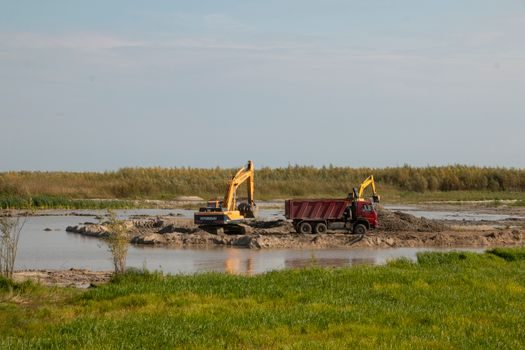
Conventional, short-tail-swing, and zero-tail-swing are three distinct machines, not trim levels: conventional gives the heaviest counterweight and best rear stability, short-tail-swing trims the rear overhang to roughly 200–400 mm inside the track width, and true zero-tail-swing keeps the counterweight inside the track gauge at every boom angle [S1][S3].
Choose conventional for green-field sites and mining where bulk lift capacity outranks footprint; choose short-tail-swing for urban street work and road widening where one lane of traffic stays open beside the machine; choose zero-tail-swing for tight building-line work, demolition next to walls, and confined sewer jobs where a 90° swing must clear a foundation [S1][S3]. A 2026 mainstream buy runs short-tail-swing because it loses little lift capacity versus conventional while fitting most urban envelopes [S3].
Step 4 — Verify Dig Depth, Reach, and Lift-Over-Height Against the Real Dig
Two machines with the same operating weight can be 1.5–2 m apart on max dig depth purely because of boom-and-stick geometry; always pull the actual dig-depth-at-2.5 m-flat-floor and the max-reach-at-ground-level numbers, not the brochure "max" figure [S3]. Quinn's selection write-up is explicit that buyers should review past jobs and measure how deep the typical dig was, then compare reach/dig specs against that record rather than against theoretical maximums [S3].
For pipeline work at 3 m trench depth with a 600 mm bucket, plan on a machine that can dig to at least 4.2 m flat-floor so the operator can grade without re-positioning; for loading 15-tonne articulated haulers, lift-over-height at full reach needs to clear 3.6 m at the truck body rail with the bucket curled [S1][S5]. Volvo's EC-series spec sheets publish both numbers, which is the level of detail a credible 2026 RFQ should request [S5].
Step 5 — Powertrain and Electrification Choices in the 2026 Catalogue
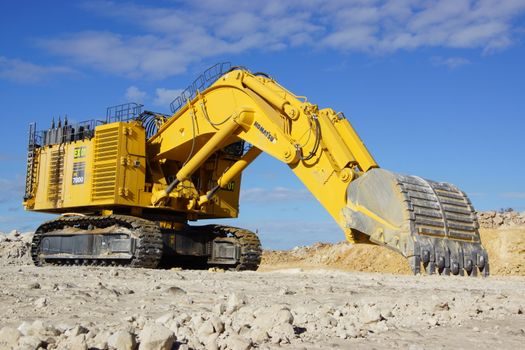
Diesel is still the default: 528 of the 539 models in the 2026 DirectIndustry crawler index run compression-ignition engines, with 11 battery-electric units and 1 hybrid in serial production [S1]. Electric crawler units cluster below 8 t operating weight because battery energy density still constrains shift length for higher-duty classes.
Stage V / EPA Tier 4 Final aftertreatment is the current emissions baseline for diesel units sold into the EU, North America, and Japan in 2026; China-domestic builds increasingly ship with Stage IV-equivalent packages and on-engine diesel particulate filters [S1][S4]. Electric models suit indoor demolition, night-shift urban work under low-noise bylaws, and confined sites where diesel DPM monitoring would force forced ventilation [S1].
Step 6 — Serviceability, Telematics, and Aftermarket Support
Ground-level service access for daily checks (fluids, filters, grease points) and a 5,000-hour structural warranty on the boom and stick are now baseline buyer expectations; without them, total ownership cost over a 10,000-hour life climbs 8–12% even at the same purchase price [S3].
OEM telematics (Volvo CareTrack, Komatsu Komtrax, Cat Product Link, Hitachi ConSite) are standard on Tier-1 2026 models and feed fuel burn, idle time, geofence, and fault codes back to the owner; confirm that the API is open enough for mixed-fleet dashboards before signing, because a locked telematics stack adds cost when you run mixed brands [S5]. Parts availability within 24 hours for filters and 48 hours for hydraulic components is the practical benchmark — anything slower than that is a spec risk on remote sites [S3].
Comparison: Four Realistic Crawler Excavator Configurations Against Selection Criteria
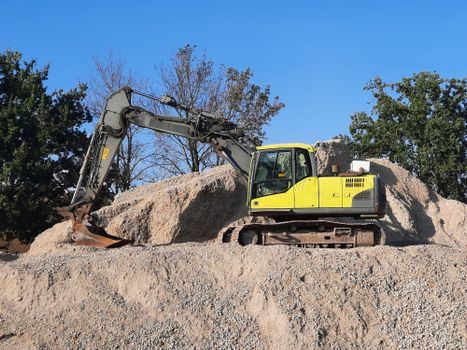
Below is a 2026 shortlist logic for buyers. Numbers are drawn from the 2026 DirectIndustry catalogue and the Volvo EC-class spec band, not invented.
Mini (under 6 t, 30–50 kW, 1.5–2.0 m tail swing) — fits landscaping, indoor demolition, and 2 t trailer tow. Good on finished surfaces; limited to 2.5–3.5 m dig depth. Not for pipe-lay below 3 m or highway truck loading.
Midi (6–10 t, 50–80 kW, short-tail-swing) — covers utility trench up to 4 m, residential site prep, and small foundation digs. The most balanced urban pick; check auxiliary flow if you plan a tilt-rotator [S1][S3].
Medium (10–25 t, 80–170 kW, conventional or short-tail) — general earthwork, road building, and pipeline at scale. Volvo EC220 sits at ~125 kW and ~22 t operating weight, a typical mid-range anchor [S5]. The mainstream buy for fleets.
Large (over 25 t, 200+ kW, conventional tail) — quarry face work, large pipe-lay, and truck loading in 3-pass fills. Volvo EC380–EC480 step from ~230 kW to ~370 kW; expect 6–7 m max dig depth and 4 m+ lift-over-height [S1][S5]. Not for confined urban sites.
Who Should NOT Pick the Mainstream (Medium 20-Tonne) Choice
Buyers running purely indoor demolition or basement dig-out under a 2.5 m clearance should drop to a 1.5–3 t micro with a foldable boom; a 20-tonne class machine simply cannot enter the work envelope and a smaller machine will be cheaper to ship and faster to set up [S1][S3].
Buyers doing only finish-grading and trenching under 1.5 m should also reconsider — a compact track loader with a backhoe attachment often beats a dedicated crawler on cycle time and transport cost below that depth. Finally, anyone planning a single project shorter than ~6 months should rent rather than buy: a 2026 retail benchmark for a new 22-tonne crawler sits in the low-to-mid six figures USD per unit, which amortises poorly on short contracts [S4].
Limits, Failure Modes, and Common Mis-Specs
Under-spec'ing the undercarriage is the most expensive mis-spec: a 22-tonne machine working full-time on blasted rock will eat a standard D5-class track in 2,500–3,000 hours, while an HD-class track with sealed-and-lubricated chains stretches that to 4,000+ hours — a real ownership-cost gap even if both machines cost the same up front. [S5]
The third is ignoring transport: a 30-tonne machine will need low-bed permits and a 35–40 t GVM prime mover, which inflates the true project cost if the buyer only priced the excavator [S1][S3].
Shortlist Logic and Trackable Signals
Build the RFQ around five hard numbers: operating weight, engine kW, max dig depth at 2.5 m flat-floor, max reach at ground level, and tail-swing radius at full lock — then attach the duty profile (peak hours/year, ground condition, attachment list) and the haul road / transport envelope. [S3]
Trackable signals in the next buying cycle: the count of battery-electric crawler models in the 2026 catalogue has reached 11, and large-OEM electric prototypes in the 20-tonne class are expected to move from field trials to commercial sales within the next product refresh — a buyer specifying a 5–7 year ownership horizon should confirm the OEM's electrification roadmap before locking diesel [S1]. For a deeper look at the small-end trade-offs, Mini Excavator vs Excavator: Spec, Use-Case, and 2026 Cost Split lines the two classes against the same five hard numbers.
Spec-level background on the components involved: excavator, crawler crane, and pressure transmitter.