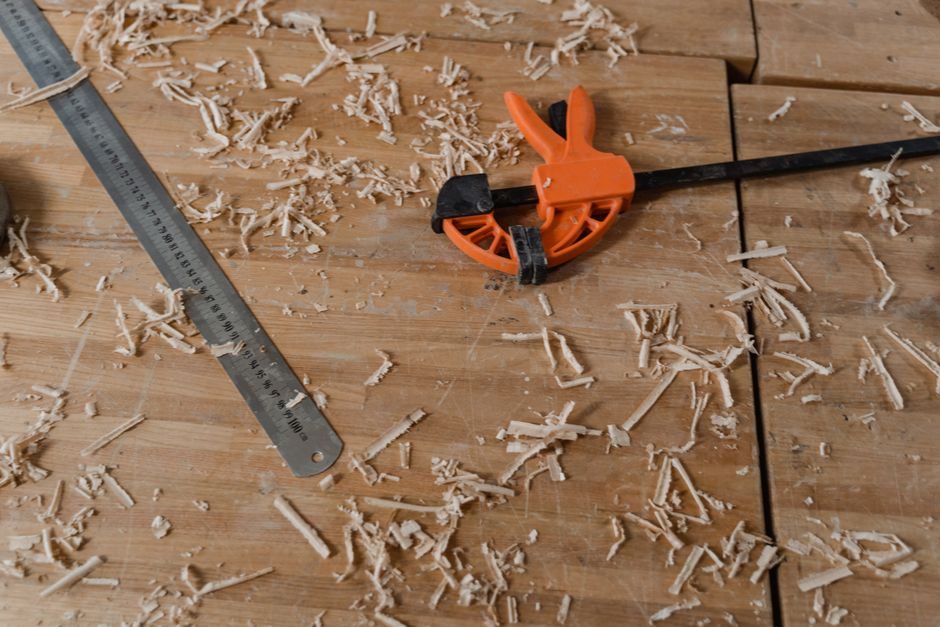
Industrial workbenches on the 2026 market span a load range from roughly 150 kg (plywood-top light-assembly benches) to 1000 kg plus (welded-steel fabrication benches), with the most common width band sitting between 700 mm and 2000 mm [S2]. Choosing the wrong unit usually traces back to one of four blind spots: top material, distributed load, depth, and adjustability — not the brand on the label.
This guide walks through those four gates with the numeric thresholds that matter, then maps them to the three most common duty profiles (electronics, mechanical assembly, fabrication) so a buyer can shortlist in under 15 minutes. For cross-reference on related workshop equipment selection logic, see how to spec a spot welding machine by kVA and current type.
Worktop material and thickness: where most benches fail first
Beech laminate, plywood, and steel are the three dominant top materials on industrial benches catalogued in mid-2026, and each carries a different thickness, repair, and tolerance profile [S2]. Beech-laminate tops typically run 40 mm thick with a multi-ply core; the LOKOMA BT436 ships a 40 mm veneered Tanganyika walnut top edged in beech, and the Facom 215 uses a 40 mm beech laminate surface with a 100 x 70 cm footprint [S2]. Plywood tops are common on the lighter end — Tecnotelai's 069 model is a 2000 x 800 mm plywood-surface bench with a 30 x 30 x 1.5 mm tubular frame, CE-marked, rated 150 kg [S2]. Steel-topped benches dominate the heavy-fabrication end but are scarcer in the beech/plywood catalog data reviewed.
Two thresholds dominate the material decision. First, top thickness below 30 mm is a yellow flag for any duty involving vice-mounted work, hammering, or repeated impact; 40 mm is the practical floor for general mechanical assembly [S2]. Second, for electronics or laboratory work, a static-dissipative (ESD) top is the correct spec — generic beech or plywood will not meet ANSI/ESD S20.20 surface-resistance requirements, so a buyer who needs ESD must verify the top is rated 10^6 to 10^9 ohms, not just labelled "anti-static" rubber matting laid on top. The Craftsman CMST27200R, a 72 in x 24 in butcher-block bench made in Sedalia, Missouri, illustrates the North American garage-tier footprint pattern (≈1830 x 610 mm) and is built around a hardwood top rather than a steel frame [S2].
Load rating, frame section, and the 600 kg dividing line
Rated load is the most often-misread spec because manufacturers quote either distributed load, point load at centre, or drawer-loaded capacity — and they rarely publish all three. Across the 2026 catalog snapshot, stated loads include 150 kg for the Tecnotelai 069 (plywood top, light assembly), 450 kg for the LOKOMA BT436 (veneered hardwood), and 600 kg for the Facom 8071 kit, whose 40 x 40 mm square-tube legs and 30 mm tabletop combine to reach the 600 kg threshold [S2]. That 600 kg figure is a useful mental line: below it, 30-40 mm tube legs with M8 fixings are the norm; above it, expect 40 x 40 mm or 50 x 50 mm legs, gusseted corners, and a steel rather than a wood top.
A useful pre-purchase check is to de-rate the published load by 25 percent for any application that involves repeated impact, off-centre loading, or drawer-loaded operation. The RS Components 9097090 TPH bench, listed at 1800 x 900 mm in the 2026 catalogue, is a representative example of a fixed-height general-industrial unit in that mid-range footprint [S1]. Drawer-equipped benches (e.g. the RWB modular series with 2000/1500 mm lengths and 700 mm depth, height-adjustable in 25 mm steps from 800 to 1100 mm) shift substantial mass into the cabinet body, and that mass must be subtracted from the top-side working load [S2].
Footprint, depth, and the 700 mm rule
Depth — not width — is the dimension most buyers under-spec. The 2026 catalog shows a strong modal depth of 700 mm: LOKOMA RWB, the Facom 215, and the GAMMA VT100005 (1900 x 700 mm) all sit on that number [S2]. A 700 mm depth accommodates a 600 mm component plus a 100 mm rear clearance for fixtures, vices, or a backboard. Going below 620 mm (e.g. the Tipo W at 1500 x 620 mm) starts to compromise vice-mounting room, and any bench narrower than 600 mm depth is effectively a writing desk, not a workbench [S2].
Width selection should follow the longest routine workpiece plus 200 mm of clearance each side. For PCBA and small-mechanical assembly, 1200-1500 mm is adequate; for fabrication of 1.5 m steel sections, a 2000 mm bench (LOKOMA RWB at 2000 mm, Otto Kind 892BAL1 series from 1000 to 2500 mm) is the right starting point [S2]. The RS 9097090 at 1800 x 900 mm is wider and deeper than the European 700 mm-depth norm, reflecting its use as a fixed general-industrial station rather than a modular line-side bench [S1]. For buyers cross-shopping assembly fixtures, the aluminum die casting machine spec map uses a similar width/depth-first methodology.
Height adjustability, ergonomics, and the 800-1100 mm range
Fixed-height benches ship at 850-880 mm in nearly every European catalogue line reviewed, matching the EN ISO 14738 ergonomic range for standing work [S2]. Height-adjustable units in the same catalogues span 800-1100 mm, typically in 25 mm steps via a pin-and-tube or crank system [S2]. Electric sit-stand benches (not represented in the S2 snapshot) extend that to roughly 650-1300 mm and are worth specifying only for mixed sit/stand duty cycles above 4 hours per shift — otherwise the cost premium is hard to justify.
A useful ergonomic gate: if more than 50 percent of operators are outside the 5th-95th-percentile height band for the regional workforce, fixed-height benches will generate measurable lost-time incidents within 12 months. The LOKOMA RWB's 25 mm step adjustment is a reasonable middle ground for mixed-operator cells [S2]. For buyers also selecting shop-floor measurement instruments, the air quality monitor vs dust particle meter spec map follows a comparable principle — match instrument spec to the dominant operator task rather than to the headline range.
Options comparison: four bench classes against four criteria

For a buyer choosing a single bench, the four realistic classes — light-assembly plywood, hardwood general-purpose, modular drawer-equipped, and heavy-fabrication steel — line up against four decision criteria as follows, drawn from the 2026 catalog data [S2].
Light-assembly plywood (e.g. Tecnotelai 069): 2000 x 800 mm footprint, 150 kg load, fixed 850 mm height, lowest cost; appropriate for packaging, light electrical, and hobby work; not appropriate for any vice-mounted or impact duty. Hardwood general-purpose (e.g. LOKOMA BT436 at 1000 x 900 mm, 450 kg): 40 mm top, moderate load, fixed or stepped height, mid-cost; appropriate for mechanical assembly and repair; not appropriate for fabrication or chemical exposure. Modular drawer-equipped (e.g. LOKOMA RWB at 2000/1500 x 700 mm, height-adjustable 800-1100 mm in 25 mm steps): integrated storage, mid-to-high load, mid-to-high cost; appropriate for line-side assembly cells; not appropriate where the cabinet body cannot be floor-anchored. Heavy-fabrication steel (e.g. Facom 8071 at 1130 mm width, 600 kg, 40 x 40 mm tube legs, 30 mm top): highest load and rigidity, highest cost; appropriate for metalwork, vice use, and impact; not appropriate for cleanroom or electronics due to lack of ESD top option in this class [S2].
Two cross-cutting rules follow from the comparison. First, if the duty is electronics, eliminate classes 1 and 4 unless an ESD mat or top is retrofitted — beech and bare plywood do not meet ANSI/ESD S20.20 by themselves. Second, if drawers are required, anchor the cabinet to the floor; a 600 kg-rated bench with full drawers on casters is a tip-over hazard on any floor slope above 1 percent [S2].
Who should NOT buy the mainstream fixed-height beech bench
The 1000 x 700 mm beech-laminate fixed-height bench — the Facom 215 archetype — is the default recommendation in most retail channels, but it is the wrong pick in three identifiable scenarios [S2]. First, in any application involving repetitive torque above 50 Nm, a 40 mm beech top will creep and loosen vice mountings within 6-12 months; a steel-topped or 50 mm-plus hardwood bench is required. Second, in any application with chemical exposure (solvents, acids, cutting fluids), unprotected beech and plywood absorb and delaminate; a stainless-topped or chemical-resistant laminate top is mandatory. Third, in any multi-operator cell where seated and standing tasks are mixed across a shift, a fixed 850 mm height bench will produce musculoskeletal complaints; a crank- or electric-adjustable unit in the 650-1100 mm range is the correct pick, not the cheap fixed unit [S2].
For fabrication and welding-adjacent cells, the same logic that excludes beech also excludes light frames; the Facom 8071's 40 x 40 mm tube legs and 30 mm top at 600 kg are the lower bound for that duty class [S2]. Buyers who need both storage and high load should look at modular drawer benches with 75 mm or thicker drawer slides and a fully welded steel sub-frame — anything less will rack under load.
Sourcing, standards, and what to verify before purchase

Three verifiable data points should be on every purchase order. First, the distributed load rating in kilograms with the test standard referenced (EN 13150 for laboratory benches, EN ISO 14738 for ergonomic height — neither appears in the catalog snapshot above, so request the certificate). Second, the top material and thickness in millimetres, since 30 mm vs 40 mm is a 30 percent-plus cost and stiffness difference [S2]. Third, the frame section size and wall thickness in millimetres, since a 40 x 40 x 1.5 mm tube (Tecnotelai 069) and a 40 x 40 x 2.0 mm tube look identical on paper but differ in stiffness by a factor of roughly 1.8 [S2].
Compliance signals to look for: CE marking for European sale (Tecnotelai 069 carries it explicitly) and ESD top certification (ANSI/ESD S20.20 surface-resistance test report) for any electronics or explosive-atmosphere duty [S2]. For buyers cross-shopping fabrication equipment, the spot welding machine types and spec ranges article uses the same numeric-first approach to shortlisting. The closing check: confirm the manufacturer's stated lead time in weeks, since 2026 supply data across European industrial channels shows mid-size bench (1000-2000 mm) lead times varying from 2 to 12 weeks depending on drawer configuration and ESD top option.
For the relevant spec sheets and selection criteria, see bench scale, aerial work platform, and aerial work truck.