Carbon fiber composites span a tensile-modulus range of roughly 230 GPa (standard modulus, T700-class) to over 600 GPa (high modulus, M55J-class), and the spec sheet you write before talking to a supplier is what determines whether the part is fit for service or scrap on the trim table [S2][S4].
Walk into any composites distributor with a part drawing and three questions: what is the dominant load path, what is the operating temperature envelope, and what surface does the buyer see. The answers pick the tow count, the weave, and the resin system. The 3K twill fabric that covers a carbon fiber tube listing at OD 8–30 mm on the consumer channels [S3] is not the same cloth an autoclave-cured aircraft skid needs.
Tow Count and Weave Geometry
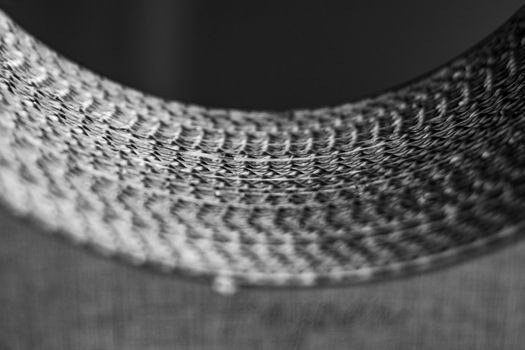
3K tow (3,000 filaments per roving) is the workhorse fabric for cosmetic and structural panels where the buyer sees a 2×2 twill or plain weave; the visible checker pattern on a motorcycle helmet shell is a 3K twill at 200 g/m² areal weight [S1]. 1K gives a finer cosmetic pattern at higher cost per kg; 6K, 12K and 24K tows drop the cost per kg and raise the laminate thickness per ply, which is why wind turbine blade shells and large yacht hulls lean toward heavier tows.
Weave choice is a drapability-versus-cosmetic trade. Plain weave is the most stable and the least drappable, so it fights you on compound curves. 2×2 twill is the default for body panels and aftermarket carbon fiber tubes because it drapes over a 25 mm radius without wrinkling [S3]. Unidirectional (UD) cloth carries 90–95% of its stiffness along the fibre direction, so it is the right pick for spars, beams and any load-path part where orientation can be laid up by the engineer, not the weaver.
Resin System, Cure Path and Service Temperature
Epoxy is the default for structural parts: room-temperature-cure systems reach 60–80 °C HDT, while 120 °C-cure epoxies (e.g., the systems behind prepreg autoclave work) push HDT past 110 °C. Polyester and vinylester resins are cheaper, tolerate hand lay-up better, and serve boat hulls, water-tank filter balls [S5] and the rear-wing aftermarket tier [S6] where peak service temperature sits below 90 °C.
Cure path drives both capex and part cost. Hand lay-up with vacuum bagging (VARTM-style infusion in some shops) needs only a pump, a bag and a table; prepreg + autoclave adds a freezer, an autoclave rated 100–700 kPa, and a 60–120 °C cure cycle, but gives void content under 1% and predictable fibre volume fraction around 55–60%. If your part sees a constant 90 °C service and any safety-factor margin matters, the prepreg route pays back; if it lives at room temperature under a car boot lip, wet lay-up is fine [S2].
Modulus Grade and Where Each One Fits
Intermediate-modulus (IM) fibres such as T800H or IM7 push modulus to 280–300 GPa and are the workhorse for Formula 1 tubs, bicycle frames, and any stiffness-critical part where the lay-up is already optimised. High-modulus (HM) grades (M40, M46, M55, M65) climb to 400–600 GPa but lose tensile strain-to-failure, so they are reserved for satellite booms, robot-arm links and the like, and are almost never used as a single skin in a crash-loaded part. [S1]
Compare the three against decision criteria a buyer can actually grade: cost per kg, tensile modulus, compressive strength, and recommended lay-up. Standard sits at the bottom of the cost column and the top of the strain-to-failure column; intermediate moves the modulus up by 20–30% for a 2–4× cost step; high-modulus adds another step on modulus and another two on cost while halving the failure strain. The wikiHow build guide implicitly follows this grading — it walks the user through mould choice and lay-up before any mention of fibre type, because the mould and the cure method are the larger variables in a hand-built part [S2].
Form Factor: Tube, Sheet, Prepreg, or Pultruded Section
Roll-wrapped tubes are the most common stock shape: 3K twill outer, UD inner, OD 8–30 mm in 500–750 mm lengths, ID tolerance roughly ±0.2 mm, weight runs 30–80 g per 600 mm length depending on wall [S3]. Pultruded rods and tubes are cheaper than roll-wrapped and carry unidirectional-only properties, so they are correct for a push-rod or a stiffening dowel, and wrong for any part that sees bending in more than one plane.
Flat sheet stock in 200–600 g/m² areal weight is the right pick for stiffening gussets, shim plates, and aftermarket wing inserts [S6]. Prepreg rolls in 100–200 g/m² and 12K tow are the workhorse for autoclave and oven cure; prepreg requires cold-chain storage at -18 °C and a stated out-life of 30–90 days at room temperature. For reference, a BMW E36-class aftermarket wing on the consumer channel is ABS in the lower-cost listings and 3K twill carbon on the premium listings — the visual difference is minor, the weight difference is 4–6 kg per wing [S6].
Standards, Sourcing Floors and What to Verify

For pressure vessels, aerospace primary structure and rail rolling stock, the standards chain (ISO 14130 for short-beam shear, ASTM D3039 for tensile, ASTM D6641 for compressive, ASTM D7136/D7137 for compression-after-impact) dictates the panel test matrix. For non-safety parts the same panel data is good engineering hygiene but is not always contractually required. [S2]
For the buy side, the price floors in mid-2026 are roughly: US$0.99–6.70 for a single 3K roll-wrapped 600 mm tube at OD 8–30 mm in lots of 1–2 pieces [S3]; US$0.15–5.00/kg for water-treatment carbon fibre ball media at 1,000 kg MOQ [S5]; US$141–200 for a 3K carbon full-face helmet with DOT/ECE certification [S1].
When Carbon Fiber Is the Wrong Choice
Specify carbon when stiffness-to-weight, corrosion resistance, or thermal stability is on the spec sheet and the part sees a steady load path: drone arms, racing bodywork, tripods, robot links, high-speed rotating shafts, filter media in chemical service [S4][S5]. Specify against carbon when the part takes an impact load with no plastic deformation — carbon is brittle in tension and fails catastrophically compared to a steel fiber reinforced or a glass fiber laminate — or when the part is a thick, low-stress moulding where a chopped-fibre SMC part gives 80% of the stiffness at 30% of the cost.
The cross-over rule that holds up in shops: if the laminate thickness you need is under 2 mm and the part is a shell, carbon pays; if it is over 6 mm and the part is a structural block, you are paying carbon prices for a job that carbon steel or glass will do. For load-isolation and vibration-damping applications — vehicle sub-frames, machine tool beds — hybrid lay-ups that pair a concrete fiber-style damping layer with a carbon skin sometimes beat monolithic carbon, because the carbon face is too stiff to absorb anything on its own.
Trackable next signal: the autoclave-grade prepreg supply chain is the bottleneck to watch for the rest of 2026; the aftermarket tube, sheet and helmet tiers are well-supplied down to single-piece MOQ on the consumer channels [S1][S3]. A second signal is the 12K+ tow fabric price — if it breaks 20% lower than the current 3K twill reference, expect wind-blade and boat-hull tooling to shift up-tow in the next two quarters.
For related coverage, see Manual Pallet Jack Sizing and Selection Guide.