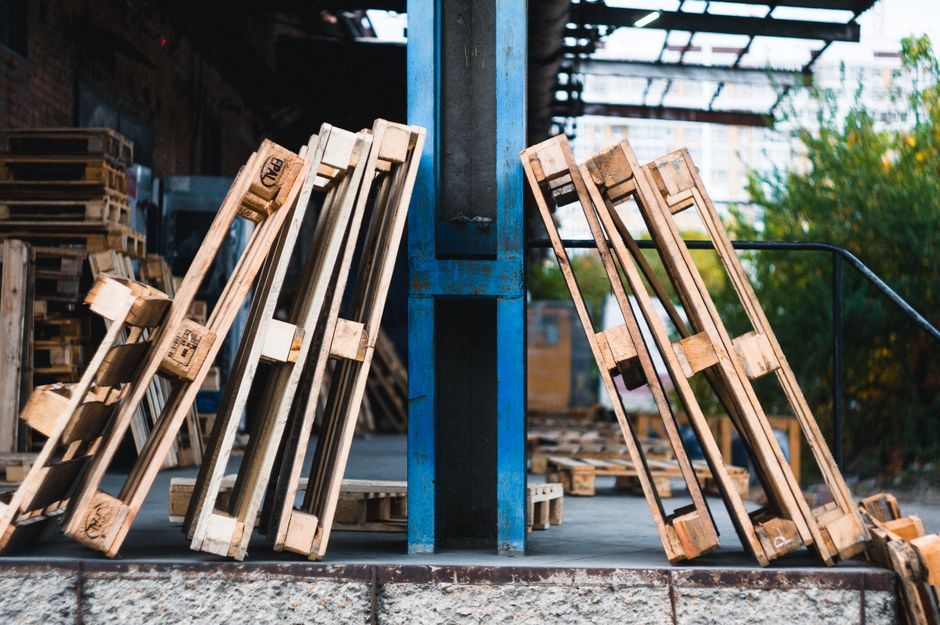
Manual pallet jack selection collapses to four spec levers — rated capacity, fork length × width, lowest fork height, and wheel/roller material — and the wrong combination is the single most common cause of premature pump seal failure and bent fork tips on a loading dock.
Across the 2026 vendor catalogue, the dominant export SKU sits at 3 tonne (6,600 lb) capacity with 550 × 1,150 mm forks and a 75-85 mm lowered height, with FOB price bands from US$73 to US$130 per set at 1-set MOQ from Chinese mills [S2], versus premium Western OEM units (Crown PTH, Mitsubishi) positioned on serviceability and 5-year frame warranty rather than first-cost [S1].
Capacity Classes and What the Tonnage Stamp Actually Means
Rated capacity on a hand pallet truck falls into three bands in current production: 2,000-2,500 lb (1.0-1.15 t) light-duty retail, 4,500-5,500 lb (2.0-2.5 t) standard warehouse, and 6,000 lb (≈2.7 t / "3 tonne") heavy-export [S2][S3]. The "3-ton" label common on Chinese export listings refers to metric tonnes (3,000 kg / 6,614 lb), not short tons, and the hydraulic relief valve is factory-set to approximately 110-120% of nameplate so over-pressure events dump oil rather than yield a fork arm [S2].
For automotive assembly and Tier-1 parts plants, the spec floor is typically the 5,500 lb / 2.5 t class with a reinforced pump casting; for retail back-of-house, the 2,200-2,500 lb class is the cost-optimal choice because the tare of a loaded European CHEP pallet rarely exceeds 1,100 kg (2,425 lb). Specifying a 5 t jack for a 1 t load wastes roughly 18-25 kg of steel and adds 15-20 mm to the lowered height, which then excludes low-profile pallet footprints.
Fork Geometry: Length, Width, and Pallet Compatibility
Standard fork length is 1,150-1,200 mm (45-48 in) to match the 1,200 mm long face of a GMA/Euro pallet; standard overall fork width (outside-to-outside) is 550 mm (21.6 in) for Euro pallets and 685-700 mm (27 in) for GMA [S3]. "Low-profile" and "ultra-low" variants drop the lowered fork height to 51 mm (2.0 in) versus the standard 75-85 mm, but require a shorter 380-450 mm fork length to keep the tip-entry angle under 12° when the pallet sits on a 6 mm thick bottom board [S3].
Specialty sizes are a real procurement trap: wide-frame 685 mm trucks will not enter a Euro pallet, narrow 450 mm trucks will not straddle GMA stringers, and the marketplace frequently lists both as "standard" because they share the same 1,150 mm fork length. Before quoting, lock the pallet population (GMA 1,219 × 1,016 mm, Euro 1,200 × 800 mm, or Asia-Pacific 1,100 × 1,100 mm) and select fork width from the table in the OEM's spec sheet, not from a generic catalogue photo.
Hydraulics, Handle, and Pump Serviceability
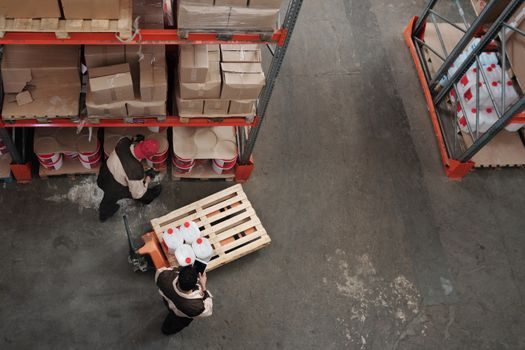
The pump is the only wearing assembly in a hand pallet truck: a one-piece cast pump body with a chrome-plated piston and a serviceable seal kit (typically $8-15 in aftermarket) separates a 10-year truck from a 3-year truck [S1]. Crown's PTH series is positioned on this exact lever — "exceptional long-term value" via serviceable hydraulics rather than disposable-cartridge design [S1]. Mitsubishi's hand pallet line carries the same 5-year / 10,000-hour frame warranty on premium SKUs.
Handle ergonomics split on the three-position lever (raise / neutral / lower): the better OEM designs use a one-piece steel handle with a polymer-coated grip rated for −20 °C to +50 °C, and a spring-return that defaults to neutral so a dropped handle cannot free-fall into the load. Cheap imports frequently ship with a stamped-steel handle and a 2-position lever that has no true neutral — a documented cause of "phantom lift" where the truck creeps up between pulls.
Wheels, Rollers, and Floor-Dependent Selection
Wheel and roller material is floor-driven, not preference-driven: polyurethane (PU) is the default for sealed concrete, epoxy, and tile at 80-95 Shore A; nylon is mandatory on rough or debris-littered floors because PU chunks at impact; rubber is specified only for noise-sensitive retail at the cost of 3-4× the rolling resistance [S3]. A typical 3 t truck ships with two 180-200 mm drive wheels and four 80-85 mm load rollers, tandem roller configuration being the standard for loads above 2 t to spread the stringer contact patch.
For cold-store or refrigerated dock work (−20 °C and below), specify low-temperature grease in the pump and either PU formulated for sub-zero flex or phenolic resin rollers; standard PU hardens below −10 °C and develops flat spots that score the floor within weeks. A useful cross-reference: PU vs nylon is roughly the same trade-off as linear guide recirculation-element material choice — the harder the contact surface, the lower the rolling resistance, the higher the impact sensitivity.
Selection Criteria: What to Lock Before You Quote

A spec sheet that will not produce a wrong shipment needs six locked parameters, in this order: (1) rated capacity in the unit your dock actually uses (kg, lb, or t — never mix); (2) fork length to nearest 50 mm, fork width to nearest 25 mm; (3) lowered fork height, with a 5 mm tolerance; (4) wheel and roller material; (5) handle pivot height for the operator population (ergonomic audits place this at 1,150-1,250 mm for a 5th-percentile female to 95th-percentile male); (6) pump serviceability — replaceable seal kit yes/no. Plants that skip step 6 typically replace the whole truck at year 4; plants that lock it run to year 8-10 [S1].
For an apples-to-apples comparison line, the manual pallet jack market now presents three distinct buying lanes in 2026: Chinese mill direct at US$73-130 per set FOB at 1-set MOQ for a 3 t standard truck [S2]; mid-tier import and re-branded stock at US$220-380 landed; and Western OEM (Crown, Mitsubishi, Lift-Rite) at US$650-1,100 with full service network and parts availability [S1][S3]. Total cost of ownership at year 5 inverts this ranking once parts and downtime are priced in.
Failure Modes and What the OEM Warranty Won't Cover
The four documented failure modes on a 3 t hand truck, in order of frequency, are: (a) pump seal leak from contamination, not wear; (b) bent fork tip from side-loading at the pallet edge; (c) handle return-spring fatigue from dropping the handle in free-fall; (d) wheel bearing seizure from water ingress on wash-down docks [S1][S3]. Items (a) and (d) are operator-driven and excluded from warranty; items (b) and (c) are abuse-driven and pro-rated. This is also why a pallet rack bay that deflects more than 25 mm under a 4,000 kg load will bend fork tips faster than it damages the racking — a coupled failure mode buyers rarely price.
A side-loaded fork at the entry tip multiplies the bending stress by roughly the length-to-thickness ratio of the fork (typically 24-28 for a 1,150 mm × 50 mm × 8 mm section), so a 1,000 kg side load at the tip is the structural equivalent of a 24-28 tonne vertical load — well above the 3 t relief setting. Operator training on perpendicular entry is the cheapest mitigation; entry guide rollers on the truck are the hardware mitigation.
Standards, Compliance, and the Spec Sheet You Should Demand
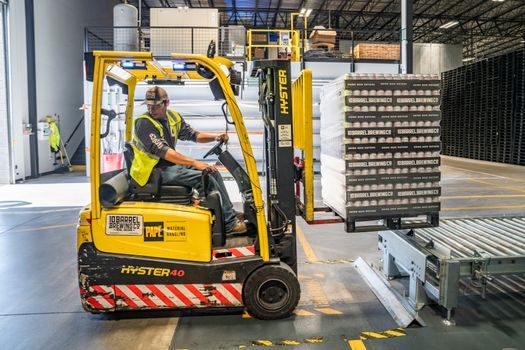
The relevant standards for a manual pallet truck in 2026 are ANSI/ITSDF B56.1 (safety standard for low-lift and high-lift trucks) in North America and EN ISO 3691-5 (driverless industrial trucks — pedestrian-controlled) in Europe, with EN 1726-1 governing the design of pallet trucks in EU markets. The OEM should be able to produce a Declaration of Conformity citing both, plus the load-test certificate (1.5× rated capacity static, 1.25× dynamic per the harmonised standard) — if the spec sheet carries only a CE mark without the underlying standard number, walk. [S1]
For cold-chain and food-grade operations, additionally specify 304 stainless hardware on the handle pivot, food-grade white PU on the load rollers (the standard black PU sheds carbon-black pigment), and a hydraulic fluid rated for incidental food contact (typically a USDA H1 or NSF H1 registered oil). A 3 t export truck with these food-grade options sits at the top of the US$130-220 band rather than the US$73 floor [S2].
Price Bands, Lead Time, and Sourcing Floors
Verified 2026 FOB price points for a 3 t standard manual pallet truck (550 × 1,150 mm forks, PU wheels, standard 75-85 mm lowered height) from Chinese manufacturers cluster at US$73-130 per set at 1-set MOQ, dropping to roughly US$65-95 at a 50-unit MOQ for the same SKU [S2]. Western OEM equivalents (Crown PTH, Mitsubishi standard hand pallet) sit at US$650-1,100 list with dealer-negotiated discounts of 10-20% on fleet orders above 10 units [S1].
Lead time from Chinese mills is 25-35 days FOB for stocked SKUs, 40-60 days for custom colours or laser-etched customer logos. Western OEM lead time is 5-15 days ex-dealer stock on standard SKUs, 4-8 weeks for special fork widths or low-profile variants. For a plant buying 20-50 trucks a year, the fleet-replacement arithmetic usually lands on Chinese mill direct plus a Western seal-kit spares inventory — but only if the plant has a hydraulic press to swap pump seals, which most do not. A related cross-reference on spec-band sourcing economics: pallet stacker buying follows the same mill-direct vs OEM-dealer split, with a wider spec gap because stackers carry an electric or manual hydraulic lift circuit.
For plants evaluating whether the plastic pallet footprint on the dock has shifted the fork-width requirement, or whether the crossed-roller guide analogy applies to the load-roller carriage, the answer is yes and no — plastic pallets with moulded-in stringers are more dimensionally stable than wood but require wider PU rollers (≥85 mm) to avoid edge-cracking under the 6,000 lb load class.
For related coverage, see Automatic Level Sizing and Selection: Range, Magnification, Compensator.