
Safety shoes must be specified by the dominant hazard on site, then by the certified class (EN ISO 20345 SB through S5, or ASTM F2413), then by toe-cap material and fit, because every other feature, from midsole to outsole compound, only matters once those three are right [S2][S5].
The practical decision is: toe-cap (steel, composite, or alloy), puncture-resistant midsole (steel or non-metal), outsole duty (slip, heat, cold, electrical), and upper height (low-cut vs high-cut). EN ISO 20345 SB is the minimum, with a 200 J impact and 15 kN compression toe cap; S3 adds a penetration-resistant midsole and a cleated outsole, which is the typical construction and warehousing baseline [S2].
Map the hazard before you read the catalog
Step one is a written hazard inventory: falling objects, rolling stock, sharp debris on the floor, live electrical work, wet or oily surfaces, hot surfaces, cold surfaces, and chemicals. Each item maps to a class suffix under EN ISO 20345, and to a feature letter that can be added to any class [S2].
The feature suffixes behave the same way regardless of base class: P (puncture-resistant midsole), C (conductive, resistance below 100 kΩ), A (antistatic, 100 kΩ to 1 GΩ), E (energy-absorbing heel, at least 20 J), HI (heat-insulated upper), CI (cold-insulated upper), WRU (water-repellent upper), and HRO (heat-resistant outsole, contact with 300 °C for 60 s) [S2]. For an electrical-hazard site, EH-rated footwear under ASTM F2413 withstands 18,000 V at 60 Hz for one minute with leakage under 1 mA [S4].
EN ISO 20345 class matrix, from SB to S5
SB is the floor: steel, composite, or aluminium toe cap rated to 200 J impact and 15 kN compression, with closed heel and antistatic behaviour. S1 adds antistatic properties and energy-absorbing heel (the "E" requirement, ≥ 20 J). S2 layers water resistance of the upper onto S1. S3 adds a penetration-resistant midsole and a cleated outsole, the most common specification for general construction, logistics, and light manufacturing [S2].
S1P is a common European shortcut: S1 properties plus a midsole, without the full S2 water resistance or cleated outsole. S4 is the rubber/PUR boot equivalent of S2 (waterproof, no separate midsole needed because the polymer is homogeneous). S5 is the rubber/PUR equivalent of S3, the default for agricultural chemical handling, food processing washdown, and concrete work [S2]. For a written comparison, S3 (leather) and S5 (PU/PVC) cover the same impact-compression-penetration envelope; the choice is then washdown frequency, chemical exposure, and weight on foot.
Toe-cap material, with weight and conductivity tradeoffs
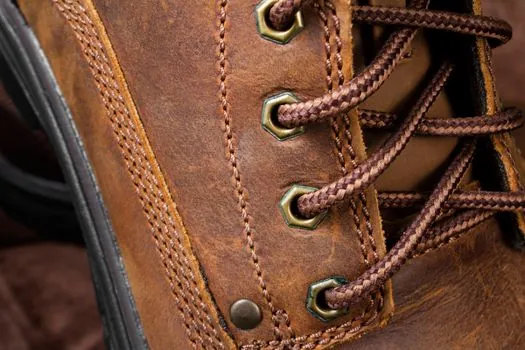
Steel toe caps are the benchmark: cheap, thin-walled, and predictable, but heavier (a steel cap adds roughly 50–90 g per shoe versus composite) and thermally conductive, so they feel cold in freezers and hot in foundries [S5].
Composite toe caps (Kevlar, carbon fibre, glass fibre reinforced plastic) are non-metallic, lighter by 20–30% than steel, non-conductive (a real plus near live LV work or where security gates trigger on metal), and dimensionally stable across temperature, which is why they are the default for cold storage and electrical PPE bundles [S4][S5]. Alloy toe caps (aluminium, titanium) sit between the two: thinner walls than steel for a slimmer toe-box profile, lighter than steel but still conductive, so they are typically chosen for fit and weight rather than for electrical safety [S4].
For site PPE policies that require both impact protection and metal-free zones (data centres, pharma, secure sites), composite is the working default. For purely mechanical sites, steel is the cheapest path to the same EN ISO 20345 impact rating.
Outsole duty: slip, heat, electrical, chemicals
For genuinely greasy floors (commercial kitchens, meat processing, oil rigs), a dual-density PU/TPU outsole with a wide heel brake and a 3–4 mm lug depth performs better than the SRA/SRB lab number alone.
Heat-resistant outsole compound (HRO, 300 °C / 60 s contact) is mandatory for foundry, welding, and hot-bitumen work. Cold-insulated outsole (CI) keeps the insole thermal resistance useful down to about −17 °C surface, which is the practical floor for cold storage and outdoor winter work [S2]. For chemical sites, specify the outsole polymer against the specific chemical; nitrile rubber outperforms PU on vegetable oils and many hydrocarbons, while PU outperforms nitrile on ketones and certain solvents.
Fit, sizing, and break-in: the half-size rule
Fit is the part most specifications get wrong. Safety-toe footwear has no stretch in the toe-box, so it must be fitted about a half size larger than normal shoes; if your toes touch the cap when standing, the shoe is too small [S3]. Measure both feet in the afternoon (the foot is largest at end of shift), buy to the larger foot, and bring the work sock you will actually wear, because sock thickness alone can swing a size [S3].
Widths range from narrow to extra-wide; if the standard last pinches the metatarsals, specify a wide last rather than sizing up, because a longer, narrower shoe puts the ball of the foot on the flex line and creates fatigue [S4].
Replacement cadence is roughly annual for daily wear, but a shoe that loses its tread pattern, shows midsole delamination, or has a deformed toe cap should be pulled immediately, regardless of age [S2]. Maintenance matters: brushing off contamination and conditioning leather uppers extends service life, and on rubber/PUR boots (S4/S5) a clean rinse after chemical exposure is the single biggest life extender [S2].
Cut height, gender fit, and specialty use cases
Low-cut (Oxford) is fine for warehouse, light assembly, and food service where ankle mobility matters; high-cut is mandatory for logging, structural steel, heavy construction, and any site with ankle-roll or Achilles-impact hazards [S2]. For kneeling work (concrete finishing, tile, under-floor mechanical), a low-cut keeps the Achilles mobile but a metatarsal guard (EN ISO 20345 "M" rating, ASTM F2413 Mt) is often the real gap, because the metatarsal is the part that takes the impact when a board pivots down.
Women should fit women's-lasted safety shoes rather than sizing down men's models, because the standard male last is 8–12 mm wider at the ball and higher in the instep than the typical female foot; the wrong last causes blisters within a week even at the correct monodot point [S3]. For arc-flash and live-line work, dielectric overshoes are layered over the safety shoe, the safety shoe itself still has to meet the class rating for the underlying mechanical hazards. For work near machine safety hazards with rolling stock, an S3 or S5 with a defined heel brake and a defined cleat pattern is what prevents the foot from being run over, the toe cap protects the toes, the outsole and fit protect the rest.
Standards to verify on the shoe, not in the brochure
EN ISO 20345 (EU), ASTM F2413 (US), and CSA Z195 (Canada) are the three certification marks that count; a shoe labelled "steel toe" without one of these marks is a fashion boot, not PPE [S1][S5]. For safety certification traceability, the mark must include the class (e.g. "S3 CI HRO"), the year of the standard revision, and the notified-body number. For fire safety contexts (wildland, structural), look for NFPA 1977 or EN 15090 firefighter boot markings in addition to EN ISO 20345; the two standards cover overlapping but distinct requirements (flame resistance, radi
For ESD-sensitive electronics or explosives handling, the requirement is a different standard family entirely (EN 61340-5-1 for ESD control), with a resistance window of about 1 × 10⁵ to 3.5 × 10⁷ Ω across the shoe-floor system, which is tighter than the EN ISO 20345 "A" antistatic band; check the actual resistance range on the data sheet, not the marketing label.
Two trackable signals: confirm whether the site hazard inventory names a specific class suffix (for example, "S3 CI HRO" vs generic "S3"), and check whether the safety shoes you are issuing appear on a published EN ISO 20345 / ASTM F2413 certificate that names the same model number printed on the tongue, because the certificate model and the supplied model are the most common audit finding in PPE inspections. PPE selection criteria interact with broader safety barrier logic, the shoe is the last line, the engineered control should already have reduced the hazard before the foot ever sees it.
This topic is covered further in Architectural hardware for schools: a spec-driven selection map.